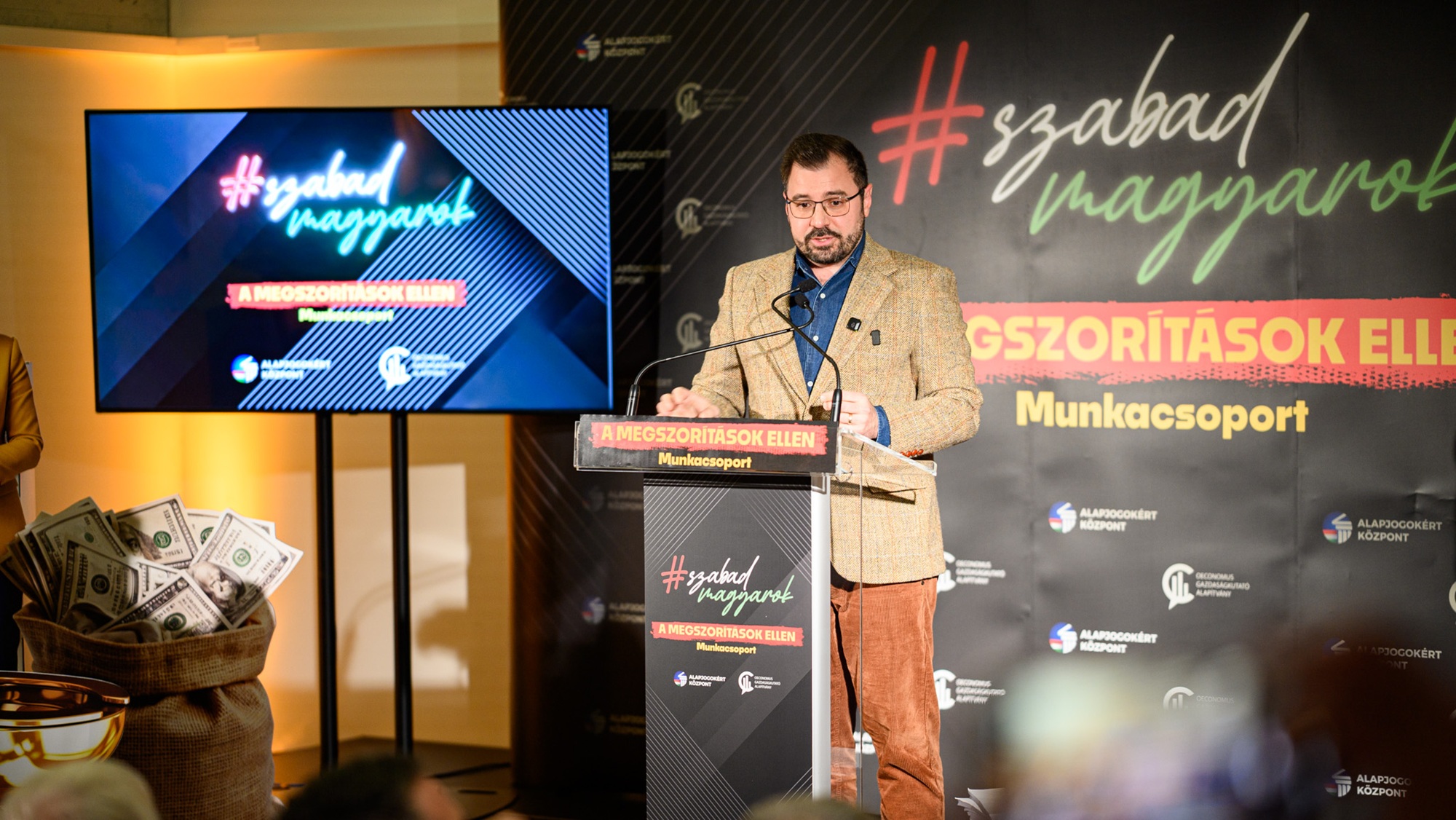
The Budapest-based think tank Center for Fundamental Rights has announced the establishment of the #Free Hungarians Against Austerity Measures Task Force. This comes in response to the leak of the leading opposition Tisza Party’s economic programme, which contains proposals for tax increases and the slashing of tax benefits for families and pension payments.
The new task force’s foundation was marked by an event co-hosted by the Center and the Oeconomus Economic Research Foundation at the Bálna Shopping and Convention Centre in Budapest, Hungary, on Wednesday, 10 December.
Director General for the Center for Fundamental Rights Miklós Szánthó took the stage first, with a giant stack of papers in his hand. Jokingly, he told the audience that it is Tisza’s ‘non-existent’ austerity programme, in a reference to the party leaders’ denial of the leak’s authenticity. He then went on to state that currently, Hungary has a ‘family-friendly tax system’ and a ‘reliable pension system’, which could all change with the election of Tisza candidate Péter Magyar next spring.
He also argued that the denial by the Tisza Party is futile, given that some of the leaked documents have the signatures of people they themselves have named publicly as their economic advisers, such as László Lengyel, Áron Dálnoki, and Péter Felcsuti.
Director Szánthó has pointed out that the opposition’s austerity plans would take away 7.25 trillion HUF from Hungarian entrepreneurs, employees, and pensioners, which is what necessitated the formation of the new task force in opposition to it. The group will provide expert analysis and opinion on the adverse effects of such measures, as well as raise awareness about them, Szánthó stated.
Then, he also recalled the words of MEP Zoltán Tarr, Vice Chair of the Tisza Party, who told supporters at a campaign event in August that they cannot reveal all of his party’s plans ahead of the election, because that would lead to their demise.
Director Szánthó also shared that expert opinions from Brussels have long called for similar measures to those proposed by the Tisza Party, claiming that the flat income tax is not progressive enough, Hungary’s family support measures are discriminatory, and its pension system is not sustainable. In addition, the EU is currently soliciting contributions from its Member States to continue its war aid to Ukraine, which is where some of the increased tax revenue would go if Tisza were to win.
After Director Szánthó’s remarks, a four-person panel gathered on stage. It featured Imre Boros, Former Minister of Agriculture during the first Orbán administration; Professor of Economics at the Ludovika University of Public Service Dr Szabolcs Pásztor; and Imréné Kusovszky, member of the Council of the Elderly. Péter Törcsi of the Oeconomus Economic Research Foundation served in the role of the moderator.

Mrs Kusovszky started the discussion by saying that she and many of the other members of the Council of the Elderly are ‘astonished’ by how some people in Hungary cannot recognize how much things have improved in the country in the last 15 years. She also described the opposition’s plans to do away with the 13th-month pension payments as outright ‘malicious’.
Mr Boros then explained that the ‘national income’ is always distributed among three groups: the entrepreneurs, the employees (including those now collecting pensions), and the state; and the government’s tax policy determines which group gets that income in what proportion. According to the Former Minister, Tisza’s austerity measures would take away income from entrepreneurs and employees and give it to the state. Also, due to pressure from Brussels, some of the additional tax revenue raised by the state would leave the country, which is why the EU leadership is hoping for a Tisza victory.
Professor Pásztor has told the audience that tax evasion was ‘a national sport’ before 2010. However, after the second Orbán administration came into power that year, it was no longer worth risking tax evasion due to the major tax cuts. This resulted in a large decrease in the black market economy of the country. He touted the flat 15-per-cent income tax and 9-per-cent corporate tax rates as the great economic achievements of Hungary. These tax policies allowed the Eastern Hungarian city of Debrecen to win the bid for the new BMW plant against 159 other cities across the Globe, he shared.
The speaker also praised initiatives such as the income tax exemption for people under 25, as well as the ‘skilled and disciplined’ Hungarian labour force, which makes the country very attractive for foreign investors.
Mr Boros also lauded the family support policies of the current Hungarian government; and juxtaposed that to Western European nations, which have no such incentives. Meanwhile, Professor Pásztor has explained that the global GDP is expected to grow by 2–3 per cent next year, with China and India claiming the biggest chunk of that. Meanwhile, Europe is expected to keep lagging behind its competitors on other continents.
Related articles: