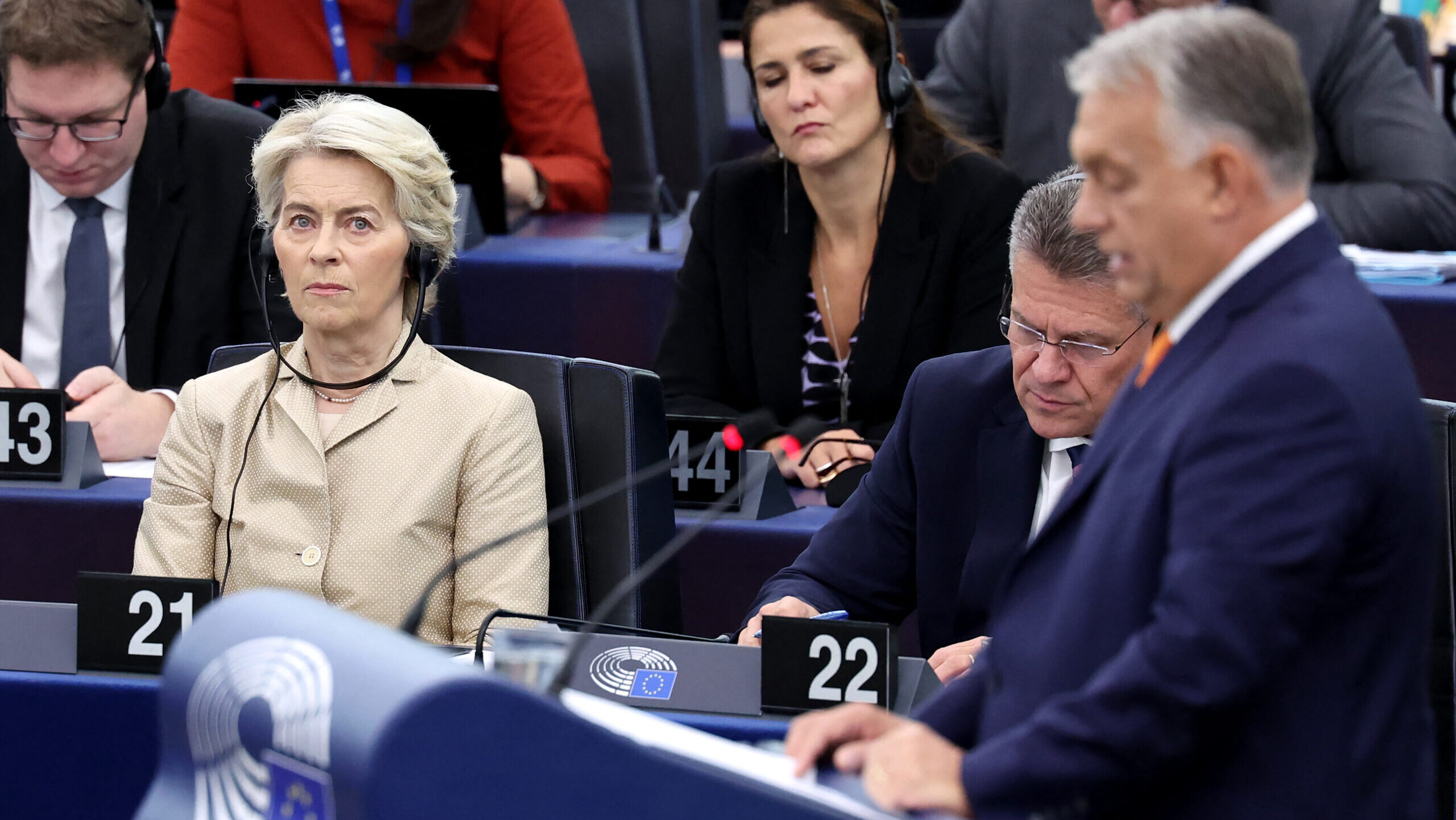
Less than a day after Viktor Orbán’s electoral defeat, European Commission President Ursula von der Leyen called on the European Union to abolish the national veto in foreign policy decision-making.
Speaking to reporters in Brussels, von der Leyen said that ‘governments should be able to push through EU policies by majority’ rather than allowing individual member states to ‘wield a veto’, particularly on issues such as sanctions on Russia and funding for Ukraine.
‘Moving to qualified majority voting (QMV) in foreign policy is an important way to avoid systemic blockages, as we have seen in the past,’ she said, urging member states—which would have to unanimously approve such a change—to ‘use the momentum now’.
The abolition of the national veto in foreign policy has long been a highly controversial issue within the EU. Debate over a shift to QMV in the European Council has intensified since Russia’s invasion of Ukraine, after which Orbán increasingly used Hungary’s veto power to block or delay decisions on sanctions, particularly those affecting Russian energy imports. The outgoing Hungarian prime minister also blocked a €90 billion EU loan to Kyiv in response to Ukraine’s blockade of the Druzhba pipeline, which supplies Hungary and Slovakia with Russian oil.
EU foreign policy chief Kaja Kallas outlined a similar position in January 2026, stating that ‘unanimity often prevents timely action on urgent foreign policy matters’. ‘Responsiveness and relevance are key to addressing modern geopolitical challenges,’ she said, arguing that QMV would strengthen EU cohesion and enable a more unified voice on the global stage.
President of the European People’s Party (EPP) Manfred Weber argued, in February 2026, for the ‘better implementation’ of the Lisbon Treaty, including the expanded use of qualified majority voting to limit individual member states’ ability to block decisions on key issues such as sanctions and foreign policy.
However, Orbán was not alone in opposing such reforms. Several member states—particularly smaller countries in Central and Eastern Europe and the Baltic region—have expressed concern that abolishing the veto would weaken their ability to defend national interests within EU decision-making.
‘Orbán was not alone in opposing such reforms’
Slovakia, for example, had indicated it would veto the EU loan to Kyiv in the event of a government change in Hungary. Speaking at an international press conference on Monday, Prime Minister-elect Péter Magyar said he would not block the loan, but would adhere to the opt-out negotiated by Viktor Orbán in December 2025.
According to von der Leyen, the European Commission is prepared to move quickly to engage with Magyar’s incoming government. ‘We can already see that he is very clear on the European path…committing the new government to continue working with us,’ she said, adding that progress on EU funds and reforms would be a priority because ‘the Hungarian people deserve it’. ‘There is much work to be done. Hungary is coming back to the European part,’ she added.
Related articles:
At a time when public debate is increasingly polarized and superficial, Hungarian Conservative remains committed to depth, intellectual honesty, and independent conservative thought.
Producing high-quality journalism requires resources. Your contribution helps us expand our coverage, reach new audiences, and keep our content accessible.

Please consider supporting our mission.