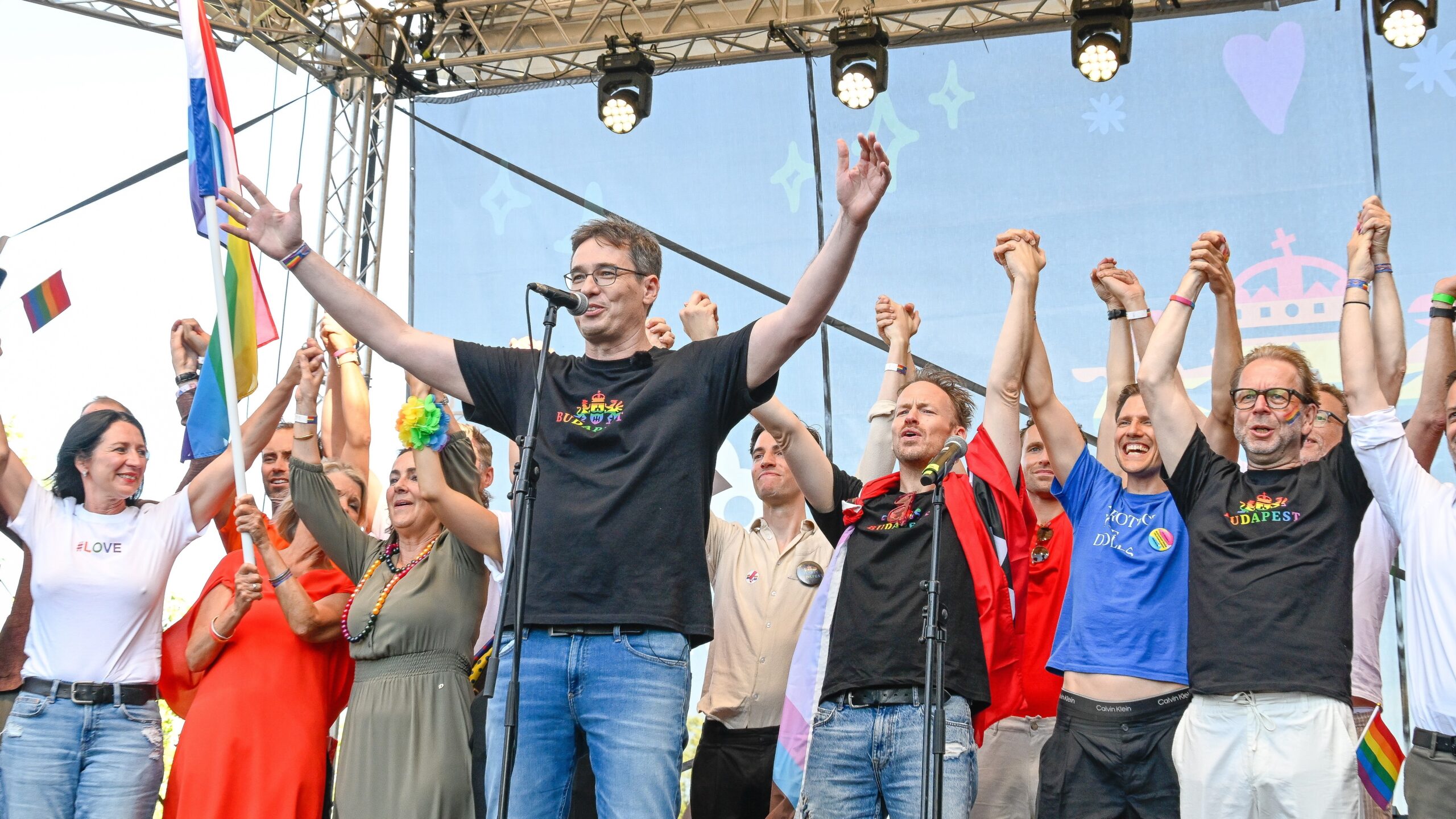
Liberal-progressive Renew Europe has quickly run to the defence of Budapest Mayor Gergely Karácsony after Hungarian authorities filed charges against him for organizing the Budapest Pride march in June 2025.
In a statement released on Wednesday, 28 January, the liberal-progressive group in the European Parliament said that ‘criminalizing an elected mayor for defending freedom of assembly and equal rights’ represents ‘yet another step away’ from European values and towards Russian-style authoritarianism.
Renew Europe strongly condemned the prosecution of Gergely Karácsony, framing the case as a political attack on fundamental European values over his role in allowing a peaceful Pride event to take place in the Hungarian capital last year.
Valérie Hayer, President of Renew Europe and a French MEP from the Renaissance party, linked the case to Hungary’s broader domestic political context, accusing the authorities of prioritizing ideological confrontation over governance. With elections approaching, Hayer said the government appears more focused on ‘culture-war provocations and confrontations with the European Union’ than on addressing pressing social and economic challenges, including a struggling economy, rising living costs, a healthcare system under strain, and ongoing concerns over corruption and the misuse of public funds.
Hayer added that targeting the Mayor of Budapest and vilifying the LGBTIQ+ community would do nothing to improve public services or restore trust in state institutions. ‘It is a deliberate attempt to divide society and divert attention from government failure,’ she said.
On 18 March, the Hungarian Parliament adopted an amendment to the law on the right of assembly, which, citing child-protection concerns, introduced stricter conditions for organizing mass events such as Budapest Pride. Under the amendment, if an organizer attempts to obtain permission for a prohibited assembly through deception, or if an individual knowingly participates in such an event despite having been informed in advance by authorities of its prohibited nature, this constitutes an offence. Violators may be fined, with the sums collected treated as public debt and earmarked for child-protection purposes.
The move triggered immediate backlash from the liberal-progressive establishment in Europe, with even European Commission President Ursula von der Leyen calling on Hungarian authorities to allow Budapest Pride to proceed. ‘To the LGBTIQ+ community in Hungary and beyond: I will always be your ally,’ von der Leyen wrote in a post on X at the time. By the end of March, 22 EU member-state embassies—alongside those of the United Kingdom and Australia—issued a joint statement expressing concern over the legislation. The following weeks saw demonstrations across Budapest, including one attended by German MEP Daniel Freund, a vocal critic of Hungarian Prime Minister Viktor Orbán in the European Parliament.
Despite the ban imposed by Hungarian authorities, Mayor Karácsony decided to organize the march regardless. The event was attended by several progressive European lawmakers, including French socialist Raphaël Glucksmann.
Prosecutors now charged Karácsony with the misdemeanour of violating the freedom of association and assembly. In the indictment submitted to the Pest Central District Court, they requested that the court impose a fine without holding a trial.
Fabienne Keller, another Renew Europe MEP, also expressed full solidarity with Karácsony, Budapest Pride, and those in Hungary ‘defending freedom, equality, and democracy’. Keller said the group would continue to oppose what she described as the ‘systematic erosion of the rule of law’ in Hungary and support ‘those who refuse to be silenced’.
Renew’s condemnation comes as Hungary prepares for a decisive parliamentary election on 12 April. Orbán’s opposition has long been described by government figures as ‘puppets of Brussels’, while Hungarian officials have repeatedly warned of possible foreign interference. Just days before Renew’s statement, Hungarian Minister for Foreign Affairs and Trade Péter Szijjártó urged EU ambassadors not to interfere in Hungary’s democratic processes ahead of the vote. ‘It is in no way the job of an ambassador serving here to interfere in Hungarian elections,’ he said, adding that the government would not accept external criticism or commentary regarding the ballot.
Related articles: