Hungarian Minister for Foreign Affairs and Trade Péter Szijjártó condemned the detention of ethnic Hungarian politician Örs Orosz by Slovak police during a demonstration against the controversial Beneš decrees on Friday, 30 January. In a statement, Szijjártó said he had immediately contacted László Gubík, president of the Hungarian Alliance party in Slovakia, who later informed him that no proceedings would be launched against Orosz.
The minister stressed that the Hungarian government considers the principle of collective guilt unacceptable and regularly raises this position with the Slovak government. ‘I have done so repeatedly in the past, and I will continue to do so in the future,’ Szijjártó said.
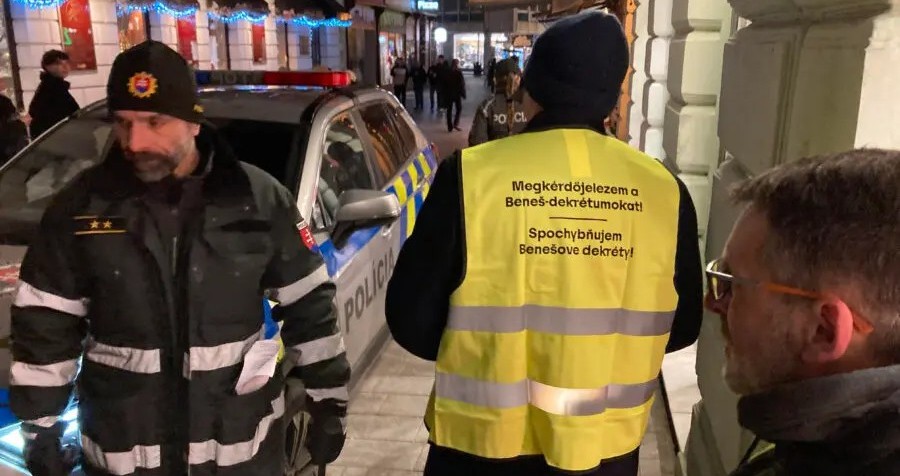
Earlier in the day, Slovak police escorted Orosz away from a protest in Bratislava’s Old Town held against the Beneš decrees, according to reports by Új Szó and parameter.sk. Both police officers and organizers had asked Orosz to remove a high-visibility vest bearing the inscription ‘We question the Beneš decrees’, which he refused to do. He later posted on Facebook around 7pm that he was awaiting questioning.
Under a recent amendment to Slovakia’s Criminal Code, publicly questioning or denying the Beneš decrees may constitute a criminal offence, punishable by up to six months’ imprisonment. Orosz is among the initiators of a petition calling for the repeal of the amendment.
The incident comes amid heightened tensions between Hungary and Slovakia following the entry into force of the new legislation at the end of last year. Hungarian Prime Minister Viktor Orbán has said Budapest intends to conclude negotiations with the government of Slovak Prime Minister Robert Fico over the law, underlining that Hungary rejects the principle of collective guilt and unconditionally supports ethnic Hungarians living in Slovakia.
The Beneš decrees were a series of laws issued by Czechoslovak President Edvard Beneš before and immediately after the Second World War, providing the legal basis for treating ethnic Germans and Hungarians as collectively responsible for wartime collaboration. As a result, hundreds of thousands lost their citizenship, property was confiscated, and large-scale expulsions and population transfers were carried out, alongside severe restrictions on language and cultural rights. Although most of the decrees were later repealed or fell into disuse, elements of their legacy have persisted in Slovak legal and judicial practice, particularly in cases involving property restitution and nationality. For ethnic Hungarians in Slovakia, the decrees remain a symbol of unresolved historical injustice and institutionalized discrimination rooted in post-war transitional justice.
Critics of the current Slovak legislation argue that criminalizing public criticism of the decrees violates freedom of speech and effectively shields historically discriminatory measures from scrutiny in a 21st-century European Union member state. Slovak authorities, by contrast, maintain that the amendment protects the post-war legal settlement from defamatory challenges and safeguards national sovereignty.
In a Facebook post published after his release, Orosz said he had been freed and thanked those who had expressed solidarity with him during the detention. He also shared a verbatim translation of the statement he gave to police, stressing that he does not deny the existence of the Beneš decrees or Slovakia’s territorial integrity. ‘What I question and deeply condemn is the 21st-century application of the principle of collective guilt, specifically the ongoing expropriation of private property today on the basis of 80-year-old documents,’ he said, explaining that this was why he had decided to take part in the public event.
‘Public outrage was growing despite the threat of criminal sanctions’
Orosz recounted that police escorted him out of the demonstration and demanded that he remove the vest, after which an organizer warned him that if he refused, the police would disperse the crowd. ‘I replied that I consider this kind of intimidation a restriction of freedom of speech, and that I will continue to stand by my opinion,’ he wrote. Concluding his post, Orosz said he believes in honest reconciliation based on mutual respect between societies and pledged to continue working toward that goal.
Several speakers at Friday’s demonstration warned of broader implications of the recent amendment for fundamental rights. Zsófia Voda, director of the Hungarian College of Advanced Studies in Bratislava, drew a parallel with protests held 12 years ago over the Malina Hedvig case, in which a Hungarian woman was controversially prosecuted by Slovak authorities. She said current government measures go even beyond what she described as an earlier ‘dark period’.
Attila Stubendek, one of the petition’s initiators, said public outrage was growing despite the threat of criminal sanctions, noting that around 8,000 people have already signed the initiative. He added that the movement’s determination was underscored by the fact that Orosz Örs and another initiator, lawyer János Fiala-Butora, voluntarily reported themselves to the police, accepting any legal consequences.
Balázs Kovács, one of the protest’s organizers, referred to the post-war expulsion of his grandparents from Czechoslovakia, saying: ‘We owe it to the memory of our parents, grandparents, and great-grandparents to state clearly that what happened after the Second World War should never have happened.’ The demonstration concluded with participants singing both the Hungarian and Slovak national anthems.
Related articles: