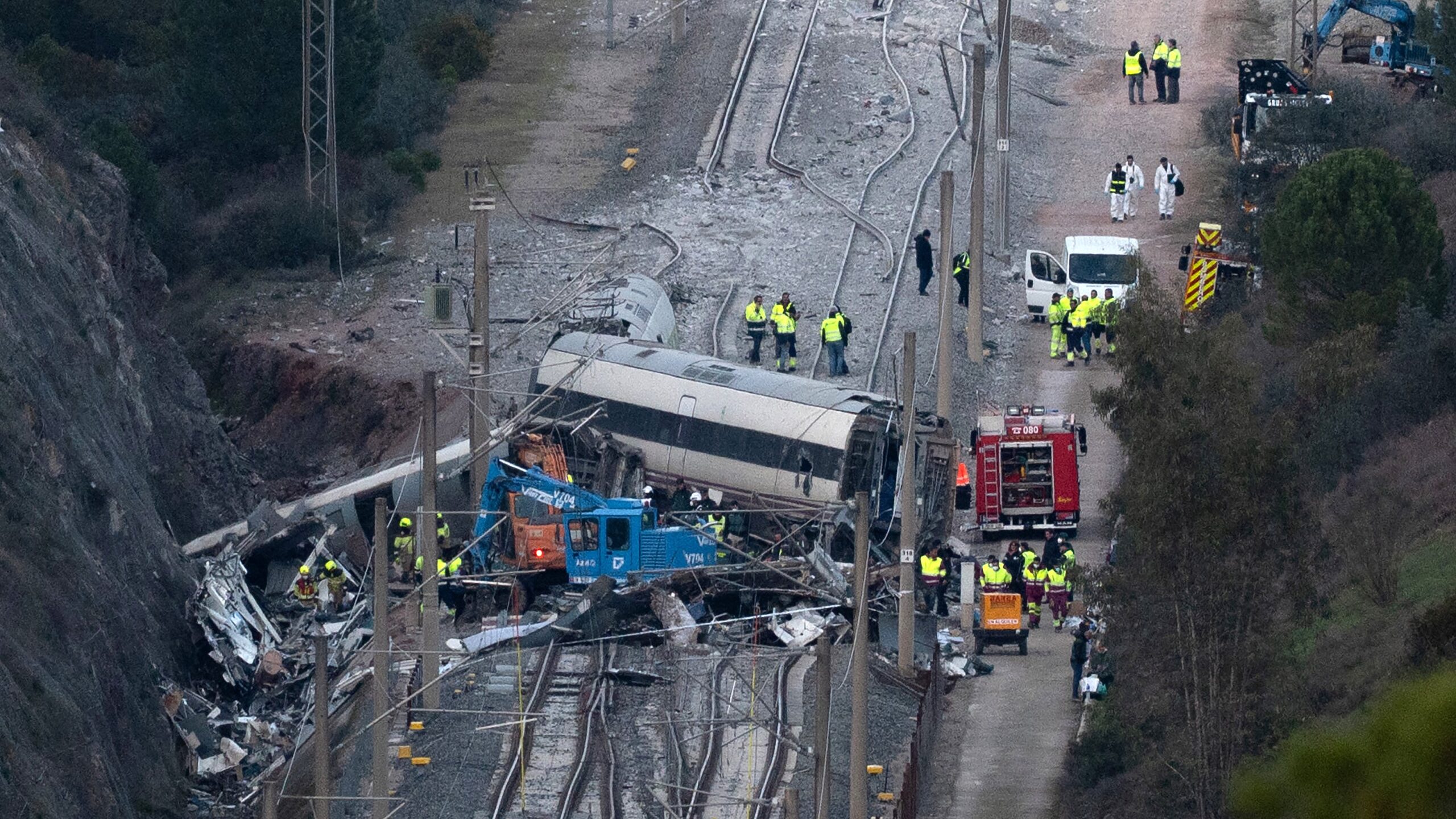
On 18 January a catastrophe took place at Adamuz, where two high-speed trains collided after a derailment on a supposedly modernized stretch of track, killing 45 people. Two days later, another machinist was killed in Catalonia when his train derailed. These two incidents, beyond the obvious human tragedy, cannot be understood merely as a technical failure or an unfortunate coincidence. It is, rather, an expression of something far deeper—in a nutshell, the progressive decay of Spanish institutions under the coalition government of socialists and communists that has ruled Spain since 2018.
Institutions’ importance for democracy or state-building as a whole cannot be stressed enough. Long before modern debates about infrastructure or public management, thinkers such as Edmund Burke warned that societies collapse not when laws are rewritten, but when institutions lose their internal moral ecology—habits of responsibility, competence, restraint, and accountability. For Burke, institutions are not machines to be redesigned at will; they are living inheritances, fragile accumulations of trust and practice. When they are treated as instruments of political convenience, they begin to fail silently.
This insight runs like a red thread through conservative thought. Alexis de Tocqueville observed that democratic societies are especially vulnerable to institutional decay because centralization encourages citizens to outsource responsibility to the state while simultaneously hollowing out the very structures that make the state effective. Administrative power expands, yet competence contracts. What remains is an omnipresent but increasingly brittle authority—capable of issuing statements, less capable of maintaining systems.
Spain’s rail tragedy fits this pattern with uncomfortable precision. The network is publicly owned and centrally managed. Budgets are politically negotiated rather than technically optimized. Maintenance is subordinated to public visibility—we live in the Instagram era. Responsibility is diffused across agencies, commissions, and spokespersons. As a result, when failure occurs, it is described as ‘strange’, as a ‘tragedy’ at most, as if complexity itself were an explanation. Needless to say, no resignations have taken place as of today.
This is precisely the danger exposed at Adamuz. Spain did not lack investment, nor regulatory frameworks, nor rhetorical commitment to steadily improving public services. What it lacked was the quiet discipline of institutional maintenance. It should be crystal clear by now that prosperity and safety depend less on declared intentions than on the quality of institutions: incentives, enforcement, norms, and informal constraints. When those erode, no amount of moral posturing compensates.
Regarding morality—and outright illegality—the Spanish case is particularly alarming in light of the succession of corruption scandals surrounding the government’s inner circle. Many of these scandals directly implicate political appointees—ministers and senior agency heads—who, over the past few years, have been responsible for the oversight of critical infrastructure, including the railways.
For readers unfamiliar with Spain’s political soap opera, these episodes include ministers soliciting prostitutes while the population was confined during the pandemic; officials demanding kickbacks on multi-million-euro contracts for medical masks at the height of Covid-19; and commissions extracted from multi-billion-euro oil contracts during the peak of the energy crisis triggered by the war in Ukraine. When Spaniards were suffering most, a small political caste was thriving in vice—and profiting from it.
At this point, it is worth invoking The Fable of the Bees, but au contraire. Mandeville famously argued that private vices could, under certain conditions, generate public benefits through unintended consequences. Markets can turn greed into prosperity, ambition into innovation, and vanity into employment. Yet that paradox only works—if it works at all—only within a framework of strong institutions capable of channelling self-interest into socially productive outcomes.
‘When Spaniards were suffering most, a small political caste was thriving in vice—and profiting from it’
What Spain illustrates today is the inversion of Mandeville’s logic. Here, private vices occur not in the market but at the very peak of government, rotting institutions at their very core. Vices have infected the political and administrative ruling class—careerism, irresponsibility, rent-seeking, blame-shifting, and moral exhibitionism—and are not constrained by institutions. They are amplified by them, as these have been captured, politicized and instrumentalized by those same politicians. The result is not public benefit, but public risk.
This is why socialism’s failure is not primarily economic, but institutional and, ultimately, moral. By instrumentalizing the state, it shields public power from scrutiny and accountability. Adamuz, therefore, is not merely a disaster of steel and speed. It is a case study in what happens when institutional quality is sacrificed to ideology, when moral decay is normalized at the top, and when the state becomes the private estate of a few.
Nations rarely fall because they adopt the ‘wrong’ ideology in theory. They fall because they allow their institutions to rot in practice. Wiser statesmen understood this long ago. And Spain’s population—though not its ruling class—is now being forced to relearn it at an unbearable human cost.
Read next: