When labour migrates from rural to urban areas, people often think of the Harris–Todaro 1970 migration theory, derived from wage differences between rural and urban labour markets. Indeed, cities offer better opportunities when urbanization is intertwined with the growth of employment opportunities in productive secondary and tertiary sectors. Rural-to-urban migration in Ethiopia, however, continues without structural economic transformation, and it has adversely affected the local labour market and fundamentally shaped external migration decisions.
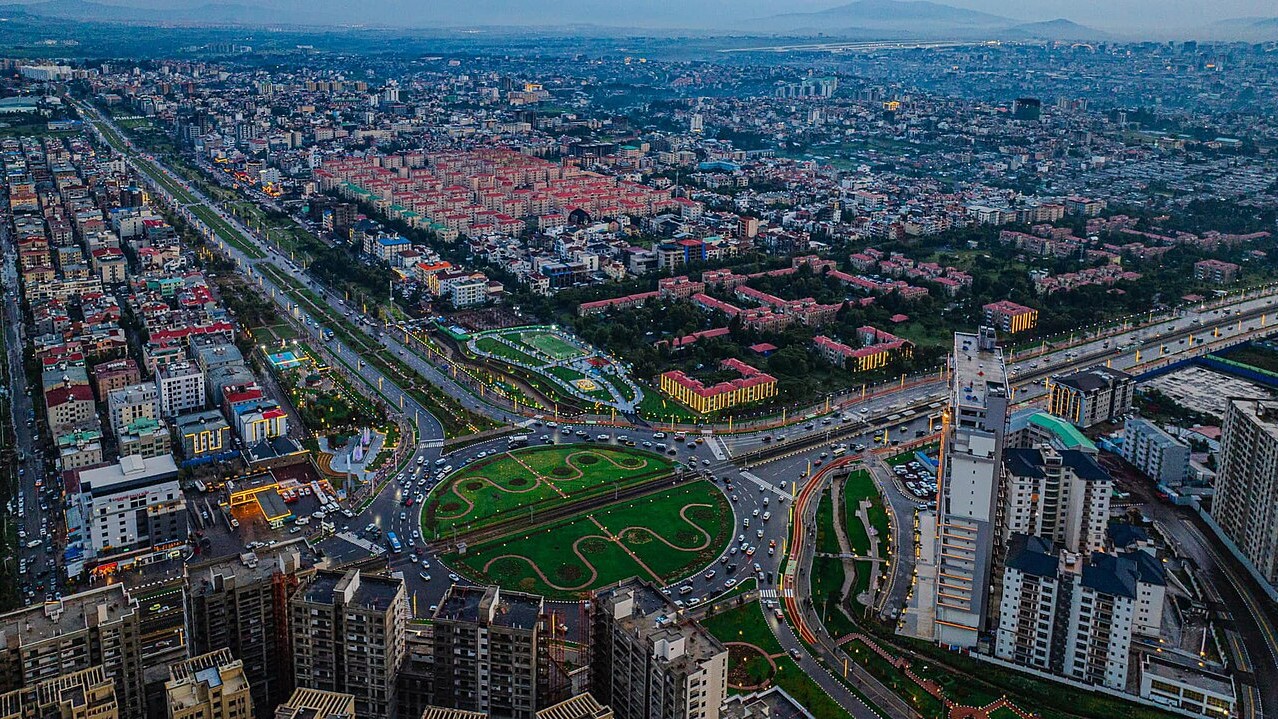
Ethiopia has the second-largest youth population in Africa, with 71 per cent of its 129 million people under the age of 30, and has been recording the fastest economic growth, twinned with low structural economic transformation. The ‘youth bulge’ is accompanied by rapid urbanization manifested by rampant urban sprawl. Under normal circumstances, such urbanization would be expected to provide job opportunities with future career prospects for youth, but the country’s economy is transitioning from low-productivity agriculture to another low-productivity service sector offering job opportunities dominated by street vending and informal employment in private households as maids or guards. Such employment opportunities failed to create decent and fulfilling jobs for the two million new entrants in the labour force every year.
Rural youth migrate to urban areas to benefit from economic incentives, including wage employment opportunities, as well as benefits from municipal governments’ programmes aimed at reducing unemployment, but this exacerbates city poverty by adding fuel to existing unplanned urban proliferations and joblessness. Such a pattern of urbanization potentially continues in the foreseeable future, with city residents projected to reach roughly 40 per cent of the population by 2050. The unprecedented level of urbanization is mainly driven by massive rural–urban migration, accounting for 44 per cent of the urban population. In the absence of a structural economic transformation, such an unmanaged migration pattern not only overstrains the limited urban infrastructure but could also be a source of social and political crises with global ramifications.
Currently, about three-quarters of the country’s population lives in rural areas, primarily engaged in subsistence family farming, with about 45 per cent of youth underemployed, working below 35 hours per week. Migrant youth are highly susceptible to poor working and housing conditions, and are less competitive in the urban labour markets due to lower endowments in education, experience, financial capital, and social networks, which leads to increasing costs of migration. The high level of youth unemployment is emblematic of urban labour markets where one in four young people is unemployed and available employment opportunities are predominantly informal and low-paying positions—accounting for 60 per cent of positions in urban areas and about two-thirds of the positions occupied by women—that lack job security and are highly vulnerable to economic shocks.
‘Such an unmanaged migration pattern not only overstrains the limited urban infrastructure but also could be a source of social and political crisis’
On the other hand, Ethiopia has been investing—about 3.2 per cent of its public expenditure—in technologies aimed at transforming the highly diversified traditional agriculture production systems towards skilled agriculture, which is a mechanized, more specialized, and business-oriented production ecosystem. Skilled agriculture has the potential to steer agribusiness productivity and facilitate rural transformation by creating decent and fulfilling jobs in the rural nonfarm economy and the rural–urban continuum. Furthermore, investing in agribusiness in low-income countries stimulates economic growth, expands the rural non-farm economy, reduces poverty, and ensures food security by enhancing innovation and supply chain management.
Successful implementation of agribusiness interventions provides pragmatic solutions by creating employment opportunities and career path prospects for the youth in the rural space, including small to medium-sized towns. According to the International Standard Classification of Education, ISCED 2011, jobs in skilled agriculture require a workforce equipped with secondary education completion. Oftentimes, the better-educated farmers adopt new technologies, utilize information effectively, and allocate resources efficiently. This is because education enhances the farmer’s ability to obtain and understand information about agricultural technologies, including digital advisory schemes and services. But the youth, who are relatively better-educated than the older cohort, migrate from rural to urban areas in search of employment opportunities and future career prospects, which depletes the human capital stock required for the effectiveness of the investments in agricultural transformation technologies.
The numbers tell how the youth rural–urban migration adversely affects both rural and urban labour markets, particularly in skilled agriculture. Based on the Central Statistics Service of Ethiopia’s 2021 Labour and Migration Survey data, about 49.2 per cent of the youth (in the age range of 15 to 35 years) in rural areas have completed some level of elementary education, and about 35.5 per cent of them have never attended school. Of the workers engaged in skilled agriculture, the majority (55.5 per cent) were under-educated, and about 23.5 per cent were over-educated for the job.
In other words, the sub-sector expected to transform the livelihoods of the country’s 95 million people has been operated by sub-optimal and/or disincentivized labour. This is evidenced by the dismal performance of agricultural productivity, which is consistently below the average for the globe and developing countries, signalling ineffective utilization of agricultural technologies. More than half of the rural–urban migrant youth (51 per cent) have completed at least secondary education, which would qualify them for semi-skilled jobs, including in skilled agriculture, had they stayed in rural areas. Similarly, of the employed rural–urban migrants, about 56.6 per cent were under-qualified in the services industry, while about 49.6 per cent of those engaged in elementary jobs—that includes cleaning, waitress, housemaid, street vending and the like—were over-qualified.
It is evident that the country’s labour markets, both rural and urban, exhibit a large discrepancy between the skills acquired and those required for the job. Such incompatible employment patterns, particularly engaging in elementary jobs in urban areas that require a lower level of educational qualification, signal working in poverty and risking a wage penalty for being over-qualified for the job. The unqualified and unremunerated migrant labour in the service industry could be fueling economic growth by boosting productivity in skilled agriculture, which is suffering from a shortage of labourers who can satisfy the bare minimum of secondary school completion. Their migration constrains the effectiveness of agricultural transformation investments and aggravates food insecurity.
Overall, the high population growth rate created a ‘youth bulge’ in the country, and the economic growth has failed miserably in creating employment opportunities for the enormous annual supply of labour. What should be driving economic growth through demographic dividends instead becomes a major problem due to the high levels of underemployment and unemployment. Youth un- or underemployment poses serious social and political risks for the country and beyond if left unaddressed. If the current unparalleled pace of internal migration continues, and the level of structural economic transformation stays the same, then the country’s development and stability will be jeopardized, and youth will be driven to migrate, willingly or unwillingly, to the Middle East and the Mediterranean, often via the irregular channels of migration.
Related articles: