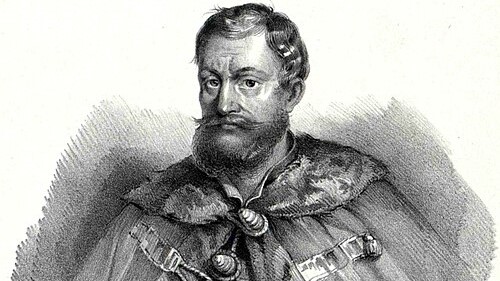
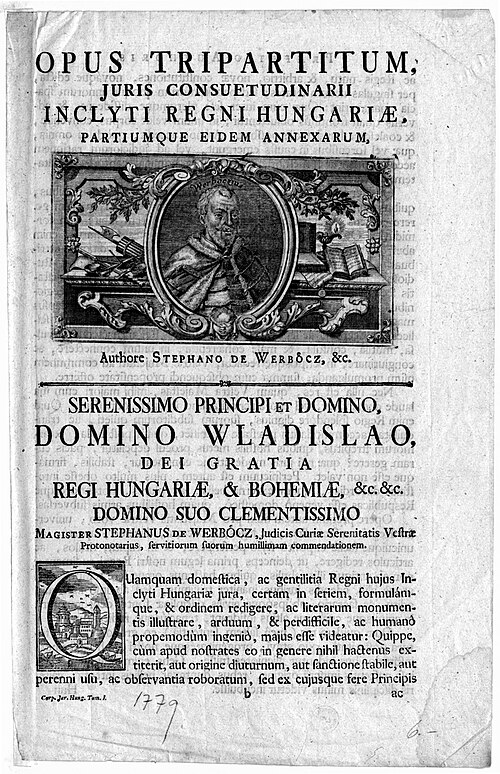
Once, in past memory, there stood a grand statue upon the Kígyó tér or Snake Square, as the now area of Ferenciek tere or Square of the Franciscans was called at the turn of the century. One of ten gifts. This momentous statute was of none other than István Werbőczy, or in Latin Stephanus Werboecius. A legal scholar, judge and lawyer of the early 15th century. Born in 1458, Werbőczy rose to fame from a lesser noble background through his exceptional legal scholarly abilities. He created, at the commission of the King, the first comprehensive Hungarian legal compilation of customary law, which became enshrined in Hungarian legal tradition. For centuries, no one could seriously mention any legal topic without mentioning Werbőczy’s compendium, the Tripartitum of 1517.
It is important to note that the book remained customary since it was never fully enacted by the King, even though it was ratified by the Diet of Hungary at the time. Yet, the work remains an extremely important historical document in Hungarian legal evolution. Courts used it in large quantities for centuries as a reference in ruling. Due to its nature, the work is theoretically malleable, but, because of its importance, no one could touch the form of the materials covered. The compilation largely reinforced the rights of nobles in a variety of ways. These, procedural law and the rights of different groups in the Kingdom were emphasized in its three books. Over time, the book formed into a sort of canon in Hungarian law and still remains so in Hungarian legal history. These ancient laws were a point of political and legal reference against the oppression of the Hungarian aristocracy by the Austrian one. Hundreds of years later, many of the rights described were expanded to apply to all nationals of the state, increasing their relevance.
Yet, this article’s theme revolves around statues, the statues received from Emperor of Austria and King of Hungary Franz Joseph I in 1897 as a gift to the Hungarian nation. Supposedly, when the Emperor was visiting after the city reached its most beautiful form, he admired the streets but found a lack of statues. At this, he declared that there should be more statues adorning the squares and streets of the capital. Thus, he commissioned the creation of the grand gifts.
The Emperor had ten statues made for the city of Budapest. These were: Saint Gerard, Péter Pázmány, Gábor Bethlen, János Hunyadi, Miklós Zrínyi, János Pálffy, István Bocskai, Anonymus, István Werbőczy and Sebestyén Tinódi. All of them are enormous contributors to Hungarian history. Werbőczy’s statue was carved by the master craftsman Gyula Donáth.
With the arrival of Communism, lots of statues were damaged, relocated or torn down. The Werbőczy statue was torn down in 1945, amongst the most severe mockery. The Communists saw his figure as a threat to the new order they were trying to establish by force. Therefore, it was displaced and removed in the most abhorrent fashion possible. That marked the end of Werbőczy’s statue, which was never found again. And today, all of the other statues stand while Werbőczy is the only one of the ten not honoured in such a way. He has no statue in Budapest at all.
‘The Werbőczy statue was torn down in 1945…The Communists saw his figure as a threat to the new order they were trying to establish by force’
Yet his work remains. It is still taught today at legal faculties and constitutes a body of canon that may not be avoided by anyone dealing with the time. Therefore, it is immortal in a sense. The relevance of the so-called Hármaskönyv is undisputed. The book is organically tied to Hungarian early development, along with being a guide for the times after. Its imprint is noticeable, and its relevance does not wane in many regards. It is also of note that Werbőczy fulfilled lots of important roles and offices during his life. He was an Országbíró or Judge Royal, a Nádor or Palatine, amongst others. He was sent to travel in the religiously conflict-torn Holy Roman Empire seeking aid for the Christian-European cause against the Ottomans. He was largely unsuccessful due to raging conflicts. So the Hungarian Kingdom stood alone and was eventually defeated. Yet, to Werbőczy’s great credit, he tried. All in all, Werbőczy is a giant of a figure by many standards of measure.
This leads to the conclusion that such a figure’s statue needs restoration. Not necessarily for the order he imposed on his work, or for his views, but largely for the consequence and relevance he had on Hungarian development. It is not right to—as the Marxist ideologues then—cut out pieces of our history.
This sort of continuation is fundamental to a conservative view of the world and history. Things alter, but there is a building, a creation process happening. The works of previous generations must, mostly, be valued by latter ones since, without them, we would not be where we currently stand. This is an evolution through individuals, woven in the complicated thread of society, based on certain cornerstone beliefs. These are placed upon each other; thus, a society with deep roots sprouting in a grand creation is actualized. In the case of Werbőczy, sure, we have moved on in political and legal development since his feudal work, yet he is a foundational part of Hungarian history.
In closing, all of the other gifted statues are still standing today. Those heroes are still very much deservedly honoured. Werbőczy, mocked and torn down, is the only figure still lost to us. This is disgraceful. I say let us further revive his memory by reinstalling his statue. The area where it will be placed can still be decided, possibly the very one where it originally stood. This would be ideal for the sake of continuity; however, if another option makes more sense, let it be so. The point is, his statue shall remind passersby for ages to come of his historical contribution to the Hungarian nation!
Related articles: