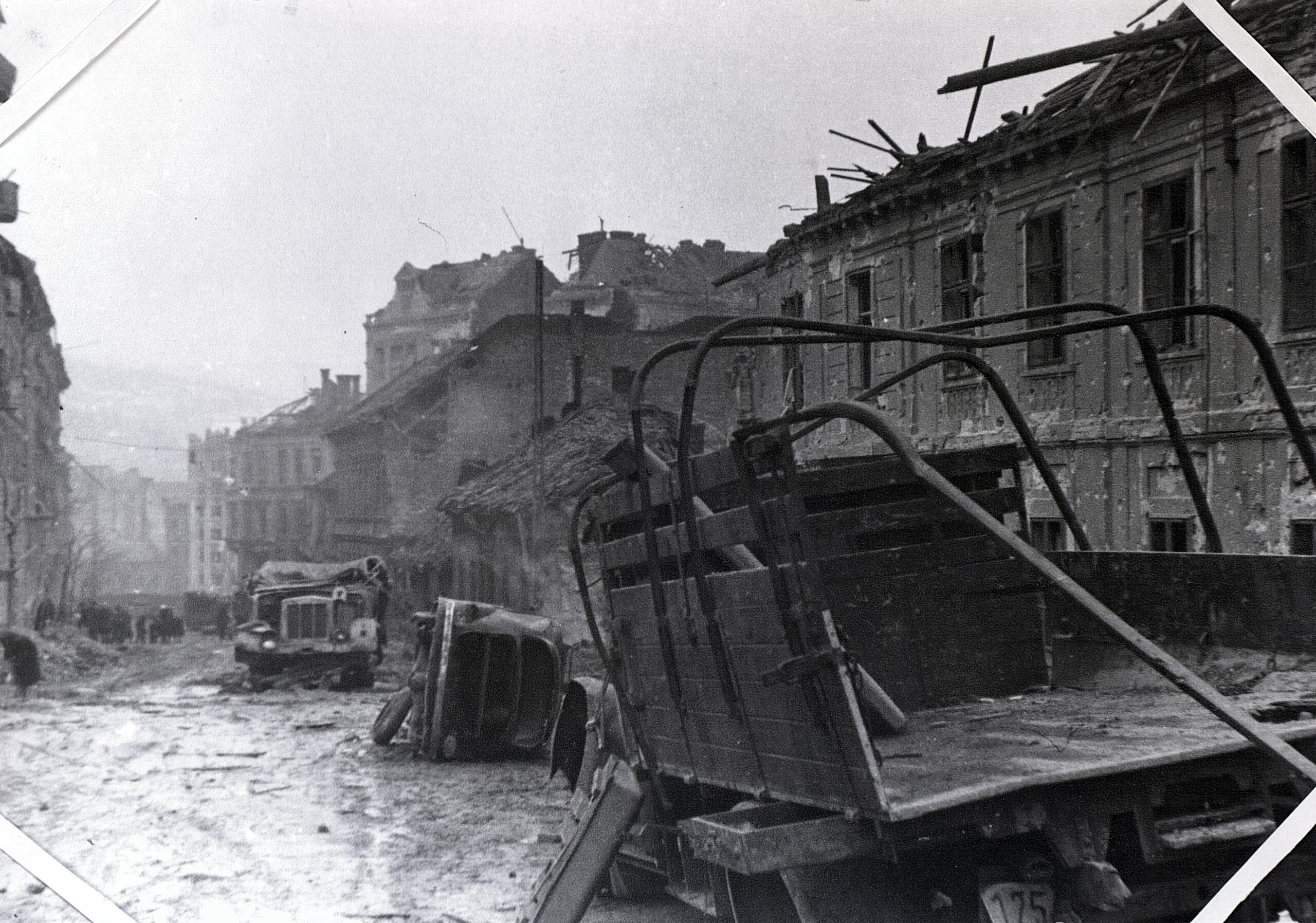
Christmas 1944 was a bleak time in Hungary. By then, the country was already half under Soviet occupation, and the Soviet siege ring had just closed around Budapest. In the eastern half of Hungary, the population was experiencing the reality of communist dictatorship firsthand: rapes, illegal arrests, and atrocities against civilians were occurring on a daily basis. In the western half of the country, meanwhile, the Holocaust was still underway, and the German occupiers and their Hungarian collaborators—the members of the Arrow Cross Party—were no less violent than Stalin’s soldiers.
In the following article, drawing on several primary sources, we explore the tragic and contradictory—at times even ironic—story of Christmas 1944.
In spite of the widespread lack of paper, the Arrow Cross dictatorship, still in place in the Western Hungarian city of Szombathely, found the time and energy to publish a Christmas special of the local Arrow Cross newspaper, the Hungarista (Hungarist). The Hungarista Karácsony (Hungarist Christmas) featured a long, ideological article by one Béla Kerekes on its front page. The almost absurd article described the social ‘teachings’ of the Arrow Cross dictator, Ferenc Szálasi, and tried to connect it to Christianity, resulting in an odd concoction of religious fanaticism and Nazi terminology:
‘The Hungarian practice of the new worldview, Hungarism (hungarizmus), is the socialism of Christ and the religion of love, because as its moral foundation it has accepted those truths and that religion of love which were laid down and proclaimed by the God-man born nearly two thousand years ago, and for which he died a death on the cross. This is the moral substance of Hungarism; this is what strengthened the apostles and followers of Hungarism.’ Later on, the article explained the significance of protecting the Hungarian ‘race’ against outside influences, namely the Jews.[1]
It is also worth examining the Christmas issue of the Soproni Hirlap (Sopron News), a newspaper from the Westernmost Hungarian city, naturally under Arrow Cross control. The newspaper announced the ‘in the National Socialist Europe’, ‘even Christmas is more profound, honest, happy and true’. Like the article cited above, the issue used religious terminology, comparing the Arrow Cross men to the followers of Christ: they followed Szálasi ‘to the Calvary’.
‘The issue used religious terminology, comparing the Arrow Cross men to the followers of Christ’
The Arrow Cross paid attention to winning over the populace: they announced reduced gas utility costs for Christmas day, organized a special play for children at the local theatre, and distributed free furniture—that is, furniture taken away from the homes of deported Jews, who, by then, had mostly already been murdered in Auschwitz. ‘Everyone can ask for Jewish furniture’, the newspaper declared the merry news on page 5.[2]
Some of the Arrow Cross men celebrated by killing Jews. One Mihály Róbert Kreutz, a 21-year-old Jewish man, was executed in Sopronkőhida on this day. Not only Jews were targeted, of course. The legendary leader of the Hungarian resistance movement, Endre Bajcsy-Zsilinszky, was also sent to the gallows on Christmas Eve.
Primary documents paint a different picture of the day-to-day realities of Arrow Cross Hungary on Christmas day. A note, dated 24 December, from the Chief District Administrator (főszolgabíró) of the Vasvár District to the Military Command of the 3rd District complains that ‘in Pácsony, a village belonging to the joint municipality of Olaszfa, a German unit of nearly one thousand men has been stationed. Its commander wished to carry out the following measure, namely that the women of the village’s civilian population should wash the German soldiers’ laundry. With regard to the above-mentioned unit, the village authorities also lodge a complaint that approximately 500 horses are being kept on the fodder of the village’s farmers, without any compensation.’ The soldiers took away whatever they needed from the local villagers, the complaint went on, and then refused to pay.[3]
From the same day, we have an order from the Hungarian military commander of the station at the city of Veszprém, addressed to the mayor of the city. ‘I call upon you to organize work groups in the city, each consisting of one work leader and approximately 20 persons, in such a way that for heavy earthworks they are made up of male labourers equipped with the appropriate tools, and auxiliary female, and possibly child, labour as support. For lighter work, we are primarily seeking female and elderly male labour. To this end, not only the working class but also the intelligentsia must be mobilized. When assigning the work groups to duty, working hours must be regulated precisely. Order of urgency: a) fortification work, b) maintenance of roads, and c) agricultural work…We do not wish to see loitering, idle civilians.’[4]
No price was too heavy for the Arrow Cross to keep up their dictatorship. Szálasi even came up with a new word for Christmas: he renamed the holiday ‘Hopechristmas’ (Reménykarácsony)—spelled this way, in one word. The significance of the new name was that it announced the hope that Hungary would, eventually, defeat the Soviet Union.[5]
‘On Christmas day, the Soviet siege circle closed around Budapest, and the first Soviet soldiers started to appear on the outskirts of the capital’
Of course, it happened exactly the other way around. On Christmas day, the Soviet siege circle closed around Budapest, and the first Soviet soldiers started to appear on the outskirts of the capital. The renowned writer Sándor Márai, himself a resident of the Castle District, wrote on this day in his diary:
‘They broke through the Hungarian–German lines…they are coming. With immense joy I set off toward the city. Excitement can be felt everywhere…Hardly have I crossed the bridge when a major air-raid alarm catches me. I go down into a cellar, taking my little Christmas tree with me…Down there I tie blue ribbons onto the small artificial tree, and with half an ear I listen as the frightened residents of the building talk among themselves. They discuss the breakthrough…and when the bangs sounding during the alarm are heard, they say that the siege of Budapest has now definitively begun. Joy and unease compete within me…No one dares venture into the city. Two German tanks are circling the building…Slowly, every window is shattered.’[6]
Sometimes even a few mundane words among death certificates tell entire stories. One Nándor Liebe, a 20-year-old peasant from Vecsés, died on Christmas day. The cause of his death is simply listed as ‘grenade’. One László Hordós, a 47-year-old man, also a peasant, died in Szűcsi, in the side of a local hill. The cause of his death is listed as ‘landmine’. Hundreds of death certificates remain from the country, mostly of civilians, which explicitly list ‘Russian’ grenades, bombs, bullets and attacks as the cause of death.
Children were not spared either. One István András Demeter, a 14-year-old boy, died in Szűcsi as well, on Christmas day. The cause of his death: ‘shrapnels’. Márta Éva Bogdán, a 3-year-old toddler, died at 11:30am in Miskolc. The cause of her death was ‘loss of blood, due to shrapnel wound’. She must have been with her mother when the shrapnel struck, as the next entry is of one ‘Mrs János Bogdán’, who died at the same hour, also due to shrapnel inflicted wounds.
Éva was not the only small child who became a victim to the Second World War in Hungary. The website of the Hungarian National Archives, where one can search for death certificates listing violent deaths during the years 1944–1945, lists 4202 death certificates of children who were under school age. Most Holocaust victims are not even included.[7]
On Christmas day in 1944 Hungary, illusion and reality collided. The promise of ‘liberation’ or ‘redemption’ was drowned out by violence, coercion, and fear on all sides. What survives of that Christmas are the testimonies, the fragmentary voices that reveal how ordinary lives were crushed between two brutal systems at the very moment meant for peace.
[1] Hungarista Karácsony (Szombathely), n. d., p. 1.
[2] Soproni Hirlap, Dec 24 1944, pp. 1–5.
[3] Sorsforduló. Iratok Magyarország felszabadulásának történetéhez, ‘1944. szeptember–1945. április’, Budapest, 1970, Ed Elek Karsai, vol 1, 342–343.
[4] Ibid, pp. 377–378.
[5] Soproni Hirlap, Dec 24 1944, p. 1.
[6] Márai Sándor, A teljes napló, ‘1943–1944’, Helikon, pp. 359–360.
Related articles: