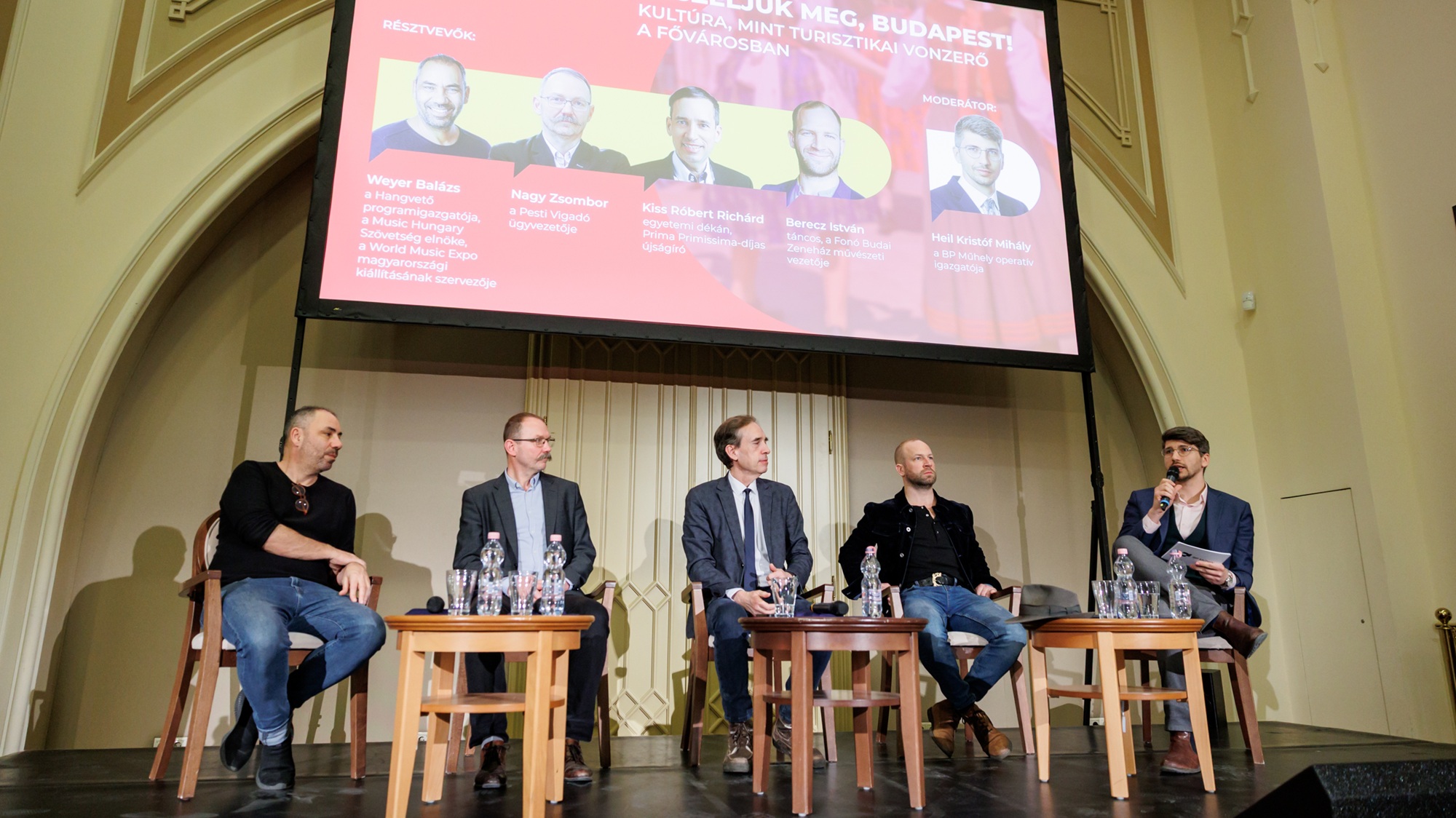
The Budapest-based urban development think tank BP Műhely hosted an insightful panel discussion at the Pesti Vigadó in Budapest, Hungary, on Thursday, 12 February. The event was titled Let’s Talk About It, Budapest — Culture as a Tourist Attraction in the Capital, and featured a line-up of five expert speakers.
They were: journalist and organizer of the World Music Expo exhibition in Hungary Balázs Weyer, Chief Executive of the host venue Pesti Vigadó Zsombor Nagy, Professor of Linguistics and Communication at Eötvös Loránd University and tourism industry journalist Róbert Richárd Kiss, and professional folk dancer István Berecz. CEO of BP Műhely Kristóf Heil served in the role of the moderator for the evening.
Mr Kiss kicked off the discussion by trying to define ‘culture tourism’ at the request of moderator Mr Heil. He explained that cultural tourists come to Hungary to view our architectural heritage, experience the local classical music scene—which he believes rivals that of Vienna, Austria and Milan, Italy—or view the spots where famous movies have been shot, pointing out that Hungary is a popular filming location for big-budget Hollywood films. Mr Kiss also noted the ‘gastrorevolution’ that took place in Budapest in recent years.
Mr Weyer claimed that culture serves an evolutionary function for the human race and is a tool for community building. Also, he added that ‘culture is what gives its flavour to our city’, and serves as a ‘memory anchor’ for the population.
Mr Nagy noted that the word ‘culture’ comes from the Latin verb ‘colere’, which is also the etymological origin for the word ‘agriculture’, and means to cultivate, but also to tend to or just spend time with something. He then told the audience that culture is a key tool in ‘humanity’s greatest value, relationships’.
Mr Berecz, on the other hand, described culture as ‘our ideological identity’, which is made up of our greatest individual creators, all-time geniuses, as well as of our collective memory and folk arts.
In the next round on the mic, Mr Kiss explained that a city’s brand is what tourism experts are consciously trying to project about the location, while its image is the culmination of general associations that non-locals have about it. On that note, Mr Meyer told the audience that Budapest is typically associated with bathhouses, low prices, and beauty among international tourists, and pointed out that changing these general ideas takes a lot of time and effort.
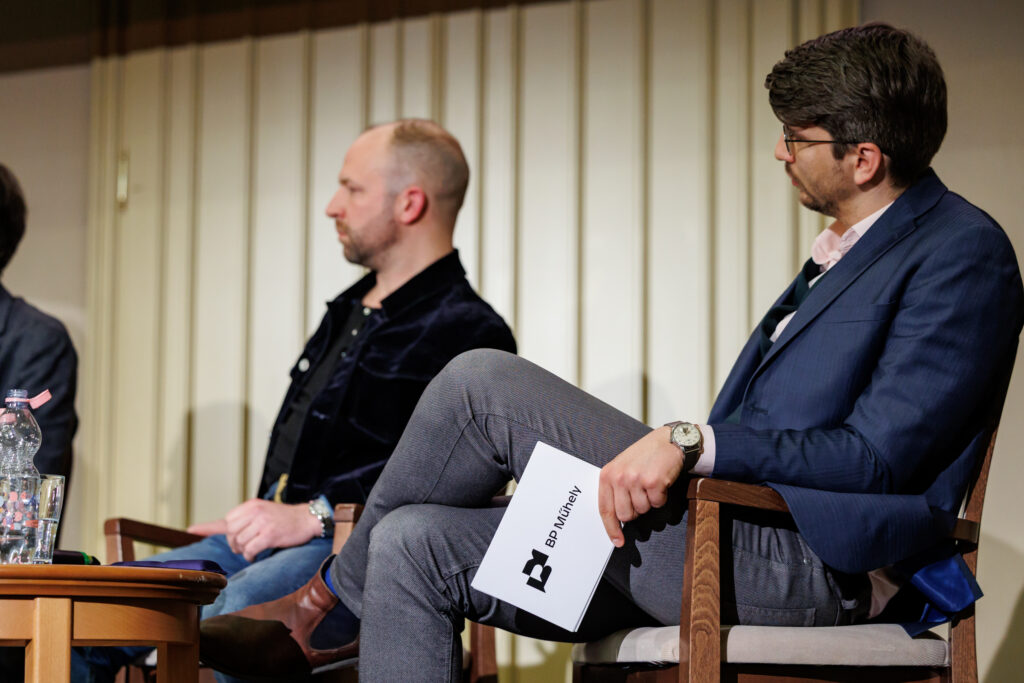
Mr Kiss added that on top of the thermal bathhouses, the so-called ‘party districts’ are also one of Budapest’s big draws for international tourists, although lately it has been facing increasing competition from Belgrade, Serbia, on that front. Sports tourism is also on the rise in the Hungarian capital, he noted, with the city hosting more and more major sporting events. The UEFA Champions League final will be held in Budapest this year, for instance. The expert went on to point out that sports tourists tend to spend more than ‘regular’ tourists, according to industry stats.
Citing more statistics, the professor also shared that 20 million foreign tourists visit Hungary every year on average. He stressed that these are very accurate figures, as each commercial establishment providing accommodation must register each guest.
Mr Nagy implored everyone, saying that ‘we, the people living here, are most responsible for the city’s image’, with special emphasis on service workers. Meanwhile, Mr Berecz had another request for the public: he told us to be curious about ourselves, as that is what an authentic tourism campaign can be built on by professionals.
Related articles: