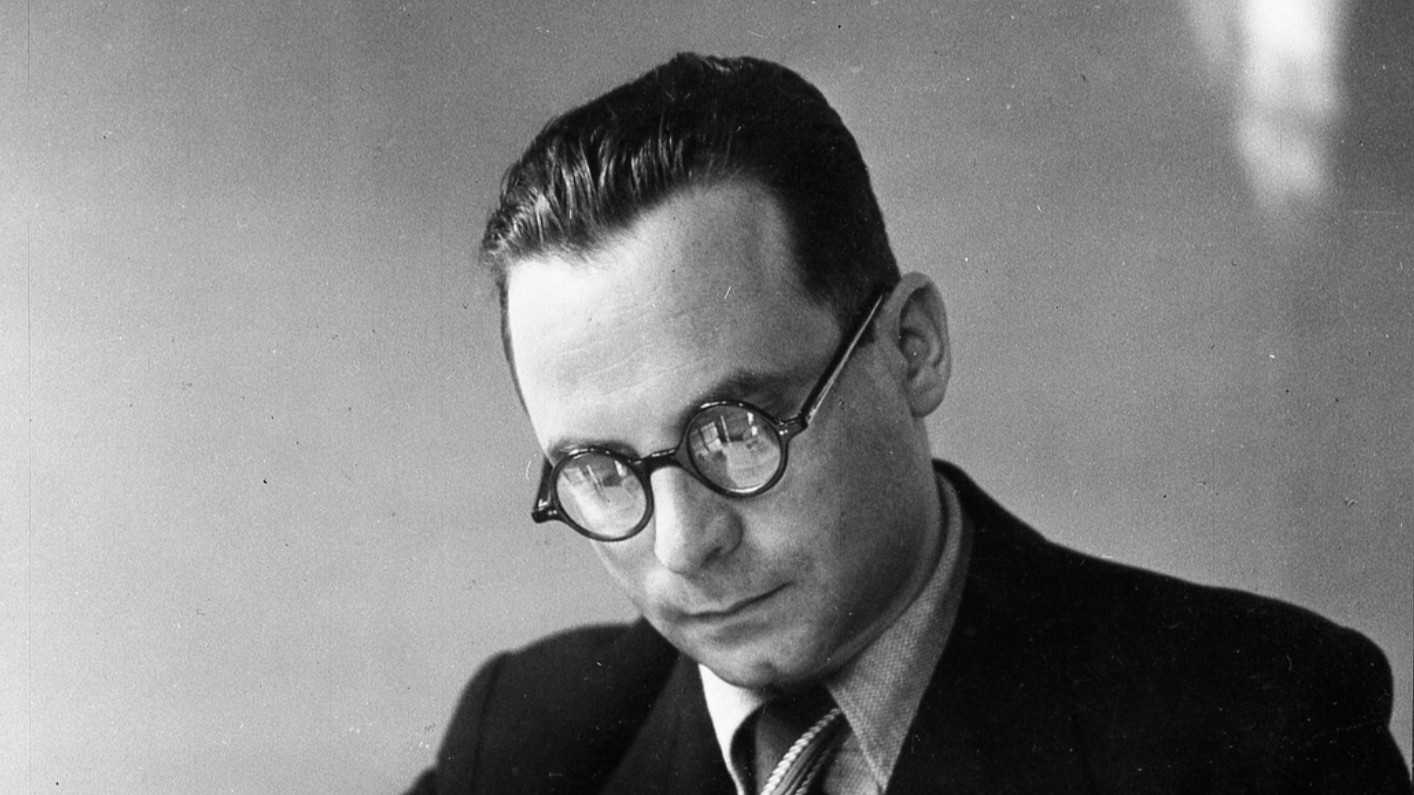
Every year, around 27 January, the anniversary of the death of the writer Antal Szerb,[1] one particular document is often shared on Facebook among Hungarian users: it is an excerpt from an indictment submitted in 1945 by the Budapest People’s Prosecutor’s Office against one Miklós Gaál, a Jewish policeman (‘jupo’, Judenpolizei), originally published on the Facebook page of the Hungarian Archives for the History of State Security (Állambiztonsági Szolgálatok Történeti Levéltára, ÁBSZTL).
According to the indictment, in December 1944 Gaál was in Balf, near Sopron, serving as a guard selected from among the Jewish prisoners. As a jupo, he was cruel to his fellow inmates: he took their food and clothing, beat them, and ‘the accused was the direct cause of the deaths of Dr. Antal Szerb and István Szász.’ Interestingly, the indictment was submitted by People’s Prosecutor Tibor Ferenczi, himself a survivor of forced labour—though he had not served in Balf. The document is interesting, of course, because Szerb was one of the greatest novelists of modern Hungarian literature and it is usually presumed that he was, in fact, beaten to death by Hungarian Nazis.
The ÁBSZTL site summarized the document by noting that ‘the verdict was not attached to the file, so we do not know to what extent the People’s Court’s reasoning corresponded to the above indictment; beyond abuses involving food and clothing and the application of punishments, to what extent Gaál was found responsible for deaths that occurred in the camp; and to what extent his defence was accepted, namely that he was only carrying out orders and had no knowledge of what happened to the forced labourers handed over to the Arrow Cross.’ The post was widely shared online as supposed proof that ‘you see, a fellow Jew beat Antal Szerb to death.’
The story, however, aroused my interest—if only because I previously wrote a separate book on kapos and jupos, published by the Committee of National Remembrance (Nemzeti Emlékezet Bizottsága, NEB).[2] I am well aware that ‘kapo trials’ were often built on hearsay and legend, often serving as instruments of personal revenge and paying little regard to the constrained and desperate situation of Jewish guards.
‘“Kapo trials” were often built on hearsay and legend, often serving as instruments of personal revenge’
Moreover, until now the scholarly literature has known nothing certain about Antal Szerb’s death. His death certificate simply lists ‘exhaustion’.[3] Although it circulates online that Szerb was beaten to death by an ‘Arrow Cross guard’, as I also note in my book on unarmed labour service (munkaszolgálat), in reality we know nothing about the identity of his killer, and consequently we do not know whether that person was a member of the Arrow Cross Party or even a Hungarian or a German. According to the historical literature, Szerb’s widow, Klára Bálint, at one point referred to ‘young Arrow Cross thugs’, allegedly citing ‘the camp doctor’, but what exactly this meant, from whom she obtained the information, and whether it was reliable has never been clarified.[4]
At the ÁBSZTL, under the reference number provided, Gaál’s investigation file can indeed be found. It shows that Gaál was born on 19 August 1919, in Budapest; his father was Miksa Gaál, his mother Etel Neulander. His religion is listed as ‘Evangelical’, but clearly because of his Jewish origin he was assigned to unarmed labour service beginning in August 1940. He escaped but was captured and taken to Balf, where, according to his statement of 14 July 1945, his knowledge of German led to his appointment as a jupo. He claimed that he mainly supervised clothing repairs, but when too many people crowded around them, he dispersed them with a stick. Those suffering from frostbite who remained in the barracks were handed over to the Arrow Cross, and among them several were beaten, some to death. Three days later he added that Antal Szerb may have died of typhus or blood poisoning. During the investigation other testimonies were taken. For example, one Edit Korda—described as Gaál’s ‘secretary’—stated that Szerb had been beaten several times, but from the text it was unclear whether by Arrow Cross men or by Gaál.
The continuation of the story can be reconstructed from the records of the Budapest City Archives. According to these, on 10 January 1946, Gaál appeared before a People’s Court panel presided over by the infamous Communist judge Gusztáv Tutsek. At the trial he pleaded not guilty and stated that he had beaten no one. Clothing was taken only from the dead because garments were needed. He did not know Antal Szerb and did not know how he had died.[6]
Witnesses testified both for and against him. According to Andor Weitfeld, Gaál struck them with a stick, but no serious injuries resulted. ‘I know from hearsay that the accused had Antal Szerb beaten by the Arrow Cross, as a result of which he was placed in the sick ward and died.’ This, however, was hearsay, and under the criminal procedure law of the time only eyewitness testimony counted. The witness Sándor Fischer likewise added only that, according to what he had heard, the accused and his fellow jupos ‘beat Szerb together with Arrow Cross men.’ What this meant—whether he personally participated, gave orders, or merely watched—remained unclear. Rather awkwardly, he added: ‘I do not know whether the accused himself had a part in this.’
‘What this meant—whether he personally participated, gave orders, or merely watched—remained unclear’
Particularly interesting was the testimony of the doctor, Zsolt Mittelmann. He stated that although Gaál sometimes struck people, he never caused serious injury. ‘The accused bears no responsibility for the death of Antal Szerb.’ There may have been much truth in István Farkas’s testimony that because of Gaál’s role, the Arrow Cross, the Germans, and the deportees all hated Gaál. According to Ferenc Vértes, Gaál did not beat anyone at all. Mrs Jenő Schwarcz stated that Gaál’s disciplining measures were well-intentioned, he often procured food and drink for others, and he did not send the sick to work.
From the completely contradictory testimonies, the Tutsek panel concluded that Gaál was guilty under Section 15, Paragraph 2 of the People’s Court Act (that is, ‘exceeding his official authority and violating the bodily integrity of others’). He was sentenced to three years of forced labour. The verdict did not specifically mention Szerb’s beating or alleged beating to death; it spoke in general terms of Gaál’s responsibility for mistreating people, though it cited Weitfeld’s testimony, apparently accepting it.
Since the defendant appealed, the case went before the National Council of People’s Courts (NOT). The NOT upheld the first-instance judgment, correcting only the sentencing portion and increasing the penalty to four years of forced labour, incorporating into its reasoning the case of a forced labourer named Egon Ábel, which does not concern our present topic.
During and after this period Gaál bombarded the NOT with petitions, in which he also addressed the accusations concerning Szerb’s death. In these submissions he portrayed himself as a benevolent but strict jupo who struck only when necessary, beat no one to death, and essentially used his authority to protect other Jews. ‘I was accused of beating Antal Szerb and another deportee. This was testified too. But when the camp doctor, Dr Zsolt Mittelmann, was questioned, he in contrast testified that Antal Szerb was brought in from the workplace, where the Germans beat him. He testified—and it can otherwise be established from the documents—that I was not present at the workplace, therefore I could not have been present when this eminent scholar was beaten; yet this does not disturb the prosecution’s witness in accusing me of the gravest charge.’ In reality, Mittelmann did not testify that the Germans beat Szerb, and it is unclear what ‘documents’ Gaál was referring to.
In a subsequent petition he wrote: ‘In the first fervour after liberation, upon seeing me, they tried to pin every evil on me. See, for example, the beating of Antal Szerb and his death resulting from it. The attending physicians were questioned, who of course remembered very well the case of this writer of European renown, and testify that Antal Szerb—according to their own statement—was beaten by the Germans.’ In fact, only one doctor testified, and he merely stated that Gaál was not involved in Szerb’s death. Gaál also contradicted himself when, in another request, he asked that Mittelmann be heard to confirm that Szerb had died ‘of illness’.
Eventually Gaál’s case was reopened. Most of the witnesses—at least those who reappeared—simply repeated their earlier testimony, though this time positive opinions regarding Gaál predominated. Nevertheless, in November 1949 the Budapest Criminal Court again found Gaál guilty, sentencing him to three years’ imprisonment, which was deemed already served in light of his previous sentences. (In fact, Gaál had over-served the sentence, as he had been in pretrial detention since 19 July 1945, and was released on 9 September 1949.) According to his so-called ‘operational record card’, Gaál emigrated in 1956.
‘In November 1949 the Budapest Criminal Court again found Gaál guilty’
In evaluating the People’s Court materials, we must recognize that they tell us essentially nothing beyond the fact that Gaál was a jupo in the village of Balf and almost certainly struck people there. As is typical in the trials of kapos and jupos, the testimonies were highly contradictory; the prosecution’s witnesses relied on hearsay and rumour; and the People’s Court (and later the criminal court) made no real attempt to filter out the contradictions or to establish a causal link between the accused’s actions and specific atrocities, injuries, or deaths.
One additional source sheds some light on the story. In the Petőfi Literary Museum in Budapest, several letters by Szerb’s widow, Klára Bálint, are preserved. On 19 January 1968, she wrote to the renowned rabbi Sándor Scheiber about her late husband: ‘In Balf, it was from the mouth of the jupo that the words were heard: “let him live and die like the rest of the Jews.” Perhaps, if this sentence had not been uttered, he might still be alive today. There are too many “ifs” in this whole affair!’ Here a specific quotation appears, though it is unclear whether Gaál or someone else said it, and from whom the widow heard it. She added: ‘Every community consists of human beings, mortal human beings, and it would not occur to me to reproach anyone for not standing in their place, at the height of their humanity, at the lowest point of life.’ This shows remarkable insight and understanding on the widow’s part. She does not pass judgment and even signals that, although she undoubtedly sought closure, she did not accept every story she heard—since ‘there are too many “ifs”.’[7]
The historian knows, of course, that in cases of violent acts such as these, unless there are crime scene reports or autopsy records, we will likely never know exactly what happened. One may hope that readers interested in history will reach a similar conclusion. Until then, let us heed Klára Bálint’s advice: let us not ‘reproach’ anyone while there are still too many ‘ifs’.
[1] On Szerb, see: Havasréti József, Szerb Antal, Bp, Magvető, 2019; and Poszler György, Szerb Antal, Bp, Akadémiai Kiadó, 1973.
[2] Veszprémy László Bernát, Kápók a múlt fogságában. Náci koncentrációs táborok magyar zsidó funkcionáriusai a népbíróság előtt, Bp, Neb, 2023.
[3] Magyar Nemzeti Levéltár Győr-Moson-Sopron Vármegye Soproni Levéltára XXXIII.1.a. Kópháza halotti anyakönyve, 67/1946. sz.
[4] Veszprémy László Bernát, Piszkos munka – A munkaszolgálat és a keretlegények történetei a népbíróságon, Bp, Jaffa, 2024, p. 239.
[5] Budapest Főváros Levéltára, VII.5.e.1949.17052. See also: Állambiztonsági Szolgálatok Történeti Levéltára, 3.1.9. V-91499.
[6] Petőfi Irodalmi Múzeum, V.5415/178.
Related articles: