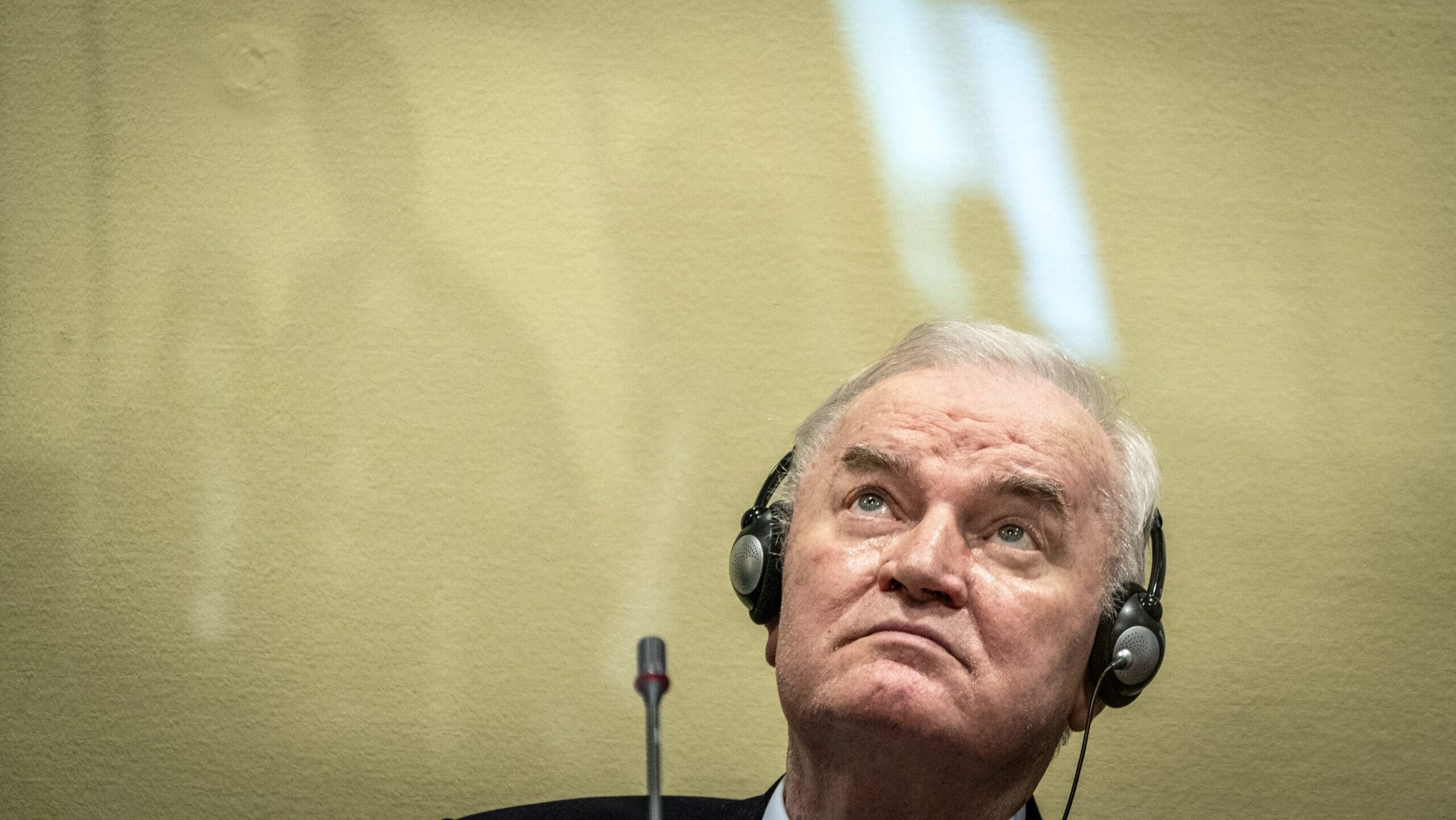
Ratko Mladić, the former Bosnian Serb military commander convicted of genocide over the 1995 Srebrenica massacre and sentenced to life imprisonment for some of the worst crimes of the Bosnian War, died on Thursday in United Nations custody in The Hague. He was 83.
A UN official confirmed Mladić’s death to Reuters after Serbian and Bosnian Serb media first reported it. His health had deteriorated severely in recent years following strokes and other serious medical problems, with his family repeatedly seeking his release to Serbia on humanitarian grounds. The latest request was rejected only days before his death.
Mladić commanded the Army of Republika Srpska (VRS) during the 1992–1995 Bosnian War and became one of the conflict’s most notorious figures. The International Criminal Tribunal for the former Yugoslavia convicted him in 2017 of genocide, crimes against humanity and war crimes, sentencing him to life imprisonment. The verdict was upheld on appeal in 2021.
Central to the conviction was Mladić’s role in Srebrenica. Bosnian Serb forces captured the eastern Bosnian enclave, which had been declared a UN ‘safe area’, on 11 July 1995. Women, children and elderly people were forcibly removed, while thousands of Bosnian Muslim men and boys were separated, detained, transported to execution sites and killed. More than 8,000 were murdered in what international courts have ruled constituted genocide.
The tribunal found that Mladić had participated in a joint criminal enterprise whose objective was the elimination of Srebrenica’s Bosnian Muslim population. The judges concluded that he intended to achieve that objective by killing the enclave’s men and boys and forcibly removing its women, children and elderly residents.
His death immediately produced sharply contrasting reactions reflecting the divisions that still surround his legacy. Milorad Dodik, leader of Bosnia’s Serb nationalist SNSD, offered condolences to Mladić’s family and ‘everyone who respected him’, while claiming that better medical treatment could have allowed the former general to live longer.
Murat Tahirović, president of Bosnia’s Association of Victims and Witnesses of Genocide, struck the opposite tone, saying the essential objective had already been achieved because Mladić lived to be convicted and sentenced. ‘We achieved the goal of justice; everything else is biology,’ he said.
Serbia’s Justice Ministry said it was already in contact with Mladić’s family and awaiting instructions from the UN tribunal over the transfer of his remains to Serbia.
Mladić had evaded international justice for nearly 16 years after being indicted in 1995, before his arrest in Serbia in May 2011.
Related articles:
At a time when public debate is increasingly polarized and superficial, Hungarian Conservative remains committed to depth, intellectual honesty, and independent conservative thought.
Producing high-quality journalism requires resources. Your contribution helps us expand our coverage, reach new audiences, and keep our content accessible.

Please consider supporting our mission.