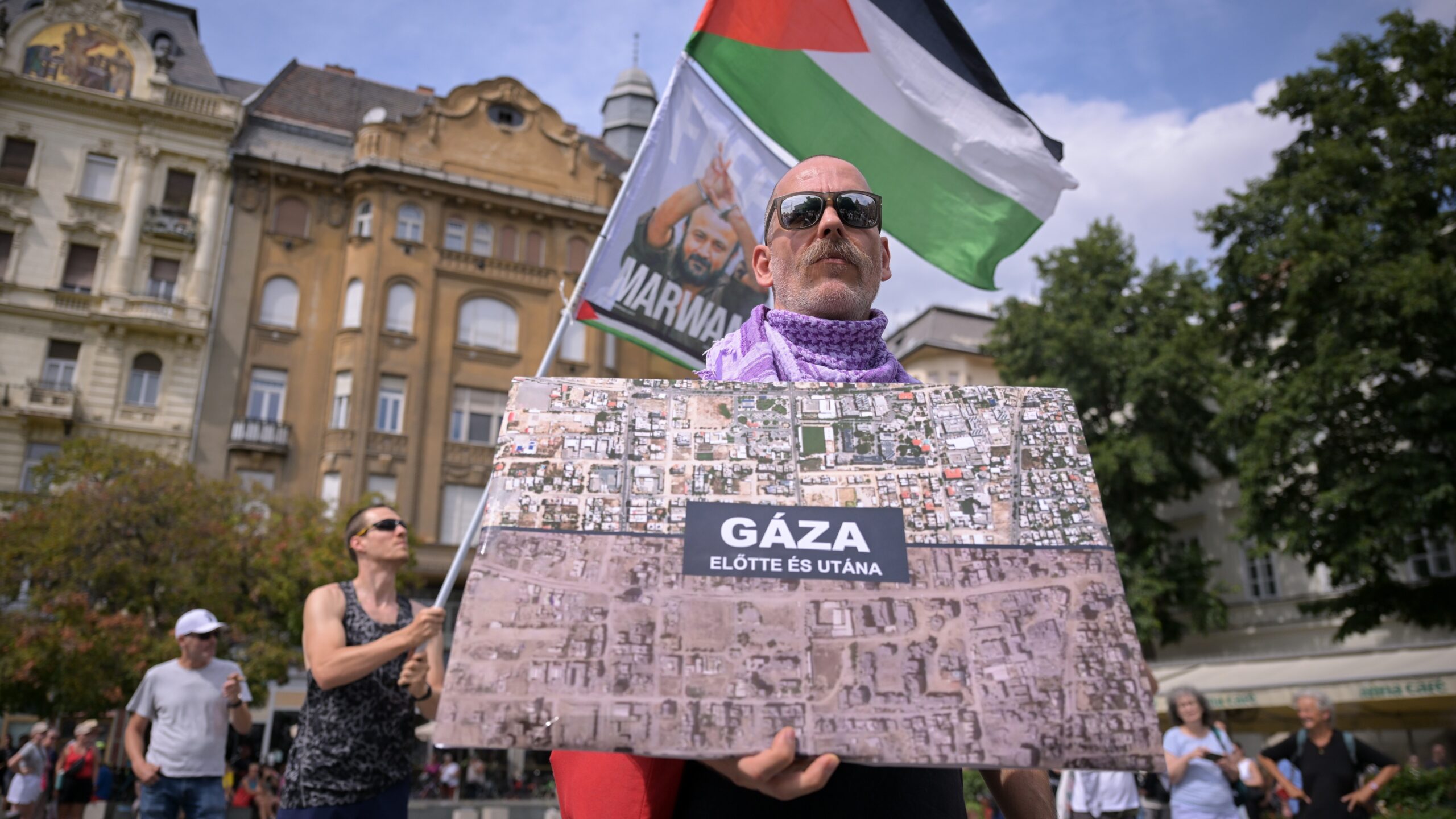
On Friday afternoon, Budapest became the scene of two sharply contrasting demonstrations. On Fővám Square, the Palestinian Community Living in Hungary held a pro-Palestinian demonstration in support of Palestinian prisoners and Dr Hussam Abu Safieh, whom Israeli authorities identify as a Hamas figure. At the same time, around 100–150 people gathered at Herzl Tivadar Square in front of the Dohány Street Synagogue for a pro-Israel counter-demonstration, standing up for Israel’s right to self-defence and the safety and civil rights of Hungary’s Jewish community.
While only a few dozen people attended the pro-Palestinian demonstration, the larger gathering at Herzl Square featured Hungarian and Israeli flags and speeches emphasizing that the issue was not only Israel’s security but also whether Hungarian Jews should be able to live openly, display an Israeli flag and express solidarity with Israel without being treated as legitimate targets.
The Budapest Police Headquarters (BRFK) cleared a demonstration expressing solidarity with Palestinian prisoners and Dr Hussam Abu Safieh. The decision raises a question that would have been difficult to imagine after 7 October: has Hungary’s ‘zero tolerance’ approach toward demonstrations supporting Hamas come to an end?
The BRFK confirmed on 19 August that it reviewed a notification for a gathering scheduled to take place in Budapest on 21 August and found no legal grounds to prohibit it.
‘On August 21, 2026, a private individual announced a meeting falling under the scope of the Assembly Act. BRFK, as the assembly authority, examined the notification and acknowledged it in the absence of a prohibitory reason,’ the police communications department told Hetek.
‘Glory to the martyrs! Freedom to the prisoners! Long live Palestine!’
The organizers said the demonstration was being held ‘in support of Palestinian prisoners detained in occupied Palestine and in solidarity with Dr Hussam Abu Safieh’. Their call concludes with the slogans: ‘Glory to the martyrs! Freedom to the prisoners! Long live Palestine!’
The wording is significant. The demonstration was not simply a general expression of support for Palestinian civilians. It explicitly identified Abu Safieh as a person whom participants were being asked to support in relation to his imprisonment.
Who Is Hussam Abu Safieh?
Abu Safieh, the former director of Kamal Adwan Hospital in northern Gaza, has become a prominent figure in international campaigns calling for the release of Palestinian detainees. WHO Director-General Tedros Adhanom Ghebreyesus, Amnesty International and others have called for his release, presenting him as an innocent doctor whose detention deprives Gaza’s civilians of essential medical care.
Israel, however, alleges that Abu Safieh was far more than a physician caught up in the war.
The IDF has identified him as a Hamas colonel and says he was detained on suspicion of terrorist activity. Israeli authorities have also alleged that Kamal Adwan Hospital was used by Hamas as a command and control centre and that Abu Safieh was involved in the organization’s activities.
These allegations are supported, according to NGO Monitor, by publicly available Arabic-language sources, local media reports and social-media material. A 2016 photograph appears to show Abu Safieh wearing a Hamas military-style uniform alongside military and security commanders. Palestinian medical websites and local media have also reportedly referred to him as a colonel.
Israeli officials have further pointed to evidence concerning the hospital itself. During an IDF operation at Kamal Adwan, hundreds of people were detained, with Israel saying that some were subsequently identified as having participated in the 7 October massacre. Israeli officials have also cited testimony from the hospital’s previous director, detained in December 2023, who allegedly admitted during interrogation that Hamas used the facility to conceal personnel and conduct military activity.
The IDF has additionally argued that Kamal Adwan operated under Hamas-controlled security structures rather than simply as a civilian medical institution, and has released or cited photographs showing him wearing Hamas’s uniform.
Abu Safieh’s supporters dispute the allegations, maintaining that he is a medical professional and that his detention is unjustified. But the distinction is crucial: the person being celebrated at the Budapest demonstration is not simply an unnamed Palestinian doctor. He is an individual whom Israel identifies as a senior Hamas figure and whose hospital, according to Israeli authorities, was used by the terrorist organization for military purposes.
That context is largely absent from the organizers’ appeal, which calls the demonstration a ‘victory and support’ for imprisoned Palestinians and concludes with ‘Glory to the martyrs! Freedom to the prisoners!’ Before Budapest hosts a demonstration in his name, the Hungarian public deserves to know the full picture.
This was precisely the argument made at the counter-demonstration in front of the Dohány Street Synagogue. Speakers argued that public discussion of Abu Safieh should not present him solely as a doctor while omitting Israel’s allegations concerning his alleged Hamas affiliation and the use of Kamal Adwan Hospital.
The Police Did Not Allow the Two Demonstrations to Be Held Side by Side
The original plan of the pro-Israel organizers was to hold their counter-demonstration closer to the Fővám Square event. The Budapest Police Headquarters, however, did not allow that, citing concerns that it could not guarantee the safety of participants. The pro-Israel event was therefore moved to Herzl Tivadar Square, directly in front of the Dohány Street Synagogue.
According to the organizers, it was telling that while the pro-Palestinian demonstration could be held at its original location, those protesting it were sent farther away, citing security reasons.
There Is No Right to Glorify Terror
One of the most striking speeches of the demonstration was made by Tamás Vajda, a community activist and author of our newspaper, who emphasized that a clear distinction must be made between sympathy for Palestinian civilians and the glorification of terrorism.
‘Anyone who raises their voice in the face of the suffering of Palestinian civilians, demanding negotiations and peace, has an indisputable right to do so… Everyone has the right to make mistakes, even serious mistakes. There is no right to glorify terror.’
Vajda also spoke at length about Hamas’ use of Gaza’s hospitals and other civilian facilities for military purposes, while using its own population as human shields.
‘I am not saying that all doctors in Gaza are terrorists. I am saying that Hamas is using the white coat, the school building, the ambulance, the aid truck, and the camera all in the service of warfare.’
Jews Are Often the First, but Never the Last
The counter-demonstration was not framed solely as a defence of Israel. A substantial part of the speeches focused on the position of Hungary’s Jewish community and the right of Hungarian Jews to express solidarity with Israel without intimidation.
According to the speaker, Western European experiences show that antisemitism will never remain exclusively a problem for Jews.
‘Jews are therefore often the first targets, but never the last. Their safety is not some isolated “Jewish cause” but one of the most sensitive indicators of the state of a free society.’
At the end of the speech, he spoke about the rights of the Jewish community in Hungary.
‘Hungarian Jews are not tolerated guests in their own country… We have the right to appear with an Israeli flag without anyone considering us a legitimate target.’
This message became one of the defining themes of the Herzl Square gathering. Speakers argued that the debate over Israel and Hamas cannot be separated entirely from the question of Jewish security in Europe, particularly when public demonstrations invoke Hamas, 7 October and the Israeli-Palestinian conflict.
The demonstration concluded with two central messages:
‘We’re not backing down. We’re home,’ and ‘Budapest will not be Hamas’ European PR stage. If they try to make it one again, the Hungarian state must be the first to act, consistently and with all legal means. And we will be here every time to hold them accountable.’
The demonstration ended with participants singing the Hungarian and Israeli national anthems and waving both countries’ flags.
Departure from Hungary’s Approach since 7 October
The decision is particularly notable because Hungary adopted an exceptionally firm position toward demonstrations perceived as supporting Hamas following the 7 October 2023 massacre.
Days after the attack, Prime Minister Viktor Orbán stated that demonstrations supporting terrorist organizations would not be permitted in Hungary. Budapest Mayor Gergely Karácsony subsequently declared that there was ‘no place’ in Budapest for demonstrations supporting Hamas and said that the city rejected any attempt to relativize terrorism. Karácsony made the statement after consulting with Budapest’s police leadership.
That position became part of Hungary’s broader political response to the massacre, which killed approximately 1,200 people in Israel and resulted in the abduction of hundreds of hostages.
Since then, demonstrations perceived as directly supporting Hamas have been treated very differently from ordinary political protests.
The 21 August event therefore represents a significant development. The BRFK has not merely indicated that it will tolerate a spontaneous gathering. It has formally reviewed the notification under Hungary’s Assembly Act and concluded that no legal basis exists to prohibit it.
That does not necessarily mean that a government decree or formal ‘ban’ has been repealed. Nor does the police statement itself establish that the government has deliberately changed its policy. The BRFK’s wording is narrower: as the authority responsible for assemblies, it found no legal ground for prohibiting this particular gathering.
Nevertheless, the contrast with the political position articulated after 7 October is impossible to ignore.
And the fact that a sizeable counter-demonstration was simultaneously held in support of Israel and Hungary’s Jewish community adds another dimension to the debate. The authorities were not simply faced with one controversial political gathering: they had to manage two opposing demonstrations dealing directly with Hamas, Israel and the security of Jews.
Where Did the ‘Zero Tolerance’ Policy Go?
Hetek contacted the Ministry of the Interior, the Ministry of Foreign Affairs and the Government Spokesperson’s Office to clarify whether Hungary’s post-7 October ‘zero tolerance’ policy remains in force.
The Ministry of the Interior referred the matter to the BRFK, whose response was that the demonstration had been acknowledged because there was no prohibitory reason.
At the time of publication, the Government Spokesperson’s Office and the Ministry of Foreign Affairs had not provided substantive answers.
This leaves an important question unanswered: if Hungary’s post-7 October policy against demonstrations supporting Hamas remains in force, why is a demonstration explicitly expressing solidarity with an individual whom Israeli authorities identify as a Hamas officer being permitted?
If that policy has changed, when was the decision made, and by whom?
The distinction matters. In a constitutional democracy, freedom of assembly is a fundamental right, and restrictions on demonstrations must have a clear legal basis. The police cannot simply prohibit an assembly because its political message is controversial or offensive.
‘The police cannot simply prohibit an assembly because its political message is controversial or offensive’
At the same time, Hungary’s political leadership previously established a clear principle after 9 October: support for terrorism would not be given a public platform in the country.
The 21 August demonstration appears to put these two principles into direct tension.
Israeli Ambassador to Hungary Maya Kadosh Reacts
Israeli Ambassador to Hungary Maya Kadosh released a video statement addressing the demonstration and said that ‘there is no place in Hungary for demonstrations supporting terrorism.’
Kadosh argued that the Hungarian public should know the facts about Abu Safieh before presenting him as a martyr. She also defended Israel’s decision to detain him and emphasized allegations that Kamal Adwan Hospital had been used by Hamas.
‘A white coat does not erase membership in a terrorist organization,’ the ambassador said.
For Israel, the issue is therefore not simply one of freedom of assembly. It is also about what the public symbolism of such a demonstration communicates.
Hungary’s Commitment to Israel Faces a New Test
The controversy also comes at a sensitive time for Hungary’s relationship with Israel and its Jewish community.
Budapest has repeatedly presented itself as one of Israel’s strongest European allies and has emphasized its commitment to combating antisemitism and protecting Jewish life. That commitment was particularly visible after 7 October, when Hungary adopted a markedly different approach to pro-Palestinian demonstrations than many other European countries.
The 21 August demonstrations therefore raise a broader question: is Hungary’s post-7 October zero-tolerance policy toward demonstrations supporting Hamas still in effect? If the rally was legal under the Assembly Act, the government should clarify whether its previous policy has changed rather than leaving the public to infer that it has quietly disappeared.
At the same time, the 100–150 people who gathered at Herzl Square showed that support for Israel and the security of Hungary’s Jewish community remain significant public concerns.
Whether the events mark a genuine policy shift or simply the application of existing assembly laws to a particular case remains unanswered. What is clear is that Hungary’s post-7 October approach to Hamas, Israel and Jewish security now faces its most visible test yet.
Related articles:
At a time when public debate is increasingly polarized and superficial, Hungarian Conservative remains committed to depth, intellectual honesty, and independent conservative thought.
Producing high-quality journalism requires resources. Your contribution helps us expand our coverage, reach new audiences, and keep our content accessible.

Please consider supporting our mission.