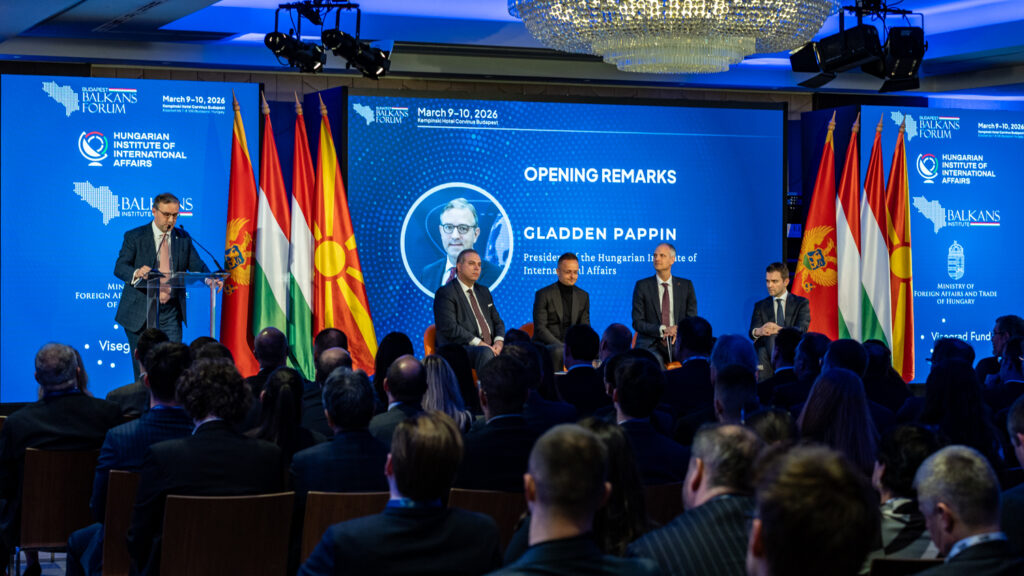
The first day of the decennial Budapest Balkans Forum was held at the Kempinski Hotel Corvinus in Budapest, Hungary on Monday, 9 March, hosted by the Hungarian Institute of International Affairs (HIIA). Gladden J Pappin, HIIA President, was first to greet those gathered with brief opening remarks.
He started by noting the 10th anniversary of the inaugural Budapest Balkans Forum, then pointed to Budapest’s emergence as a ‘core diplomatic link in the new geopolitical world order’. Mr Pappin stressed that the Hungarian capital was able to attain this status despite the fact that it used to be scolded by the big Western powers for choosing to pursue its national interest and sovereignty over the liberal order.
Mr Pappin also opined that while the liberal order had great potential and intentions at its beginning, it slowly turned into a system of certainty and arrogance, which eventually forbade the questioning of its tenets. Hungary, however, showed the world that a lawful order and economic growth can be achieved even while operating outside of the rules of the liberal order, he added.
Turning to the main topic of the day, the speaker emphasized that Hungary has long been a strong advocate for the European Union accession of Western Balkan countries—and, with that, for a strictly merit-based enlargement process within the EU as well.
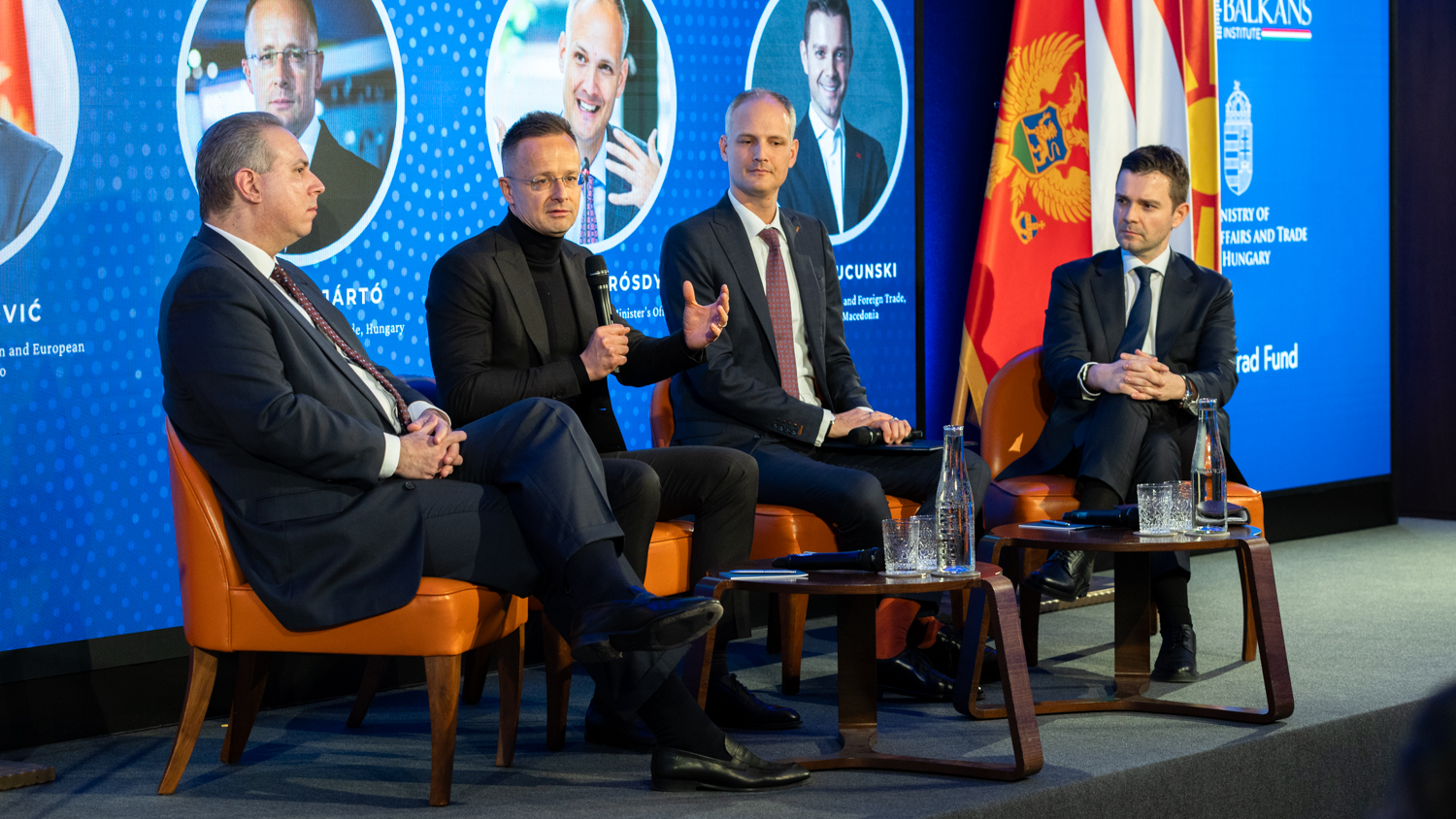
A panel discussion of four illustrious guests followed Mr Pappin’s remarks. Minister of Foreign Affairs and Trade Péter Szijjártó of Hungary, Deputy Prime Minister for Foreign and European Affairs Filip Ivanović of Montenegro, and Minister of Foreign Affairs and Foreign Trade Timcho Mucunski of the Republic of North Macedonia were featured on the panel. Márton Ugrósdy, Deputy State Secretary for the Prime Minister of Hungary’s Office, served in the role of the moderator.
Minister Szijjártó kicked off the talk by declaring that ‘the EU has lost its common sense’ because it has become ‘overideologized’. He also criticized Brussels for isolating the bloc from the United States, Russia, and China all at the same time for different ideological reasons. What’s more, because of its expectation of adhering to woke ideas and the LGBTQ agenda, Europe is increasingly distancing itself from the emerging regions of Africa and South-East Asia as well, he warned.
The Minister then told the audience that the EU needs ‘new energy’ and ‘refreshment’ in its current state, and the accession of Western Balkan nations would provide just that. As of now, the EU needs the Western Balkan countries more than the Western Balkan countries need the EU, he argued. Meanwhile, Minister Szijjártó described the proposed accelerated membership process for Ukraine simply as ‘a bad joke’.
On the timely topic of the crude oil and natural gas price hike following the US–Israel strike on Iran, Minister Szijjártó stated that the safety of energy supplies has always been a key issue for every state, which has now become even more pronounced during the Iran war. He also shared that in terms of energy transport, the Balkan countries, such as Türkiye and Serbia, have been a reliable partner to Hungary. By contrast, Ukraine has decided to cause even more disturbance by refusing to reopen the Druzhba pipeline. The Minister also called on the EU to lift the sanctions on Russian energy imports to ease the impact of the recent hikes on the commodity markets.
Deputy Minister Ivanović shared his delight at the fact that a forum dedicated specifically to the countries in the Western Balkan region is held at the capital city of an EU Member State. On the issue of his country’s EU accession, he stated that Montenegro should definitely join the EU, since ‘we are Europe, geographically, culturally, historically, in every way’; and even went as far as saying it is a ‘shame’ that his country has had to wait for this long for its membership despite its hard work.
‘Minister Szijjártó called on the EU to lift the sanctions on Russian energy imports to ease the impact of the recent hikes on the commodity markets’
Mr Ivanović also noted that Hungary has been a strong advocate in his country’s pursuit of joining the Union; and that this goal has wide support among the Montenegrin people, with about 70–80 per cent national approval according to opinion polls. He hopes that Montenegro can complete the accession process by the end of 2028.
Minister Mucunski started by sharing that he has learnt a lot from his Hungarian counterpart, Minister Szijjártó, who was one of the first foreign ministers he met for a diplomatic visit upon assuming office. He also stated that, among left-leaning people, he observed a notion that countries need to choose between pragmatism and values, with pragmatism being a morally inferior choice. However, he argued, he does not believe that is the case, and instead countries need to find a balance between the two approaches.
The speaker from North Macedonia went on to state that at this time of great volatility in the energy market, the EU and the Balkans need each other even more. He also called for a higher level of clarity on the accession process from Brussels, and stressed that EU membership should not be granted based on charity, but merit. Minister Mucunski shared that his country was willing to do a lot to become an EU Member State, including changes to its constitution and even its official name, referring to his country officially becoming the Republic of North Macedonia (as opposed to its prior name, the Republic of Macedonia) in 2019. However, he stressed, despite these concessions, his country is not willing to give up its national identity to join the European Union.
Towards the end of the discussion, Minister Szijjártó shared an inconvenient truth with his fellow panellists: according to him, the majority of EU Member States are willing to say different things to the candidate countries in the Western Balkans than to other Member States. While they may tell the aspiring new EU countries that they would love to see them join, at EU summits, they instead talk about the difficulties Western Balkan enlargement would cause for Europe, the Minister ‘tattled’.
Related articles: