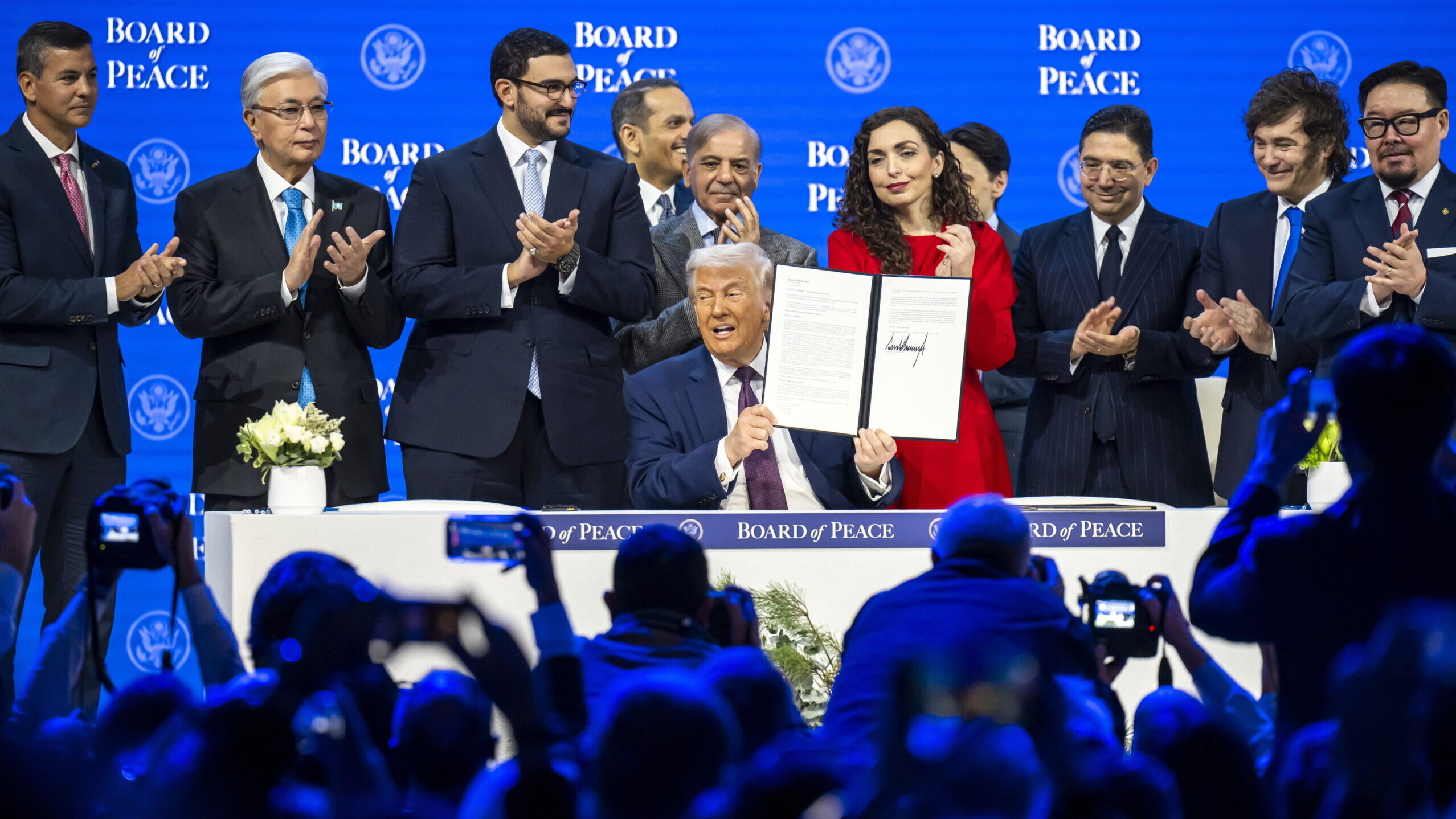
US President Donald Trump established the Board of Peace, a new international forum for conflict resolution, on 22 January in Davos, Switzerland, alongside dozens of world leaders from across the globe. Joining the Board of Peace as one of the few European founding members, Hungarian Prime Minister Viktor Orbán praised the organization as a key pillar of peace in a transforming international order, while his political director said the Board of Peace is ‘one of the first institutions’ of the new world order.
With more than two dozen countries having joined the initiative to date—including regional powerhouses such as Türkiye, Saudi Arabia, Argentina, Kazakhstan, and Azerbaijan—the declared goal of the Board of Peace is to promote stability, peace, and governance in conflict-torn regions. While its initial focus is on the Gaza Strip, the charter signals a broader global mandate.
Although several European capitals remain sceptical of the initiative—France, the United Kingdom, and others rejected Trump’s invitation—the ambition of the Board of Peace goes well beyond what is formally stated in its founding charter. In effect, Washington has created the platform to take over core conflict-resolution functions from the United Nations, while simultaneously attempting to loosen the strategic alignment between Moscow and Beijing.
For this plan to succeed, many conditions still need to fall into place. Yet Trump’s intention is clear, and given the US president’s recent foreign-policy momentum, it is far from implausible that he could score another strategic victory by driving a wedge between America’s two principal adversaries, which have grown uncomfortably close in recent years.
Exploiting the System
Donald Trump and his administration have long been openly critical of the United Nations. He has repeatedly described the organization as ‘anti-American’, slow, bloated, ineffective, and ‘structurally captured’ by adversaries of the US. Speaking at the UN General Assembly in September 2025, he argued that the UN is incapable of resolving wars, offering ‘empty words’ and written statements instead of decisive action. He also accused the organization of fuelling migration pressures on Western countries and advancing a misguided climate agenda. These criticisms translated into concrete policy in early 2026, when the United States announced its withdrawal from 66 international bodies, including 31 UN agencies and affiliated organizations.
Critics of the UN argue that the institution increasingly provides a framework for certain countries to exploit procedural mechanisms, distort its intended mission, and weaken its ability to hold states to common standards. Blocking investigations into alleged human-rights abuses, occupying influential positions within the UN Human Rights Council despite poor domestic records, and shielding allies from scrutiny are among the most frequently cited examples of how countries such as China, Iran, and—until recently—Russia have been accused of holding the UN ‘hostage’, undermining its original purpose.
‘At present, China is widely regarded as the single greatest beneficiary of the UN system’
At present, China is widely regarded as the single greatest beneficiary of the UN system. It offers Beijing three critical assets: veto power, a global moral stage, and institutional leverage. ‘China uses the UN to threaten its neighbours without firing a shot,’ geopolitical analyst Ken Cao noted in a recent video. Without the UN framework, Beijing would lose one of its most important tools for exerting regional influence.
By contrast, the institutional design and decision-making mechanism of the Board of Peace appear deliberately constructed to avoid precisely these pitfalls—namely bloc vetoes and institutional gridlock. The initiative is led by a single Chairman—Donald Trump—who holds authority over invitations, agenda-setting, interpretation of the charter, and final approval of all decisions, including a tie-breaking vote. Member states serve fixed terms, renewable at the Chairman’s discretion. A contribution of at least $1 billion within the first year allows a country to secure a permanent seat. While members vote on budgets, policies, and appointments, all decisions require the Chairman’s approval to take effect.
This highly centralized structure stands in stark contrast to the UN model. The Board’s majority-vote-plus-Chairman-approval system is explicitly designed to fast-track decisions in line with its stated mission to ‘promote stability, restore dependable governance, and secure enduring peace’.
Stress Test for Moscow and Beijing
A key question, however, is why Russia would consider joining such an organization and effectively relinquishing its veto power at the UN? The answer is simple: for Moscow, the United Nations has become largely useless since the invasion of Ukraine. Russia is routinely outvoted, its membership in the Human Rights Council has been suspended, repeated resolutions condemn its actions and demand withdrawal, and the institution has become a platform for diplomatic isolation. Even China has declined to offer consistent backing, opting instead to abstain on most Russia-related resolutions. From Vladimir Putin’s perspective, the UN is no longer neutral territory, but a hostile environment.
Participation in the Board of Peace could also offer tangible benefits to Moscow, including the potential revival of US–Russian trade and economic relations currently constrained by sanctions, but not necessarily permanently—as early-stage negotiations between Washington and Moscow in 2025 already suggested. By engaging with the institutional architecture of an emerging global order, Russia could further erode its diplomatic isolation and, crucially, reduce its strategic dependence on China.
Both Russia and China received invitations to join the Board of Peace, and their responses have been telling. Beijing stated that it remains committed to a UN-based world order, effectively rejecting the initiative—though without issuing a formal refusal.
‘From Vladimir Putin’s perspective, the UN is no longer neutral territory, but a hostile environment’
The Kremlin, by contrast, confirmed that it is studying the proposal, with President Putin instructing the foreign ministry to analyse the terms before making a final decision. Media reports have even suggested that Moscow may consider offering a $1 billion contribution, potentially drawn from Russian sovereign assets frozen in the United States, to secure a permanent seat. Russian officials have also indicated they would consult ‘strategic partners’, most likely China, before deciding.
This is where the critical ‘ifs’ emerge. If Russia joins—which would arguably be the strategically rational choice for Putin—two of the three major global powers would be inside the new framework. In that scenario, China would face a stark dilemma: remaining outside would risk marginalization, yet joining would strip Beijing of veto power, institutional privilege, and procedural leverage. Within the Board of Peace, China would be reduced to one participant among many—an outcome it clearly seeks to avoid. This would clearly represent the biggest stress test of the Russian–Chinese alliance.
Should all three major powers ultimately participate, European states would be left with little choice but to follow. In that case, the United Nations’ core function—conflict resolution and peacekeeping—would effectively be overtaken by a new institution, rendering the UN largely irrelevant in the emerging international order.
Related articles: