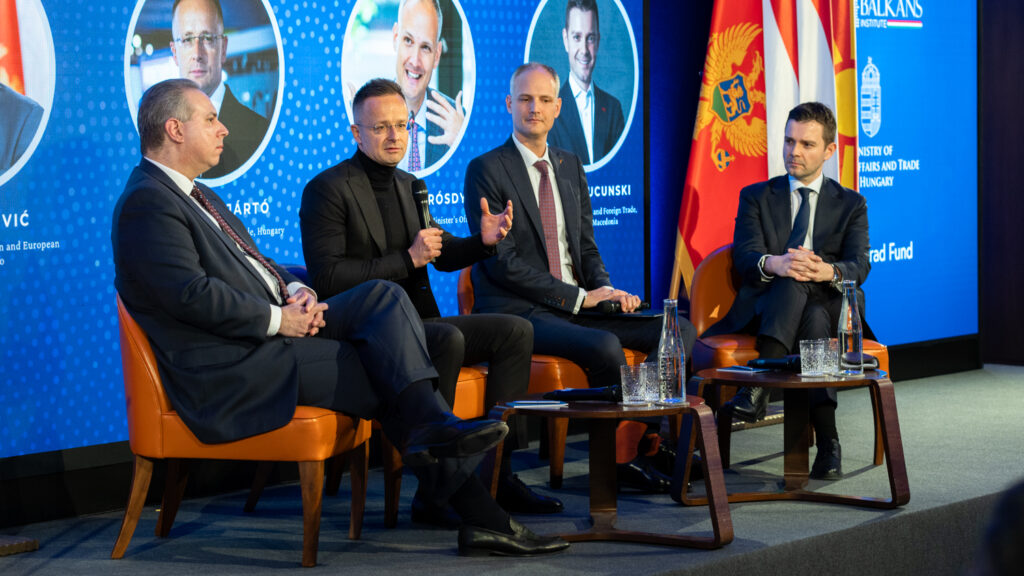
This speech was delivered by Deputy Director of the Danube Institute Gergely Dobozi at the conference A Pivotal Year: Israel, the Middle East, the US, and Europe Come 2026 on 21 January.
I agree with those who believe that a new chapter has opened in the international system of relations between states. The previous order was based on the Peace of Westphalia. That settlement established the principle that states recognize each other’s sovereignty within their own territories, together with the rule of non-interference in internal affairs. Instead of dynastic interests, the independent and sovereign interests of nation-states became the primary concern.
The Westphalian framework strengthened the concept of the territorially based state and the inviolability of its borders. And perhaps most importantly from an institutional perspective, international law became the foundation for regulating relations between states, guaranteeing the functioning of this new system. The goal at that time was to create a balance of power in which the great powers mutually checked one another, preventing the excessive rise of any single dominant power.
Today, although the starting point appears very similar, the behaviour of dominant states suggests that the gap between de jure principles and de facto realities is steadily widening in the implementation of their objectives. One major reason for this is that the originally respectable and broadly supported—essentially liberal—system was ultimately founded on the universal and equal protection of human dignity.
Over the decades, however, unchecked progressive trends have demonstrated that certain social groups, unilaterally labelled as ‘vulnerable’, have come to enjoy priority over others. ‘We will protect those we choose, and the rest can take care of themselves’—this cynical attitude has, unsurprisingly, had consequences.
The result is a new era that an increasing number of observers describe as the age of nations. More and more states are choosing to withdraw from various institutional frameworks—or at least to challenge how those institutions currently operate—and some are even proposing the creation of entirely new ones.
‘Sovereignty matters. States want to shape international processes, not merely submit to them’
From this, several conclusions can be drawn. Sovereignty matters. States want to shape international processes, not merely submit to them. Instead of judicial activism, democratically elected political forces should prevail. And finally, the importance of bilateral diplomacy simply cannot be overstated.
This old-new era is fertile ground for both opportunities and dangers. Hungary’s experience offers a particularly clear illustration of this duality.
Recognizing these trends, Hungarian foreign policy decision-makers have pursued the consistent implementation of a strategy of connectivity over the past 16 years. The foundation of this approach is the conviction that Hungarian interests come first, and that defending them may require accepting necessary conflicts.
Despite scepticism and criticism rooted in mainstream thinking, this strategy now appears to be bearing fruit. One very concrete example illustrates this well: following the pandemic, in the midst of the Russo-Ukrainian war, and despite the continuously obstructive attitude of European Union bureaucracy, a Hungarian multinational company emerged victorious among American, Russian, Chinese, and Gulf-based competitors.
Now let us turn to the dangers.
The European Union—despite bearing little resemblance today to the organization Hungary joined as a member state—remains one of the continent’s most successful peace projects. Since the creation of its predecessors, there has been no armed conflict between EU member states.
At the same time, the Balkan wars and the Russo-Ukrainian conflict serve as reminders that peace is not automatic.
Meanwhile, economic crises, migration pressures, and disputes over the rule of law demonstrate that the EU’s internal functioning is far from conflict-free. Brexit should serve as a warning to everyone.
‘Connectivity, bilateral diplomacy, and the firm representation of national interests are not acts of isolation, but tools for survival and success’
In conclusion, the transformation of the international order is neither theoretical nor distant—it is already shaping political, economic, and security decisions across the globe. The age of nations is not a rejection of cooperation, but a demand that cooperation be grounded in mutual respect, sovereignty, and democratic legitimacy.
For Hungary, this moment requires realism rather than illusion; courage rather than conformity. Connectivity, bilateral diplomacy, and the firm representation of national interests are not acts of isolation, but tools for survival and success in an increasingly fragmented world.
At the European level, the choice is equally clear. The European Union can either adapt to this new reality or risk deepening internal divisions that weaken the entire continent.
The coming years will therefore not be about returning to the past, but about shaping a stable future—one in which nations remain the cornerstone of international order, cooperation remains possible without coercion, and Europe remains strong precisely because it respects the sovereignty of its members.
Read more from the event: