Christmas has been a great holiday in Christian culture for generations, closing the calendar year as a time when we temporarily step out of profane, busy life to share precious moments with our loved ones, give each other gifts, rejoice, and love one another—in other words, it is a bit like the ‘Sabbath’ of Christians.
The holiday is not closely related to Jesus’ own Jewish tradition or to the Old Testament holidays he also observed, and it is not a Christian holiday in terms of its origin: it derives from the pagan Sun anniversary of 25 December, the festival called dies solis invicti nati, which was once popular in the Roman Empire and was Christianized from the 4th century onward by imperial intention, as Christianity became the state religion. From then on, it was celebrated as a commemoration of the birth of Jesus.
For around 1,700 years now, the Christian tradition has regarded it as its own holy festival. Some consider it primarily a holiday of family and love, while others, based on its religious content, celebrate the birth of Jesus. And if it is a birthday, then it is appropriate that those who commemorate it know who the subject of that birthday is—what he did, what he said, what our relationship is with him, and why we remember him. For this purpose, I would like to remind ourselves of some biblical facts concerning Jesus’ birth and his personality.
The Circumstances of Jesus’ Birth
Date of Birth:
Today, almost all countries in the world use the Gregorian calendar, a universal system established by a 16th-century reform that counts years from the birth of Jesus (‘Anno Domini’). Yet paradoxically, this designated origin does not correspond to the actual date of Jesus’ birth.
According to the Bible, a census was conducted in the Roman Empire at the time of Jesus’ birth, and by decree of Emperor Augustus, all residents had to register with the Roman authorities in their town of origin. The Bible also notes that in that year, Herod was ruler of Iudaea, and Quirinius was the Roman governor of the province of Syria (which included Iudaea). Since Augustus records in his autobiography that only three censuses were taken during his reign, these details together correspond to a single event: the apographe, which took place in 8 BC.
Joseph travelled with his newly married, pregnant wife from their residence in Nazareth, Galilee, to Bethlehem in Judea, his hometown. While they were there, Mary’s pregnancy came to term, and their son, Jesus, was born. Since the Roman census required residents to register in person with the authorities, it is highly unlikely that the entire process—which spanned several months and involved the movement of millions of people—took place in winter. This is further supported by the biblical note that shepherds were grazing their flocks in the surrounding hills at the time, which would have been unusual in Judea’s Mediterranean winter.
‘These details together correspond to a single event: the apographe, which took place in 8 BC’
Jesus could therefore have been born 7–8 years before the date assigned to his birth in the Middle Ages. The event almost certainly did not occur in winter, and thus did not take place on 25 December.
Another temporal reference to Jesus’ birth comes from the Bible: John the Baptist’s father, Zechariah, was performing his regular priestly duty of offering incense in the Temple in Jerusalem when the angel Gabriel appeared to him, announcing that despite their old age and many years of waiting, he and his wife, Elizabeth, would miraculously have a son in nine months. The 24 families of the Aaronic priesthood served in weekly shifts according to a specific order; according to the First Book of Chronicles, the service of the Abijah family fell in the fourth month of the year, making Zechariah’s turn traceable. Comparing these two biblical time references, the event could have occurred in the late spring of 9 BC.
Six months after the conception—that is, at the end of that year—the angel Gabriel appeared again, this time to Mary in Nazareth, a relative of Elizabeth (traditionally, her cousin). He delivered a similar message: she would conceive a child, not by her husband Joseph, but by the Holy Spirit, for the son to be born would be the Messiah promised to Israel by the prophets of old.
According to these calculations, theologians generally conclude that John was born in the spring of 8 BC, on one of the Jewish spring festivals, perhaps Passover (Pesach), while Jesus (John’s second cousin) was born about six months later, possibly on another major holiday in the autumn festival cycle, the Feast of Tabernacles (Sukkot). This is supported by the fact that his parents could not find accommodation in the Bethlehem area. Sukkot was one of the three great pilgrimage festivals during which all Jewish men were required, according to the Torah, to journey to the Temple in Jerusalem to offer sacrifices to God. These were mass religious events attended by millions, and at such times, lodgings in the surrounding settlements were fully occupied. Additionally, the census ‘migration’ mentioned above may have occurred concurrently in that year.
‘Jesus (John’s second cousin) was born about six months later, possibly on another major holiday in the autumn festival cycle, the Feast of Tabernacles (Sukkot)’
Place of Birth:
Jesus’ natural birthplace would have been Nazareth in Galilee, where his father, Joseph, and his fiancée, Mary, lived. From the biblical text, we know that after Jesus was conceived in Mary’s womb and she learned from the angel that her relative, Elizabeth, was also supernaturally pregnant, the young Jewish lady immediately set out to visit the priestly couple in their house in the ‘Judean hills’ and stayed with them for three months, only returning to Nazareth before Elizabeth’s impending birth.
Six months later, nine months pregnant, she and her husband had to return to Judea only because the emperor’s decree required personal registration in the general census, the Roman authorities personally registering the inhabitants in the town of origin of their ancestors. Joseph was from the tribe of Judah and had to travel to Bethlehem in Judea—a 150-kilometre journey, which was calculated to take them at least five to six days to complete due to his wife’s advanced pregnancy.
They finally arrived in Bethlehem, but due to the pilgrims and the census crowds, they were unable to find a guest room (which also means that Joseph no longer had relatives living in the town who could have helped with their accommodation). However, the birth began, so Mary was forced to give birth to her son in a nearby barn.
‘A 150-kilometre journey, which was calculated to take them at least five to six days to complete due to his wife’s advanced pregnancy’
Circumstances of His Birth:
– The first important circumstance is that Mary was not yet Joseph’s wife when she conceived her child. This was problematic for the religious Jewish groom for two reasons. Firstly, according to moral rules, the child should have been conceived only as the fruit of married life that began after the wedding. Secondly, since the two young people adhered to these rules—that is, there had been no sexual intercourse between them during their engagement—Mary was theoretically a virgin. Joseph could therefore have been certain that Mary had committed a serious offence against him and against God: she had become pregnant by another man. Joseph’s character is precisely shown in the way he reacted to this. He did not make a scandal, did not denounce his bride, and in fact did not want to disgrace her, so he decided to break off the engagement secretly, causing the least harm to her.
But then a turning point occurred: an angel appeared to him in a dream, telling him that Mary had not broken her engagement, that she had not had a relationship with anyone, and that instead a miracle had taken place, one that would happen only once in human history and that the ancient prophets of Israel had foretold: the Son of God Almighty would be born in the flesh through a woman, to suffer as a man and redeem his people. Just as Mary had done a little earlier, Joseph now believed the angelic declaration and, accepting the shame caused by the rumours—it must have been obvious to outsiders that Mary had become pregnant out of wedlock—took her as his wife. In fact, he did not have sexual relations with her until the child, conceived in a holy way, was born.
– Jesus was born in difficult circumstances: he was cared for among the domestic animals in the stable in Bethlehem, wrapped in swaddling clothes, and laid in one of the troughs used to water the animals.
– Several people learned of the child’s birth in a supernatural way: an angel appeared to shepherds who were grazing their flocks nearby under the open sky, informing them that the Messiah of Israel had been born in Bethlehem. The men immediately went to visit the family and praised God for the miracle.
– Scholars from Eastern countries (Babylon, Persia), skilled in astrology, occultism, and the study of the Torah and the Jewish prophetic writings—especially the Book of Daniel—arrived in Jerusalem, where they also consulted King Herod, because a bright star had indicated to them the birth of the ‘King of the Jews’. The star then led them to Bethlehem, where, having found the infant Jesus, they worshipped him and returned home without informing Herod.
A miracle occurred that would happen only once in human history, as the ancient prophets of Israel had foretold: the Son of God Almighty would be born in the flesh through a woman.
– Jerusalem was in an uproar over the news of the arrival of the wise men from the East, and Herod learned from the high priests and professional scholars of the Scriptures that, according to the prophecies, the baby was to be born in Bethlehem—that is, he should search for him there.
– After a few weeks of waiting, Herod realized that the wise men from the East had deliberately left without informing him of the baby’s whereabouts. In his anger, he sent soldiers to Bethlehem, who, on his orders, killed all the boys under two years old in and around the town.
– At the same time, Joseph, who had returned home to Nazareth with his family, received a warning in a dream from an angel about Herod’s intentions. Following this heavenly guidance, he temporarily fled to Egypt with his family.
What Do We Know about Jesus’ Childhood?
Jesus’ parents raised him according to the regulations of contemporary Judaism. This is shown by the fact that on the eighth day after his birth he was circumcized in accordance with the Law of Moses. Later, they made an annual pilgrimage to Jerusalem for the Passover holiday, and after the 40-day period of purification prescribed in the Torah following childbirth, Joseph and Mary also travelled to Jerusalem to offer a sacrifice to God in the Temple in gratitude for the life of their firstborn child, in accordance with the Law. At that time, two remarkable events also occurred: an elderly Jewish believer named Simeon prophetically recognized the Messiah in the baby, and an elderly prophetess named Anna similarly received a revelation that this child was the Saviour promised by the prophets.
It may have been around this same time that the family, returning to Nazareth, received a warning from an angel about the danger to their lives. Jesus could not have been more than two months old when his family was forced to flee to Egypt. The Bible does not specify where they lived, but historical records show that Alexandria was home to a large and diverse Jewish community at the time, so if Joseph and his family wished to remain out of the spotlight, this ancient metropolis would have been a suitable place to hide.
They only returned to Galilee after Herod’s death in 4 BC, which means that Jesus lived in Egypt until he was about four years old. They returned to Galilee because, after Herod’s death, his son Archelaus—known for his cruelty—ruled Judea and Samaria, and the family wished to avoid further trouble. Galilee proved to be a more peaceful province.
‘They only returned to Galilee after Herod’s death in 4 BC, which means that Jesus lived in Egypt until he was about four years old’
According to the Holy Scriptures, Jesus was raised in the city of Nazareth, but the text provides no further details. It only notes that the child developed well both physically and in wisdom, was strong ‘in spirit’, obedient to his parents, that ‘God’s grace was upon him’, and that he ‘was in favour with both God and men’.
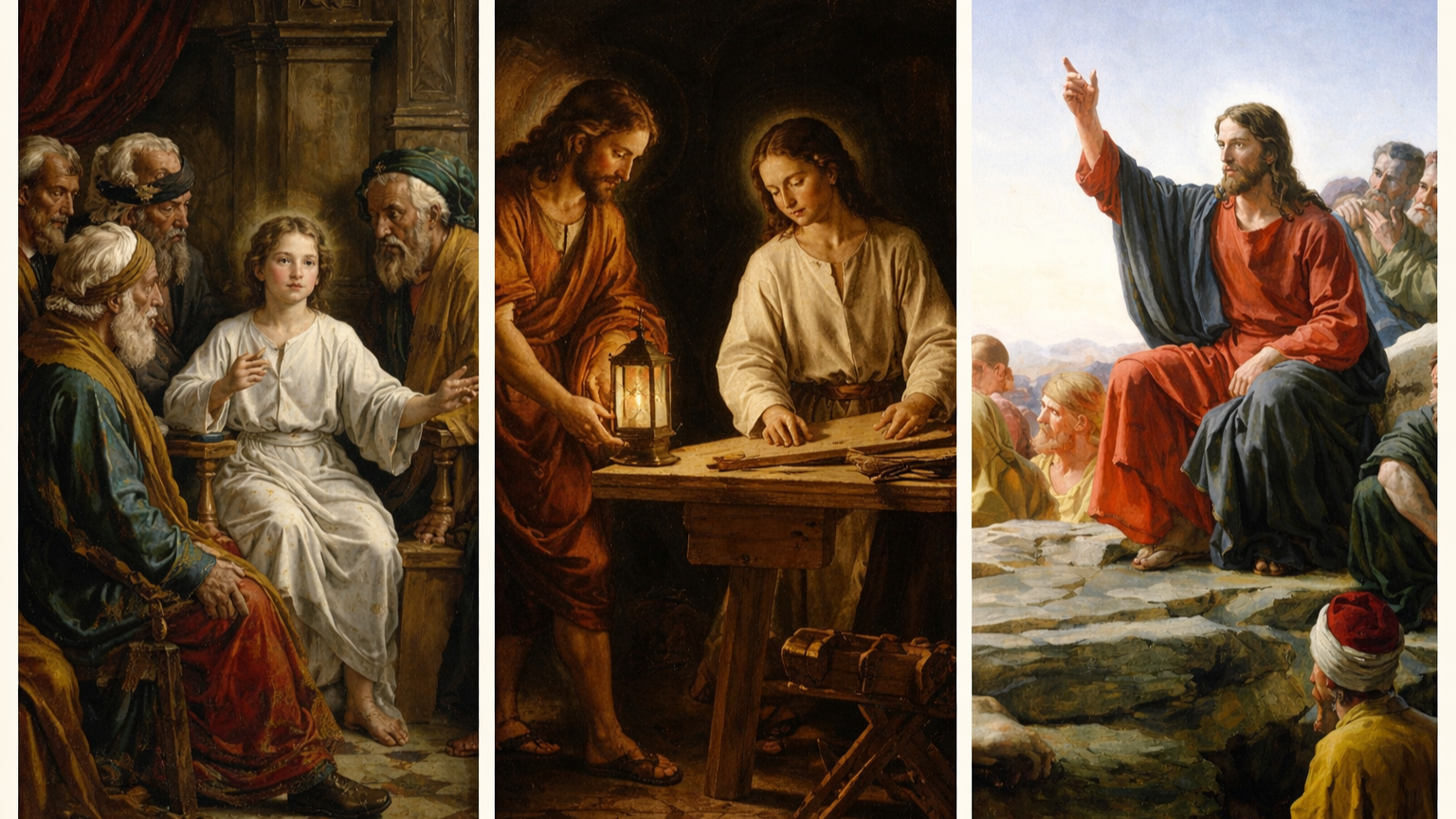
However, the Scriptures reveal an interesting story, which can be dated to the time of Jesus’ ritual coming of age, his bar mitzvah. According to the text, at the age of 12 he and his parents went up to Jerusalem for a pilgrimage festival—based on the text, this may have been the Sukkot festival in 5 AD or the Passover festival in 6 AD. After the festival, they travelled home with relatives and acquaintances in the crowd, and it was only hours later that his parents noticed their son was not among them, and they did not know where Jesus was. Joseph and his family immediately returned to Jerusalem to look for him.
They finally found him in the Temple after three days of searching. There, the scribes and rabbis who were debating and analysing were amazed at how much a 12-year-old boy could understand about the Scriptures. To his mother’s rebuking words, Jesus replied: ‘Why were you looking for me? Did you not know that I must be about my Father’s business?’ His mother took note of these words, as since his conception she and her husband had clearly remembered the declaration that their son would be the Messiah of the Jews. This temple scene nevertheless highlights that his parents were probably not always able to fully accept this due to their concern, while also showing that Jesus already knew he was the Messiah at the threshold of adulthood, at the age of 12.
Joseph and Mary had several children after Jesus was born, and the names of his younger brothers are given in Mark 6:3: James, Joseph, Jude, and Simon. The text also refers to several sisters, though they are not named. His brothers did not initially believe in Jesus’ messiahship, but they joined the disciples immediately after his death and resurrection, as indicated in Acts 1:14. Having become followers of the Messiah, James and Jude later wrote apostolic letters included in the canon of Scripture, and James became a highly respected leader of the central congregation in Jerusalem.
‘Jesus already knew he was the Messiah at the threshold of adulthood, at the age of 12’
From the passage in Mark’s Gospel quoted above, we also know that Jesus was known to his local contemporaries as a carpenter, just like his father (Matthew 13:55). This means he learned the trade alongside his father and worked at it throughout his adult life, presumably until he began his public ministry as a preacher.
This likely occurred in the spring of 29 AD. We can estimate the date because the Bible (Luke 3:1–2) specifies the appearance of John the Baptist, naming the 15th year of the reign of Emperor Tiberius, which corresponds to the second half of 28 AD and the first half of 29 AD. According to the text, Jesus, claiming to be the Son of God, first publicly appeared in Jerusalem at a Passover feast, which could have taken place in the spring of 29 AD.
Looking back at the sequence of events: a few days before the ominous Passover, Jesus performed his first miracle in Cana of Galilee, turning a large quantity of water into wine at a wedding—six jars, each containing 100 litres of water, used for washing hands. By this time, he already had his first disciples with him, whom he had called to follow him a little earlier, having moved from Nazareth to the shores of the Sea of Galilee. Among these disciples were the sons of Zebedee, James and John, who were also the sons of his mother’s sister, Salome—that is, his cousins. But before all this, he went to John the Baptist, was baptized in the Jordan River, and spent 40 days in the wilderness to confront Satan and gather strength for his three-year ministry.
‘Jesus, claiming to be the Son of God, first publicly appeared in Jerusalem at a Passover feast, which could have taken place in the spring of 29 AD’
According to the Gospels, Jesus was then in his thirties (Luke 3:23). Based on our calculations, he would have been 36 years old. Just three years later, in the spring of 32 AD, during the Passover holiday, he was arrested, sentenced, and executed. According to the average lifespan of the time, Jesus was already a man in his prime—more likely middle-aged—at an age when, according to contemporary Greek philosophers, a man had already experienced all that was important in life and undergone the key experiences that shape one’s destiny.
What Does the Holy Scripture Say about the Divine and Physical Nature of Jesus?
Jesus himself, the prophets, and other contemporary authors of the Holy Scriptures all claim something about Jesus that had never been claimed about any human before—and never since: that he is equal with God in his essential nature. He is the second person of the Holy Trinity, the Son of God and the Saviour of humanity, the Christ, who by the Father’s commission and through the mediation of the Holy Spirit was conceived in the womb of a holy woman, Mary, with her consent, developed, was born, and thus truly became a man.
Moreover, he not only took on a human body, but in body, soul, spirit, and full humanity experienced all the troubles, spiritual shocks, physical illnesses, limitations, weaknesses, pains, and metaphysical fears of human destiny. He lived as an ordinary—yet exceptional—Jew until the age of 36, and then for three years, as a miracle-working rabbi and preacher, he travelled throughout much of Israel. At the age of 39, he was arrested by the Sanhedrin, and at its request the Roman authorities sentenced him to death and executed him.
The message of the Gospel is that three days later—as he had foretold—he rose from the dead. Death could not hold him, for he had lived his entire 39 years on earth without committing any sin. For this reason, he was able to fulfil the role of Saviour: he died not for his own sins, but for the sins of all, paying the ransom for humanity.
‘Death could not hold him, for he had lived his entire 39 years on earth without committing any sin’
‘I and the Father are one,’ Jesus stated in one of his sermons. The apostle John begins his Gospel with this thought: ‘In the beginning was the Word, and the Word was with God, and the Word was God…And the Word became flesh and dwelt among us (and we saw his glory, the glory as of the only begotten of the Father), full of grace and truth’ (John 1:1 + 14). The most beloved disciple, the eyewitness, continues quoting the Master: ‘If I do these things, though you do not believe me, believe the works: that you may know and believe that the Father is in me, and I in him’ (John 10:38); or: ‘Jesus said to her, I am the resurrection and the life: he who believes in me, though he were dead, yet shall he live’ (John 11:25).
The apostle Paul writes about Christ: ‘Who is the reflection of his glory and the exact representation of his person, and who upholds all things by the word of his power, and who, when he had purified us from our sins, sat down at the right hand of the Majesty on high’ (Hebrews 1:2), or in another letter: ‘Who is the image of the invisible God, the firstborn of all creation; for in him all things were created, in heaven and on earth’ (Colossians 1:15–16).
Some verses describe the divine, Christlike nature of Jesus, but the Holy Scriptures also reveal much about his physical lineage. In two Gospels, they present a long genealogy of his ancestors all the way back to Adam and Abraham. Both genealogies show that Jesus’ ancestors included prominent Jewish figures, and that the Messiah was of Jewish ethnic origin.
Matthew’s Gospel was written primarily for a Jewish audience, presenting Jesus as the King of the Jews, a descendant of Abraham and the son of David. Since paternal descent was still the legal order of inheritance in first-century Judaism, Matthew lists the ancestors of Jesus’ father, Joseph, even though Jesus was not Joseph’s son by blood. From a halachic perspective, however, he was considered Joseph’s son.
‘Jesus’ ancestors included prominent Jewish figures, and…the Messiah was of Jewish ethnic origin’
Luke intended his writing primarily for Christians from a pagan background, and in this spirit he portrays Jesus as the Saviour of the world—that is, of all people. The genealogy itself extends beyond the origin of the Jews from Abraham and goes all the way back to the ancestor of all humanity, Adam. The Gospel lists Mary’s ancestors, showing the real bloodline of Jesus—the people from whom he inherited his human nature and genetic endowments. He came from the tribe of Judah and was a direct descendant of David. And he remains so, for in this body he was resurrected, and in this resurrected, transubstantiated body the Son ascended to Heaven and sat down at the right hand of the Father, God Almighty.
Related articles: