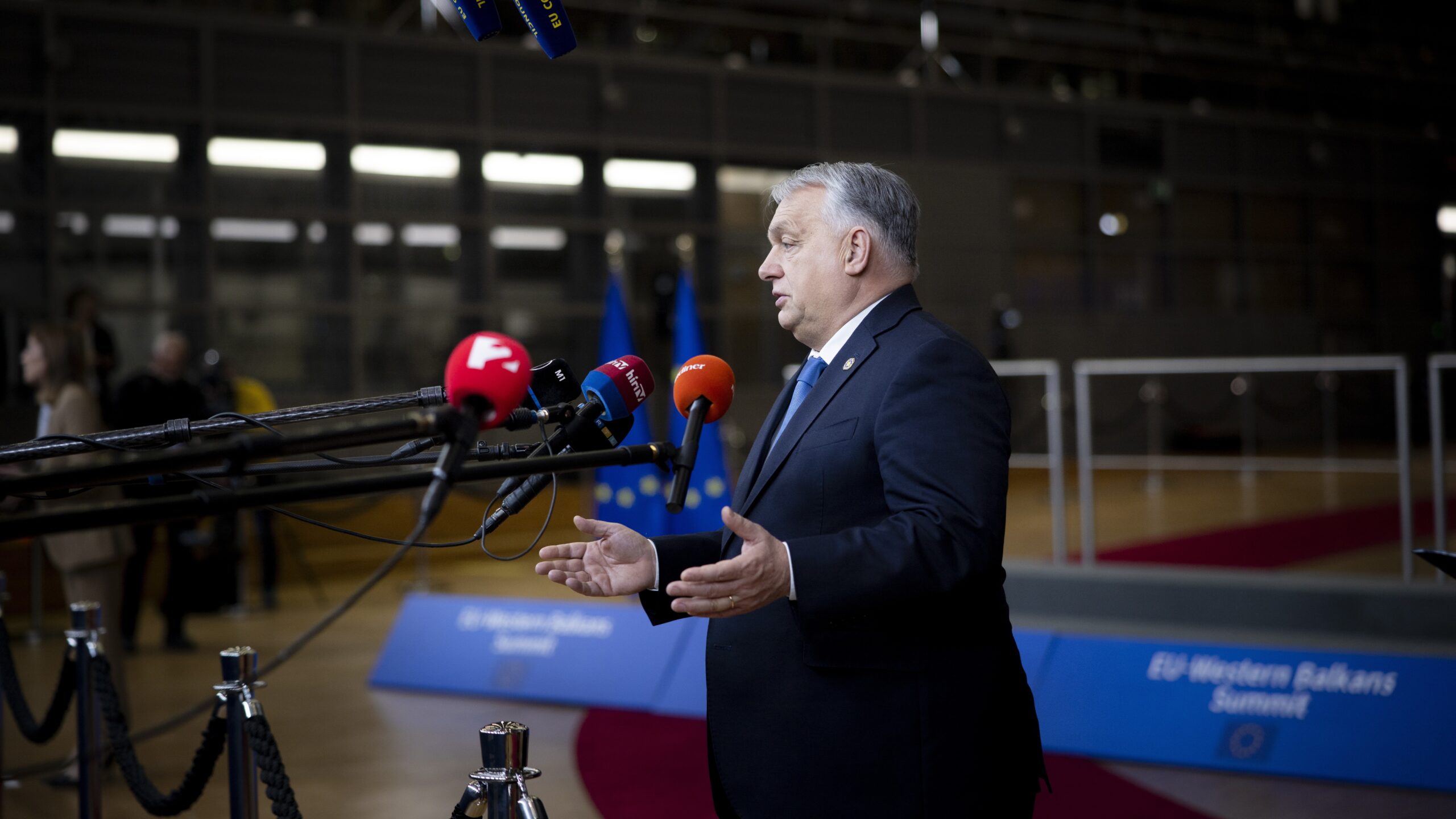
Prime Minister Viktor Orbán said the European Union has entered a ‘highly dangerous path’ by circumventing the requirement of unanimous decisions on measures related to frozen Russian assets, which had previously required renewal by consensus every six months.
Speaking in Brussels on Wednesday after a meeting of the Patriots political group, Orbán argued that member states were sidelined and established procedures were deliberately weakened. Replacing unanimity with majority voting in this case, he said, amounted to a historic mistake.
According to the prime minister, the move constitutes a clear legal violation, as it relies on a provision of the EU treaties that is unrelated to the situation. He added that such a legal interpretation would not withstand scrutiny in court.
Orbán warned that abandoning consensus is increasingly being considered in other areas as well, including the handling of Russian assets and joint EU borrowing. He said this could have far-reaching consequences by creating a precedent for bypassing member states altogether.
He stressed that using frozen Russian assets to finance Ukraine would effectively be a declaration of war. In his view, confiscating more than 200 billion euros from one belligerent and transferring it to the other would amount to a third party directly entering the conflict.
‘Using frozen Russian assets to finance Ukraine would effectively be a declaration of war’
Orbán called for what he described as a complete reversal of the EU’s current strategy, urging the bloc to abandon what he sees as a war-supporting approach and shift toward a peace-oriented policy. He argued that this could best be achieved by aligning with the president of the United States and supporting efforts aimed at ending the conflict.
Based on informal consultations, Orbán said the proposal on frozen Russian assets may be taken off the agenda. However, he noted that alternative ideas, including joint EU borrowing to finance the war, have emerged, which Hungary considers unacceptable. He reiterated his position that war is costly while peace is not, adding that people die in war, not in peace.
The prime minister compared the issue to the EU-Mercosur trade agreement, claiming Brussels intends to finalize it by sidestepping national decision-making rights. He described this as a form of conspiracy and warned that similar practices could be repeated in other policy areas and against other member states unless firmly stopped.
Orbán also criticized Europe’s attempt to disengage from Russian energy, calling it a failure. While supporting diversification and the expansion of energy sources, he said Europe’s goal should be to rely on multiple suppliers rather than cutting off specific ones. He emphasized that Hungary will never accept mandatory separation from any energy source, calling such measures economically irrational and contrary to national interests.
He added that Hungary is no longer only an energy buyer but is also acquiring oil and gas fields through state and private companies, a strategy the government intends to continue.
Turning to EU leadership, Orbán accused current EU institutions of committing several historical mistakes, some of which he said verge on criminal responsibility. He listed the chaotic implementation of the green transition, support for migration, and the war as major errors that have undermined Europe’s competitiveness.
Finally, commenting on new Slovak legislation linked to the Beneš decrees, Orbán said clarification talks are needed to understand the law’s exact meaning. He noted that certain formulations are not interpretable under Hungarian law and stressed that Hungary remains in close contact with the Hungarian community in Slovakia. Further steps, including talks with Slovak Prime Minister Robert Fico, will depend on the outcome of these discussions.
Related articles: