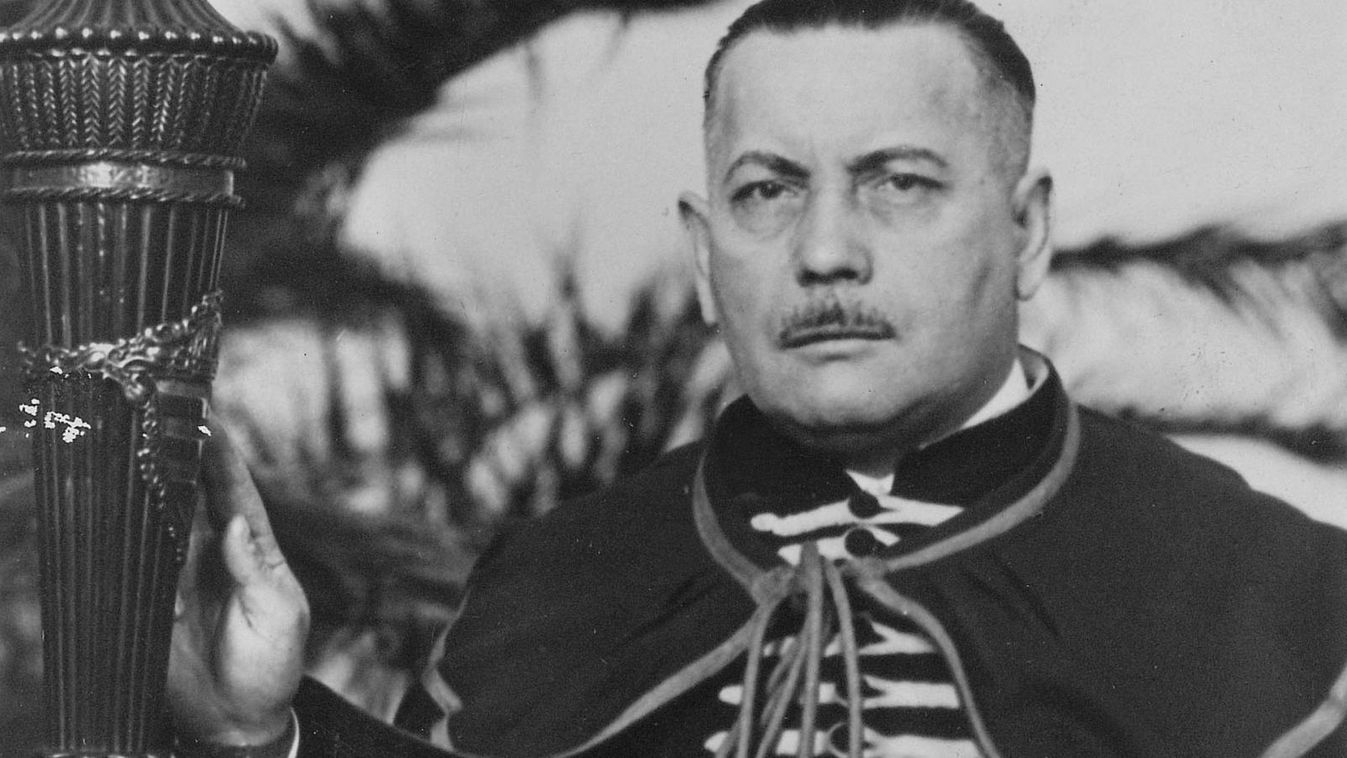
About whom, exactly?—the reader might well ask. And indeed, at first glance even historians may hesitate to recall who Kálmán Rátz was, the subject of historian Ákos Bartha’s new book,1 published under the auspices of the Committee of National Remembrance (NEB). Yet Rátz was present at several significant political and cultural moments of 20th-century Hungarian history, even if he was never a central figure—merely a figure. But a decidedly interesting one.
A vivid example is in the martyred Jewish poet Miklós Radnóti’s diary entry from 3 May 1942 about the funeral of the famous Attila József, where he noted that Rátz was the chess partner of the deceased and that he was present at József’s funeral with his ‘Arrow Cross men’.
It is a fact that if there are enigmatic figures in 20th-century Hungarian history, Kálmán Rátz is certainly among them. The army officer, born in Komárom, endured Russian captivity during the First World War, from which he successfully escaped. In February 1919 he was arrested in Budapest as a counter-revolutionary and was not released until the end of the short-lived Communist dictatorship. Afterwards he became a commander of a paramilitary detachment, and in the early 1930s he was the one who inspired the aforementioned Attila József’s notorious manuscript titled ‘National Socialism’–later treated as a mere ‘misstep’ by most scholars of Hungarian literature.
Rátz later became an insider to Gyula Gömbös, the prime minister who had emerged from the ‘racist movement’ (fajvédők), while at the same time being counted among the members of József Madzsar’s table society—the group around the man who was de facto leading the illegal Communist Party. He passed through the ranks of the governing party, later appeared among the Arrow Cross, and eventually founded his own ‘National Socialist’ party, which, starting from the far right, became within a few years the most distinctly left-wing legal political formation in Hungary.
In its eccentricity, his party went as far as establishing contact with the Zionist movement as well. It is questionable how sincerely Rátz revised his earlier, vehement antisemitism, but the fact remains that in February 1944 his newspaper, A Holnap, called the far-right ‘madmen’. ‘He was the first to take a stand for the far-left working class and for working Jews, for the labour servicemen,’ a Jewish witness testified about him after the war. ‘The Zionist idea is indeed beautiful and understandable,’ the ‘National Socialist’ representative Rátz once declared in Parliament—surprising, perhaps, but still fitting into a tradition, since the well-known antisemites Győző Istóczy, Ottokár Prohászka, and even Dezső Szabó had voiced similar views before him. Their logic was primitive: the Zionists wanted to leave Europe for Palestine while the antisemites wanted the Jews out too. Their causes seemed to align for a brief moment.
‘Their logic was primitive: the Zionists wanted to leave Europe for Palestine while the antisemites wanted the Jews out too’
One of the most important and disputed questions concerning Rátz’s biography is how he was able to get out of the Mauthausen concentration camp after the German occupation—after the Gestapo had taken him from his apartment at 9 Szemere Street, Budapest. Contrary to popular belief, it was possible to be released from the camps—though primarily for non-Jewish prisoners. To do so, a prisoner had to submit an official request stating that he had become convinced of the ‘truth’ of National Socialism and wished to become a useful member of society. Of course, it also helped greatly if the prisoner was German, if his family had political connections, or if money was paid. It is known, for example, that the Hungarian politician of German ancestry, Gusztáv Gratz was also released from a camp.
How did Rátz get out? He told everyone that he had been released because of poor health. However, the Auschwitz Museum’s website makes two points very clear: poor health was not grounds for release; in fact, sick prisoners were deliberately not released so they would not create a bad impression of the camps. Poor health argued against release—the site states. It also makes clear that the Gestapo did not release its agents: ‘In contrast to opinions sometimes expressed, informants were never released—as a reward for submitting denunciations. Although the Political Department had “spies” operating in the camp, it is unknown of any case of release of them; such a person could only enjoy certain privileges, be assigned to a good work group or sleep in a block for German functionaries. The camp Gestapo officers acted pragmatically in this regard, as they wanted to keep such people in the camp as useful, proven agents.’
No one, it should be said, specifically accused Rátz of denouncing anyone inside the camp. But even his partner admitted that ‘she herself secured her beloved’s release through her relationship with the wife of a Gestapo officer, to whom she “did favours”.’
It does not seem likely that they would have wanted to use Rátz as an operative inside the camp; if anything, his political connections were probably far more useful, since he not only knew the illegal Communist movement well, but was also trusted in the circles around Governor Miklós Horthy. According to his own account, he ended up in a ‘prison hospital’ in Budapest and ‘escaped’ from there, but did not go into hiding, since after the appointment of the Lakatos government in late August 1944, he, Gyula Kovách, and others were discussing their future in his apartment. The known resistor and state secretary Miklós Mester proposed Rátz as a member of the first official Hungarian delegation to Moscow, which was to negotiate the armistice.
‘He can only be regarded as a figure who arouses suspicion of being an agent in the story of Hungary’s attempt to exit the war’
Rátz allegedly refused, but he was nevertheless allowed to attend a small, secret meeting on 19 September, where preparations for the armistice were underway. Horthy personally negotiated the details of the delegation with him, yet in the end Rátz cancelled the whole thing: at one point he said he had been denounced, while others believed he withdrew because of an operation. It is a thoroughly contradictory story, and for now nothing definite can be said—perhaps he was a German agent, perhaps not. It does not seem likely that he was really released from Mauthausen due to poor health, but in the absence of evidence he can only be regarded as a figure who arouses suspicion of being an agent in the story of Hungary’s attempt to exit the war.
All in all, Bartha’s volume provides a good portrait of the retired hussar major known for his penchant for intrigue, who at the height of the Second World War delivered the boldest anti-war speeches in the Hungarian Parliament, and about whom people later whispered that he had operated as ‘the most skilled and most dangerous special agent of the Horthy regime’.
- Bartha Ákos, Egy magyar nemzeti szocialista. Rátz Kálmán tündöklése és bukása [A Hungarian National Socialist: The Rise and Fall of Kálmán Rátz], Nemzeti Emlékezet Bizottsága, 2025, 275 pages. ↩︎
Related articles: