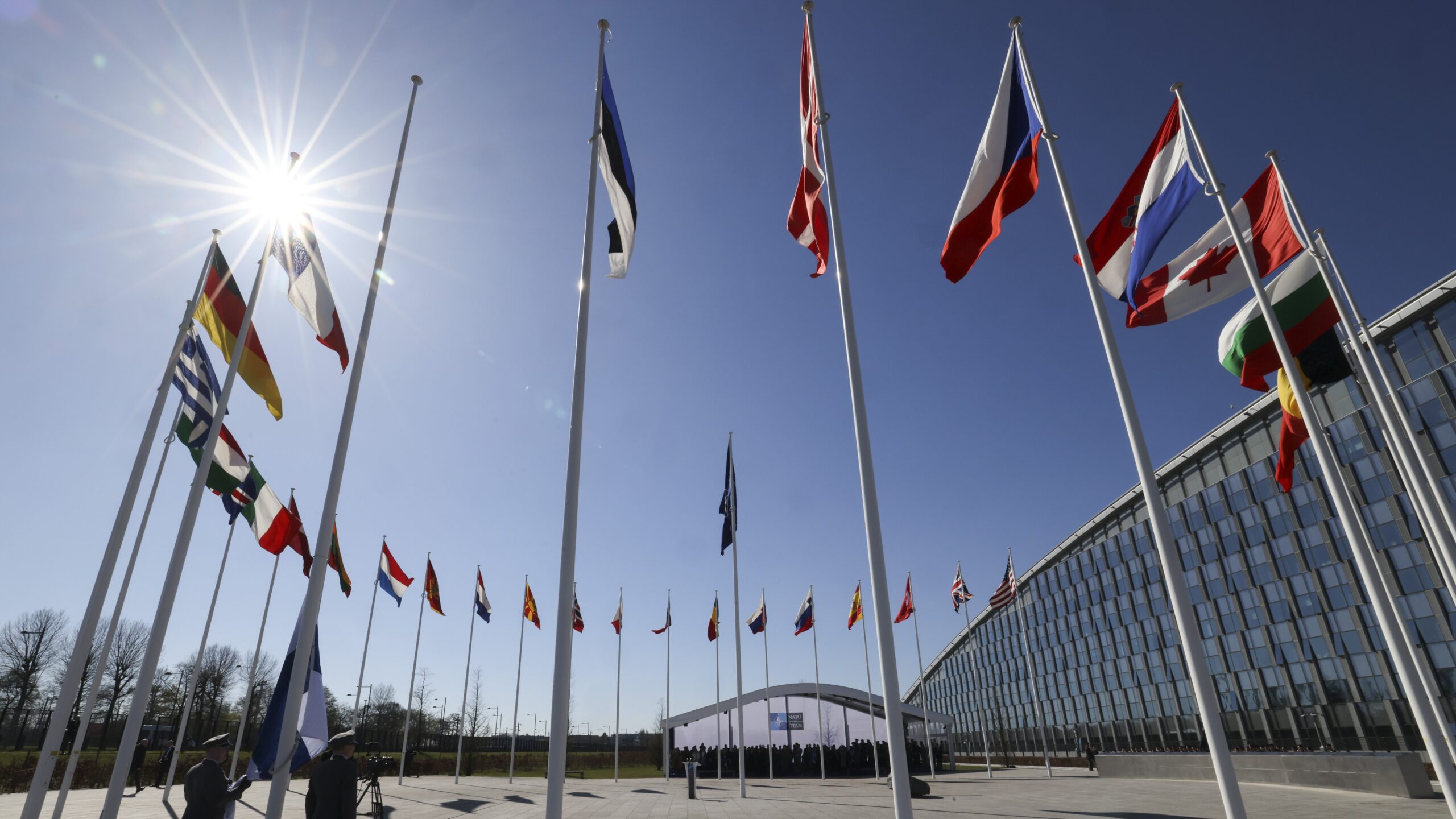
As the Trump administration brings the war in Ukraine to a close, members of the NATO alliance are going to start asking some tough questions. Ukraine itself was never in NATO, of course—indeed, the war was in part fought over the question of Ukraine joining the alliance. Nevertheless, many NATO members, especially in Eastern Europe, came to view the conflict as a test of NATO’s resilience, and although they will be reluctant to admit it publicly for some time, NATO failed that test.
Within the Armed Forces of Ukraine (AFU), NATO effectively had a highly capable proxy military. Although the AFU was unable to defeat the Russian armed forces, it was not for lack of effort: no one doubts the determination and bravery of Ukrainian troops. Europe and the United States supplied the AFU with as many armaments as they were able to provide. This support meant that, at least in the short run and absent mass conscription or a conversion of European industry to a full war footing—if such a conversion were even possible—the AFU came close to representing the strongest army NATO could field in the European theatre. Even so, this army ultimately failed to achieve victory, and it is only a matter of time before NATO members are forced to confront this reality.
On top of this, evidence is starting to emerge that the United States is getting tired of the alliance. NATO-scepticism has been growing in America since Trump first ran for President in 2016. Then candidate Trump famously told The New York Times in March 2016 that he thought NATO was obsolete because it had been designed to counter the threat of the Soviet Union and the Soviet Union no longer existed. Since 2016, this stance seems to have become close to official policy in the United States. Recently Treasury Secretary Scott Bessent said that America would not send troops if Europe got involved in a conflict with Russia but it would be open to selling the Europeans weapons. Does this mean that NATO is de facto already dead? Probably.
‘NATO-scepticism has been growing in America since Trump first ran for President in 2016’
Throughout Trump’s first term Russiagate kept the Democrats interested in NATO and provided a bulwark against Trump’s own instincts regarding the alliance. One could argue that the politics of Russiagate played a very large role in the outbreak of the war in Ukraine under a Biden administration that was riven with paranoia and hostility toward Russia. But in Trump’s second term, there is far less interest in Russia or NATO amongst the Democrats. Russiagate is yesterday’s news, the Democrats have found a much juicer scandal in the drama surrounding the so-called Epstein files. When we look at some of the potential presidential candidates for the 2028 election amongst the Democrats we find few, if any statements on NATO. All this suggests that the American political class have lost interest in the European theatre.
Then there are the developments in weapons technologies. When the alliance was formed, and even when it was consolidated and expanded after the end of the Cold War, NATO’s standardization of weapons platforms across the alliance was uncontroversial. While this standardization obviously favoured the defence firms of some countries over others—and after the collapse of the Soviet Union it de facto banished most Soviet-era weaponry from militaries in the alliance—it did not seem like a particularly bad deal. After all, the weapons being produced by defence firms within the alliance were thought to be the best in the world.
In the wake of the war in Ukraine, many are starting to question these assumptions. The ‘cutting edge’ NATO technology is no longer looking very cutting edge in the face of drone warfare and the active use of hypersonic missiles by Russia—missiles that no NATO country possesses. The extremely expensive tanks that NATO countries produced fared no better or no worse than the much cheaper tanks that Russia produces or even the old Soviet-era tanks that Ukraine still had in its stockpiles. Perhaps, after all, tanks really are just large pieces of metal on tracks with a gun attached and trying to turn them into anything else is just a waste of time and money.
If the Ukraine war raised doubts about NATO military technologies, recent developments in China have started to create panic. The recent Chinese 2025 Victory Day Parade in September 2025 showed the world that the Peoples’ Liberation Army (PLA) now has access to technologies that are out of the reach of NATO members. But while the technological developments are interesting, what is far more interesting is the cost. China has become famous for producing technology that used to be produced in the West at a fraction of the price. It should have been obvious that eventually the Chinese would apply these tried and tested manufacturing techniques to weaponry.
‘If the Ukraine war raised doubts about NATO military technologies, recent developments in China have started to create panic’
Recently a private firm in China unveiled the YKJ-1000, a hypersonic missile that some speculate can be produced for less than $100,000. It is hard to convey how much of a game-changer this technology could prove to be. These missiles are difficult, if not impossible, for air defence to intercept. The YKJ-1000 comes nestled in a launcher that looks identical to a standard shipping container, meaning that they could be transported without detection from overhead satellite or drone reconnaissance. The price tag puts them in reach not just of any state actor, no matter how small or poor, but even non-state actors or semi-state actors. An anti-shipping version of the YKJ-1000 could render American naval power projection largely obsolete as aircraft carriers might be threatened by these missiles if they parked off the coast of a country that possessed them.
If non-NATO countries start to purchase this new, low-cost technology, what will NATO countries think? Inevitably they will start to see NATO as constraining them in their capacity to defend themselves. Unless countries in NATO can produce these new weapons at similar cost—which is highly unlikely—the alliance will trap its members into a situation where they are buying overpriced, outdated weaponry while their rivals buy cheap, modern weaponry. This could actively undermine the ability of NATO member to defend themselves.
All of this suggests that NATO in its current form is not long left for this world. At just about every level, the alliance does not make sense anymore. It might hobble along for another few years. But as time goes on, all its members will start to lose interest. Can it be reformed? Possibly, but no one has provided a credible plan to reform it. Unless NATO can produce a credible plan to remain relevant in a world that is changing dramatically—geopolitically and technologically—it risks falling apart under the weight of its own irrelevance.
Related articles: