This article was originally published in Vol. 5 No. 3 of our print edition.
The German Enlightenment’s Compass for the Era of Pronouns
I
The dying breath of Immanuel Kant in 1804 flew as a bell’s dark, dignified ring over world history. For decades, the master of Königsberg had been ardently surveying— revising or burying forever—the fundamental thought patterns of the two centuries which had passed since the work of Descartes and which had resulted in a complete overhaul of the religious understanding of man and the universe. Now, with Kant’s death, an age of troublesome reformulation and foggy philosophical scouting was over. The ship had set sail. God and metaphysics were left forever forsaken to a ground alien to—at least theoretical—reason. A new era had dawned. No return to pre-Kantian thought was possible. Any philosophical attempt which pursued meaning in life and the world had to climb down from the skies and search for it in actual, lived experience.
That breath, that dying breath, left behind a void. A void, but also an imperative. Yes, one could not get around Kant and his shadow; one could not just cast aside the verdict at hand, namely, that there is a difference between what we may subjectively experience and truth, absolute and universal. But people did not sink into lethargy. To the contrary, they felt all the more anxious to come up with a meaningful map to that hidden essence of life looming behind what Kant considered to be the impenetrable wall of mere appearances. Somehow, one had to relate the domain of momentary experience to meaning—true, infinite, and omnipotent. Somehow, one had to find a bridge towards that realm. Otherwise, what is the purpose of life? Why live at all? Why breathe? For a mere hope of meaning, a potential illusion? Luckily for Fichte, Hegel, Schleiermacher, or even Marx, the world encompassing them also supplied plenty of inspiration. The French revolutionary fervour had just engulfed the continent; a man of undeniable substance, Napoleon, had just gathered the nations of Europe under his feet, and many of these lands were just about to embark on their national struggle for freedom and unity. History itself was revealing itself in one gigantic outburst. Somehow, it seemed that meaning in life was fully present and approachable.
Soon enough, a range of theories would see the light, each attempting to find truth in the domain not of the transcendent, but of mere human experience. For Fichte, it would be the absolute ego which encapsulates meaning, proclaimed through the deed, or die Tat. For Hegel, it would be history itself carrying meaning in the fluid image of the spirit or Geist. For Schleiermacher, one relates to God through human intuition, or Gefühl. Curiously, all these gentlemen were ardent enough in a seemingly different, political venture, spearheading the development of a German nationalism centred in the power of the state, with Fichte even flavouring this vision with a characteristically ethnic conception of ‘the people’.1
What here is the specific point to be made? It is none other than to observe, with rigid realism, that if man’s relation to God is cut through, man necessarily turns away from God towards the world and, more importantly, himself. It will be earthly products—the state, the nation, the human ego—that are deified and explored. Most important among these for our purposes is the adventure around the ego; for a wide array of German post-Kantian thinkers, including Fichte and Schleiermacher, the emphasis stays on self-consciousness itself. It is in this domain that they hope to find the essence of life, the fundamentals of meaning.
‘Education must once again become Bildung’
Fichte arguably goes the furthest. It is not only that meaning is encoded in our self-consciousness, but that it is we ourselves and none else who project it there through our continuous engagement with the many passive objects appearing to our mind.2 The self does not stand in any objective relationship with a higher principle, as it does for Schleiermacher, the founder of liberal theology, for whom it is the universe that reveals itself in our consciousness through intuition.3 Fichte’s map to the essence portrays the mere ego, however absolute.
Of course, these concepts were intensely political from the very beginning. The post-Kantians developed their thoughts in a Germany overrun by the French. They held lectures, attended sermons, and exchanged ideas in occupied cities such as Halle, Jena, and Berlin. In this context, Schleiermacher’s Wiedergeburt, rebirth through intuition, and Fichte’s Tat, the ego declaring itself through action, must be interpreted as the rebirth and the self-proclaiming deed of the German nation. Schleiermacher and Fichte were both ardent enemies of the French occupation. They saw in Prussia a subjugated nation, summoning its energies to liberate itself. The anxious process of self-exploration initiated by post-Kantian thinkers thus inescapably leaked into an emerging national identity, evolving all too hastily—basically from scratch. Indeed, the long process of articulating Germanness was grounded in the fictitious exploration of the I through the abstract concept-world of Geist, Will, Tat, Gefühl, and beyond. Nietzsche famously observed this whole intellectual adventure as follows: ‘It is characteristic of the Germans that the question: “What is German?” never dies out with them.’4
In many ways, Nazism itself might be seen as the product of exactly such a self-doubting, anxious identity, which is pressured to constantly infiltrate itself due to its own lack of higher meaning—due to the Kantian trauma. Indeed, Nazism was not violent because it was so sure of itself. To the contrary, it claimed the lives of millions due to its very doubting of itself. There is nothing more violent, nothing with a greater power for world-annihilation than an ego uncertain of itself, because it is left without any relation—most of all, personal relation—to higher meaning. This is not too ahistorical an analogy. In the post-Kantian circle, the most ardent anti-Semite and Francophobe was precisely the man who dug most deeply into the human soul in order to find the essence there and only there: Johann Fichte. An endlessly self-searching, self-infiltrating mind reveals itself in hate—as it clearly did in Fichte’s Addresses to the German Nation.5 If there is no firm anchor between the human soul and the transcendent, chaos ensues.
Once one’s relation with the divine is undone, one necessarily embarks on a long, anxious, never-ending journey inside one’s own soul, which is ultimately self-consuming. The tunnel of the I has no end in sight; any adventurer is lost in abstraction. Now, with this historical lesson outlined, I owe the reader an explanation of why exactly I have led them back into the dramatic moment when a ‘new era in the history of the world commenced’.6 For Fichte’s journey to the aphotic zone of the human soul finds its echoes in our very own, present moment.
II
The crisis which the Western world as such currently faces is completely novel and unique in its type, even if it has been looming for some time. Some of its roots, as we have seen, lie in the history of our ideas; some of them lie in a digitally driven world economy, which completely dissipates meaningful human relationships. Some other causes have to do with amoral, bad politicians, who for a decade or more have been completely idle while the problem at hand has grown and grown. Nevertheless, we can agree that the type of crisis this has developed into is indeed a completely novel one, not least in terms of its inner, psychological algorithm and how this asserts itself globally over every segment of our lives. Indeed, this crisis is an ontological crisis. It represents a time when human life is left without actual relationships and when, in consequence, the soul is left to explore and infiltrate itself.
The whole language of what many refer to simply as ‘Woke’ specializes in this task. It is a language of a ‘journey’, of ‘experience’, and of ‘exploration’. Kant’s ghost haunts every iPhone screen, every Instagram bio, every TikTok profile. If I can no longer be certain that I relate—simply for the unconfessed reason that I do not—why not simply become immersed in… myself? If my personality, my character, the very human person that I could become, is left without channels—relationships—to articulate itself, why not just declare my ego through isolated language signs, such as pronouns, and turn it into an ‘identity’? On my many screens and accounts, I can fabricate all the avatars I need to participate in this fluctuating, fictitious ecology of loneliness and desire. I can divide my personhood into as many scattered, distorted reflections as need be. I can play this vicious game until and beyond the point where I appear even to myself as little more than a Lego figure who is put together artificially, rather than a human person who is created.
Of course, the mistake many commentators make when declaring war on this sad era of pronouns is that they do not understand their adversary deeply enough. By suggesting that there is an ideological war to be won, they often just escalate the problem, preventing a deeper yet still more vital process of cultural reflection from unfolding. Indeed, Woke is not an ideology one can simply defeat. It is not only to be found in lecture rooms or in corporate media. It is also there in the world economy, in our pockets, in the abandonment of courting and of a chivalrous ethic. It looms over every ‘one-night stand’ and over every ‘swipe’, right or left, on Tinder. It is the whole language of an age in which human relationships—physical, caring, and trusting—crumble.
Fundamentally, all this contemplation comes down to the triumph of one anthropology, one model of human life, over another. The emancipated individual now dominates the person, free and virtuous, or at least striving to be. But what do we know of these two and their fundamental differences over life? The emancipated individual withdraws from the joy and excitement of life in the search for an island, a ‘safe space’, where one can be free from the world. Granted, here they are still forced to create their own illusory and mostly virtual ‘communities’ in the pursuit of validation and recognition. However, this pursuit is ultimately in vain. Nearly all such ‘validation’ encourages the diver to sink even deeper into the abyss, to infiltrate themselves more and more thoroughly until the whole idea of the human person who is created in an image of universality is cast aside, and the golden chest in the heart of the ocean is actually missed.
In comparison, the person participates in life so they can be free to love, free to commit and thereby free to constantly build themselves in an authentic fashion. The German concept of Bildung might be of special utility here. During the German Enlightenment, the contemporary Bildungsideal encouraged students finishing their secondary education to move out and explore the world before their first year in university or in their professions. Also, however, a general guidance prevailed to seek out, from time to time, adventure and new, unknown shores. So Goethe visited Sicily in the pursuit of Greek wisdom; so Humboldt travelled around the Americas and sent home specimens of species he encountered in such quantities that it laid the foundations for the academic study of botany and zoology in Germany. Apart from this emphasis on adventure, the ideals of Bildung also encouraged men to develop their own personality through the practice of arts, the cultivation of wise traditions, and through the greatest and most sublime quest of all, love and romance. In light of the Bildungsideal, the human person as such emerges through relationships—to nature, to wisdom, to the past, and to fellow humans.
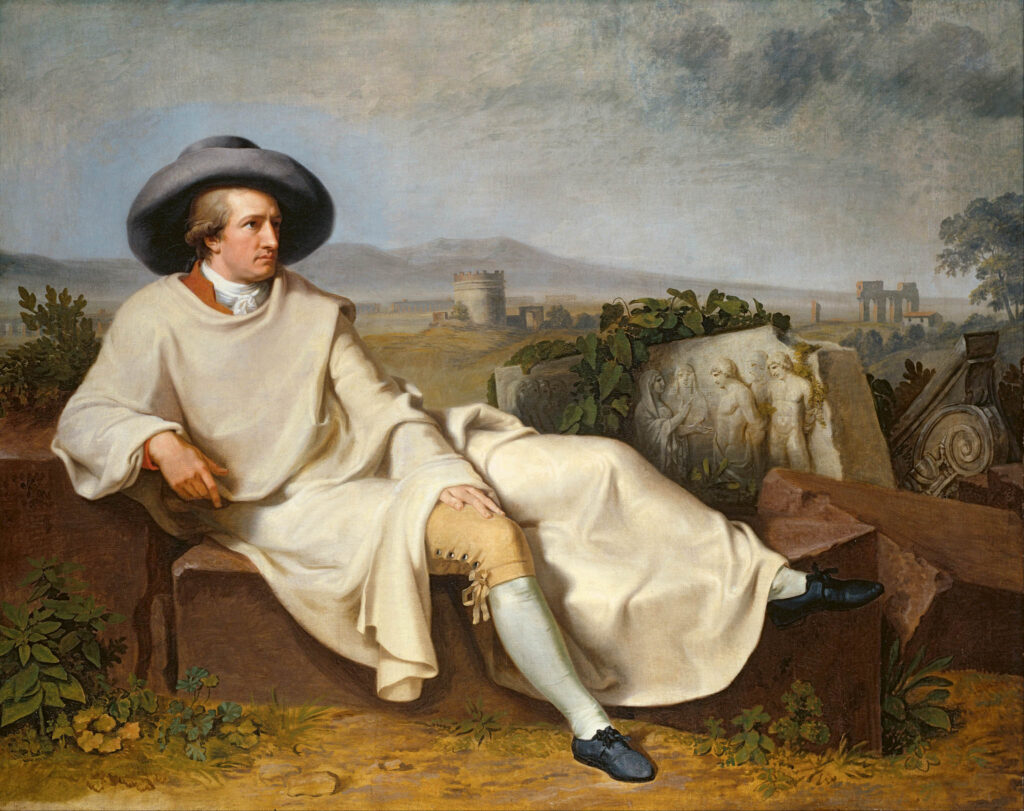
In a certain sense, of course, Goethe’s travels and Humboldt’s expeditions already signal an abandonment, or at any rate a loosening, of one’s foremost and most foundational relation—that to God. The Bildungsideal preached man’s embeddedness in the world and destiny to transform it in his image, as if man and not God was the Creator. The philosophies of Fichte, Schleiermacher, and Hegel advanced exactly this attitude. However, here at least we still have some kind of relationality, the like of which we only very rarely encounter in the world as it has changed since then. Today, the person as such has ceased to be the ideal at the heart of education or the arts. That role has been taken over by the emancipated individual who asserts himself against every social relationship which may imply the tiniest element of pressure—that is, practically every such relationship.
In consequence, our language, our entire ethics of conversation, of courtesy or intimacy, deteriorates. So does our capacity for storytelling, and for reading or enjoying the most ordinary and beautiful of things, such as nature. So do the unwritten norms of our democratic processes, rooted in the sanctity and dignity of the human person. Indeed, the person as such collapses, like a dying star, turned in upon itself. There is no exit from the dark of that tunnel precisely because every glimpse of light could and may only come from an external source of beauty and inspiration, which takes on a higher role in the universe than ordinary, wretched human life. The chest, indeed, is placed in the heart of the ocean by a higher and more perfect act of Creation.
III
What is to be done? As implied before, an authentic, truly ethical approach to this problem does not especially aim to take a stand in the culture wars. There is no one ugly ideology that needs to be demolished. But there most certainly is an entire social mindset of doubt and of unanswered love which needs to be healed. Accordingly, one needs to be mindful, caring, and attentive when addressing our great ontological crisis. In spite of this, the solution, or at any rate its domain, is quite apparent. When one is melancholic about the perceived state and prospects of culture, one should turn to a remarkable human activity which we nowadays neglect all too often in favour of senseless political skirmishing: education.
Granted, for now, our systems of education are not at a level of thought and care from which our present ontological crisis could be addressed. To the contrary, it is a disgrace how fast the authority of the arts and humanities is eroding in the schools and universities of the Western world, and how unashamedly those cognitive faculties on which the human person relies are being neglected. In the United Kingdom, for example, as an article by Stuart Croft explains, ‘student numbers for the humanities have also been steadily falling, down by around 40,000 over the last decade. Hundreds of arts and humanities courses have disappeared from prospectuses, and the cost-of-living crisis has placed an even greater focus on value for money.’7
This state of affairs, while repairable, reflects the broader predicament we have been examining. It reflects that fundamental approach to life which so falsely appeals to the human cry for freedom at the cost of the cultivation of virtue, love, and true liberty. By opposition, if our democracies, our human relationships, indeed our very culture of dignity, are to be saved, some truths need to be expressed in clear terms. To begin with, some ideas are nobler and worthier of being taught and learned than others. More, there is greater beauty, merit, and freedom in the life of the human person than of the individual, fallen captive to a philosophy of life which is not at all about freedom but the most pervasive self-oppression.
The survival of our system of ordered liberty fundamentally depends on whether we trust our best and noblest traditions enough to designate, once again, the human person as the ultimate ideal for our systems of education and learning. Accordingly, the question a responsible political movement asks at present is not how to eliminate or destroy an evidently bad idea. The question it asks is how to develop, through education and communal life, new cultural bonds of virtue, liberty, and trust within which the human person as such may operate and thereby retrieve ideas about life better than the prevailing ones. Learning, the moral and intellectual basis of human life, must be readapted and reopened to the world of value and inspiration. Education must once again become Bildung.
NOTES
1 Johann Gottlieb Fichte, Addresses to the German Nation, trans Gregory Moore (Cambridge University Press, 2009).
2 Dan Breazeale, ‘Johann Gottlieb Fichte’, in Edward N Zalta, and Uri Nodelman, eds, The Stanford Encyclopedia of Philosophy (Fall 2024).
3 Friedrich Schleiermacher, On Religion. Speeches to Its Cultured Despisers (Cambridge University Press, 1996), 18–55.
4 Friedrich Wilhelm Nietzsche, Beyond Good and Evil (Cambridge University Press, 2002), 135.
5 Fichte, Addresses to the German Nation.
6 A quote by Goethe, upon witnessing the Battle of Valmy in 1792, Harrison W Mark, ‘Battle of Valmy’, World History Encyclopedia (last modified 3 October 2022), www.worldhistory.org/Battle_of_Valmy.
7 Stuart Croft, ‘We Cannot Afford to Undervalue Arts and Humanities Degrees’, Arts Professional (3 August 2023), www.artsprofessional.co.uk/magazine/news-comment/we-cannot-afford-undervalue-arts-and-humanities-degrees.
Related articles: