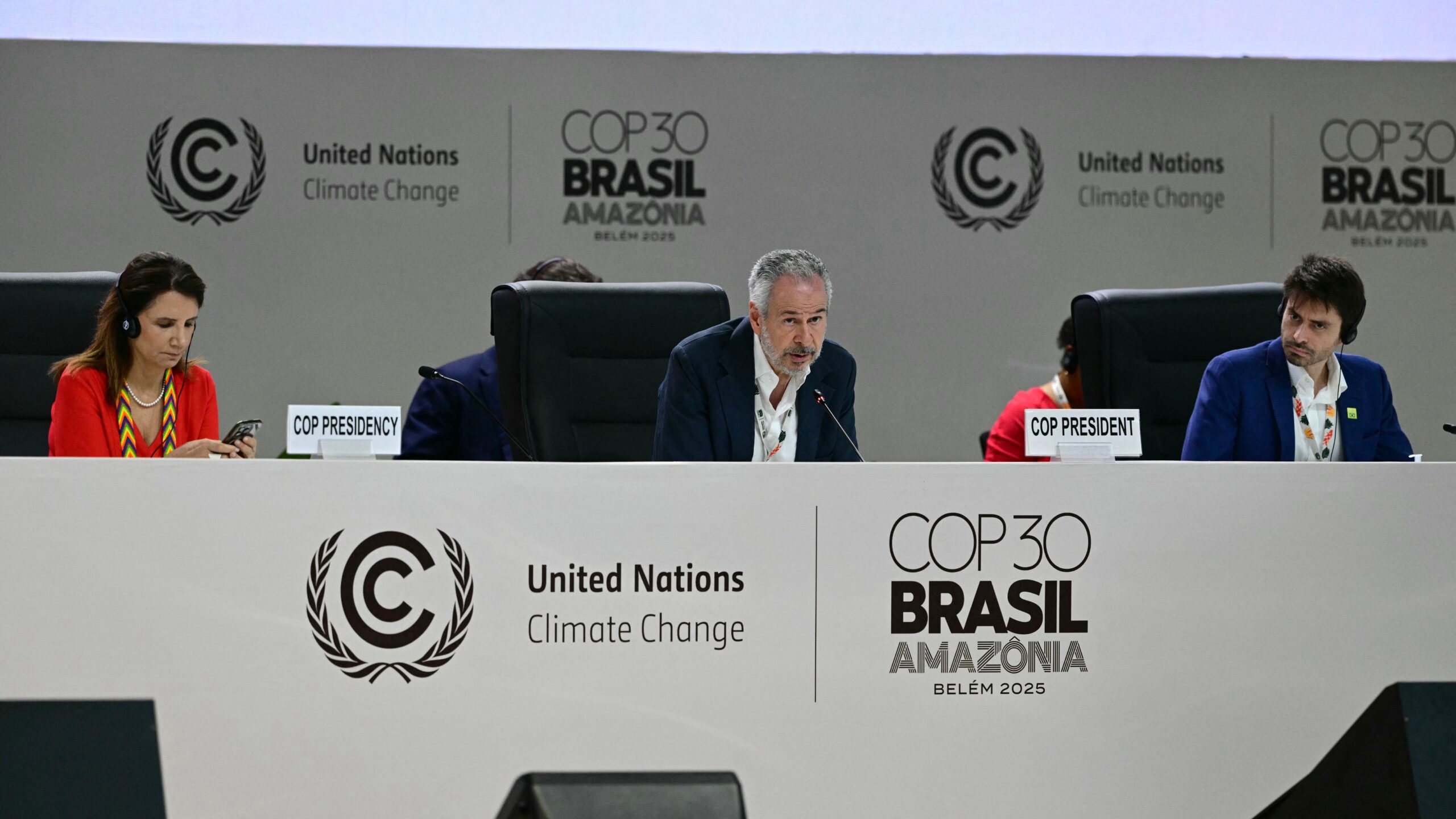
From 10 to 21 November, global leaders and more than 50,000 delegates from around the world convened in Belém, Brazil, to negotiate the most pressing issues under the UN climate framework. Decisions adopted during the annual Conference of the Parties (COP) are shaping the future implementation of the UN Framework Convention on Climate Change (UNFCCC) and the Paris Agreement. Brazil, as the COP Presidency, called for a ‘Global Mutirão’—a collective effort to unite against the threats posed by climate change. However, geopolitical tensions and diverging interests complicated efforts to achieve this goal.
The Challenging Path Towards Transitioning Away from Fossil Fuels
A report by the Global Carbon Budget, published this November, projects that 38.1 billion tons of carbon dioxide will come from fossil fuel use (coal, oil, and natural gas) this year. This quantity is a record high and represents an increase from previous peaks, even though COP28 participants in 2023 recognized the need to transition away from fossil fuels in energy use in an equitable and just manner. COP29 in 2024, however, could not move forward on this issue.
This year, Brazil was expected to advance the protracted negotiations. To this end, the Presidency introduced its ‘Mutirão Proposal’ on 18 November, offering three options to push ahead. The proposal called for the selection of one option to establish a ministerial roundtable to support countries in developing their transition roadmaps.
A report by Carbon Brief suggested that the idea of a transition roadmap was endorsed by over 80 countries. This figure includes numerous Latin American nations, notably Chile, Colombia, and Mexico; most EU Member States, the United Kingdom, and Switzerland; several small island states such as Tuvalu and Vanuatu; and a few Asian countries like South Korea and Malaysia. On the opposing side were countries of the Arab Group—Saudi Arabia being the most vocal—and Russia, which rejected the proposal.
As a result of a necessary political compromise, the adopted decision (‘the Mutirão Decision’) excluded any reference to the transition roadmap. However, it also introduced new initiatives. One of them, the ‘Global Implementation Accelerator’—a cooperative and voluntary framework—aims to speed up the realization of nationally determined contributions (NDCs) and national adaptation plans (NAPs). Another initiative, the ‘Belém Mission to 1.5,’ requests the former COP29 and COP30 Presidencies, as well as the upcoming COP31 Presidency, to summarize the work on scaling up ambition and implementing NDCs and NAPs.
Turning Climate Finance Goals into Action
Article 9.1 of the Paris Agreement requires developed countries to provide financial assistance to developing countries in support of their adaptation and mitigation efforts. Aligning with this provision, COP29 adopted a new collective quantified goal (NCQG) on climate finance, calling on public and private actors to mobilize at least $1.3 trillion per year from all sources for developing countries by 2035. Although the issue was not on the official agenda, the Mutirão Decision also highlighted that it is important to stay on course.
To deliver on this, COP30 launched a ‘New Climate Finance Work Programme’. The two-year initiative will be facilitated by two co-chairs, one from a developing and one from a developed country. Furthermore, the decision called for efforts to achieve at least a threefold increase in adaptation finance by 2035.
‘This outcome fell short of the ambitions of developing countries and civil society organizations’
However, this outcome fell short of the ambitions of developing countries and civil society organizations. According to Infoamazonia—an independent non-profit media outlet—the phrasing ‘call for’ is not strong enough to provide accountability for its implementation. Moreover, there is no base year for calculating the increases, and 2035 is seen as a delay compared to 2030, the original deadline suggested by developing countries.
Navigating Global Pushbacks to a Carbon Levy
The European Union adopted a regulation introducing the Carbon Border Adjustment Mechanism (CBAM), a tariff on carbon-intensive imported goods, such as iron, steel, refineries, cement, aluminium, certain chemicals, hydrogen, and fertilizers. Following a transitional phase, it will take effect on 1 January, 2026. It is expected to serve the EU’s overarching goal of achieving climate neutrality by 2050 and contribute to the Paris Agreement’s goals by promoting clean production. Despite these considerations, the mechanism drew criticism from third countries. Notably, Russia requested consultations under the World Trade Organization’s dispute-settlement mechanism.
However, the EU is not the only actor seeking to manage carbon leakage with a levy. The United Kingdom and Norway are also planning to introduce similar measures in the near future. During COP30, some countries—among them China, India, and the Arab Group—linked the climate negotiations to trade issues, emphasizing the need to prevent unilateral trade measures that could create barriers to international trade. Meanwhile, Wopke Hoekstra, the European Commissioner for Climate, Net Zero and Clean Growth, clarified that maintaining CBAM is a priority and a red line for the EU.
Following the Presidency’s compromise proposal, the Mutirão Decision reaffirmed the need for a supportive and open international economic system, where climate measures should not constitute arbitrary or unjustifiable discrimination or a disguised restriction.
Other Outcomes, Missing Opportunities, and Future Steps
Article 7 of the Paris Agreement established the ‘Global Goal on Adaptation’ to enhance resilience and reduce vulnerability worldwide, with particular attention to developing countries. However, measurable indicators are crucial for evaluating progress toward this target. An expert group proposed a list of around 100 indicators, but the Presidency, referring to the necessity of a political compromise, incorporated only a few. Several actors, including countries from the Independent Alliance of Latin America and the Caribbean, criticized this dilution of the original proposals.
‘An expert group proposed a list of around 100 indicators, but the Presidency…incorporated only a few’
The Belém Adaptation Indicators consider social categories, including gender, climate-related hazards, geographical characteristics, and ecosystem conditions. However, several of them are not properly measurable and omit relevant themes. This might change in the future, as COP30 established the Belém–Addis vision, a two-year process to elaborate on the indicators.
The Parties also adopted a Gender Action Plan to promote gender balance, participation, and women’s leadership. Furthermore, COP30 participants approved a declaration to launch the Tropical Forest Forever Facility, with an initial investment of $5.5 billion. Civil society organizations called for a global roadmap to end deforestation, but Brazil was unable to secure an agreement on this issue.
Notwithstanding the results achieved, fossil-fuel phase-out will likely remain a central issue in future chapters of climate negotiations, as will the practical realization of the financial commitments and the need to address critical issues such as deforestation. This is evidenced by Brazil’s announcement that it will further address the problems of deforestation and fossil fuel use.
At the same time, Colombia and the Netherlands are set to host the first international conference on transitioning away from fossil fuels next spring, and Türkiye is going to host COP31 next year, following a compromise with Australia, whose climate minister will serve as chair during the negotiations.
Related articles: