This article was originally published in Vol. 5 No. 3 of our print edition.
‘The brutal fact is that Western Europe, and increasingly also Central Europe remains largely an American protectorate, with its allied states reminiscent of ancient vassals and tributaries. This is not a healthy condition, either for America or for the European nations.’1 This is how Zbigniew Brzezinski described Europe’s geopolitical position in his book The Grand Chessboard, first published in 1997. Even now—twenty-eight years after the book’s release—the relationship between the USA and Europe remains fundamentally unchanged.
According to the classical approach to transatlantic relations, the USA has been the world’s leading geopolitical power, while the European continent—and its exclusive leadership club, the European Union—has focused on being the foremost defender of freedom, democracy, human rights, and the rules-based international order. While the USA shapes and implements its geostrategies based on power interests, the primary goal of the EU’s foreign policy has been to preserve a world grounded in values and built on multilateralism. However, the year 2025 may mark a moment of geopolitical awakening for Europe. The emerging multipolar world and the current presidency of Donald Trump are making it increasingly urgent for Europe to reposition itself within the evolving global order and to become an independent geopolitical and great power actor. Will the EU prove capable, in the near future, of developing an independent great-power strategy without the United States? Moreover, is power politics even compatible with the defence of values? This study examines Europe and the EU from a geopolitical perspective, seeking answers to one of the most pressing questions of our time: how could the European continent (and the EU) become a sovereign economic and political pole within the emerging multipolar world order?
The Emerging Multipolar World Order
Josep Borrell, the High Representative of the European Union for Foreign Affairs and Security Policy from 2019 to 2024, described the EU’s dilemma as follows: ‘Europe was poorly prepared for the harshness of the world because the project of European unity was built in opposition to the very idea of power politics…On 24 February 2022, the forgotten harshness of the world returned to Europe with intensity. Europe reacted in a remarkable manner…It was Europe’s moment of awakening as a geopolitical player…Europe has changed dramatically. We are now on alert because our vital interests are at stake.’ 2 In other words, Europe must reposition itself within the emerging new world order and become an independent great power and geopolitical actor.
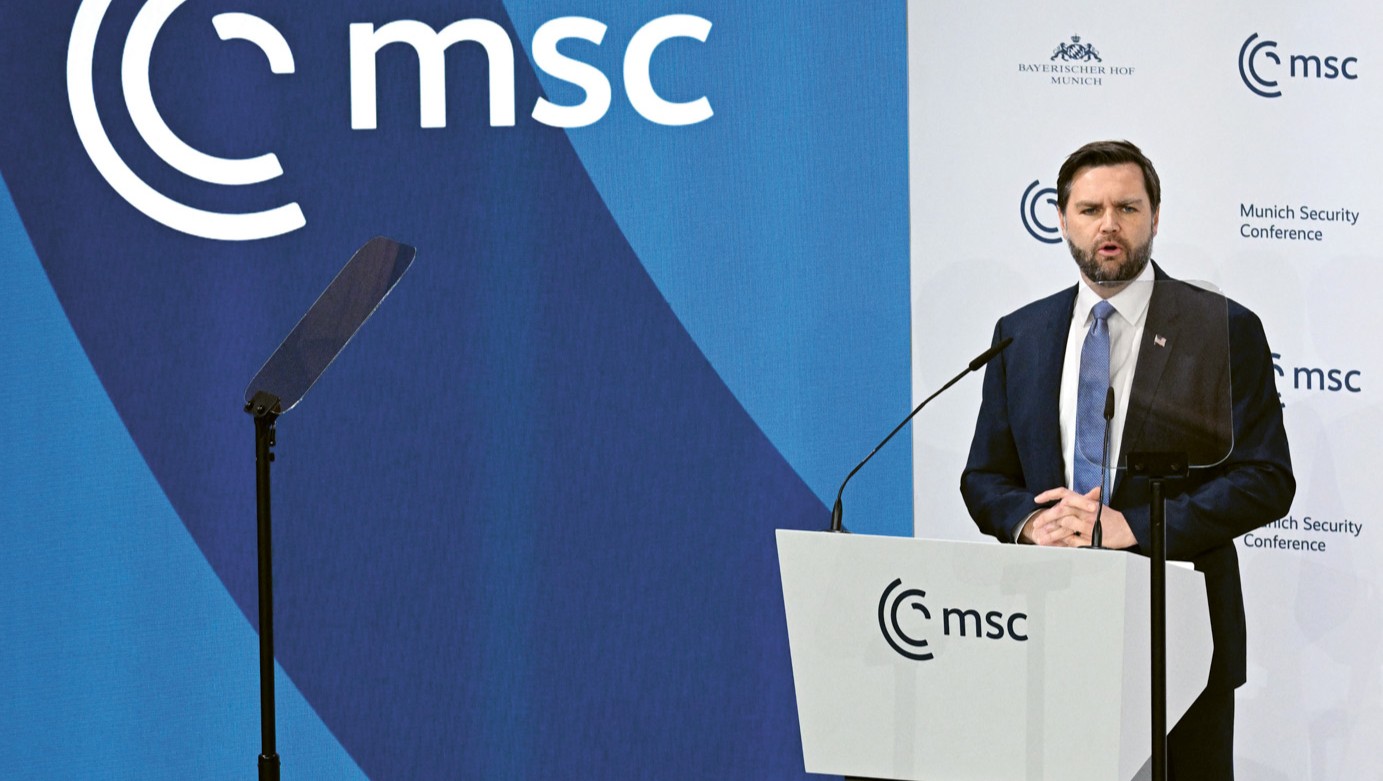
The task has become even more urgent, as on 20 January 2025, the presidential administration led by Donald Trump took office, carrying with it a clear expectation that Europe should take care of its own security, economic development, and social welfare with the least possible support from the United States. The speech delivered by US Vice President JD Vance at the Munich Security Conference on 14 February 2025 shocked European leaders. He made the startling claim that the greatest threat to the European continent comes from the EU’s own leaders, and ‘the retreat of Europe from some of its most fundamental values—values shared with the United States of America’. Moreover, in his speech, the vice president cited examples of abuses by EU leaders.3 Then, in March 2025, leaked conversations between American officials on the Signal messaging app confirmed beyond doubt the current US administration’s anti-European stance. As a result, an increasing number of experts now believe that the transatlantic alliance, at least in its current form, has come to an end, and not merely geopolitically, but also economically.
On 2 April 2025, the Trump administration announced a 20 per cent tariff on all imports from the EU, but President Trump suspended the measure by executive order until 1 August. When US–EU trade talks in the intervening months did not result in an agreement, Trump warned that, from 1 August, he would raise tariffs on all EU goods to 30 per cent. Ultimately, on 27 July 2025, Washington and Brussels struck a trade deal widely seen as a defeat for the EU. Under the agreement, the United States will levy a 15-per-cent tariff on all EU exports, while the EU will impose no tariffs on American products. In addition, the EU pledged to buy $750 billion worth of energy—particularly liquefied natural gas—and US military equipment, and to invest a further $600 billion in the American economy over the coming years.
‘The emerging multipolar world and the current presidency of Donald Trump are making it increasingly urgent for Europe to reposition itself within the evolving global order’
In all likelihood, the year 2025 marks the beginning of a new era in European history—an ‘overture’ to a brutally difficult and entirely uncertain new period. At the same time, the Russia–Ukraine War has finally swept away the old global status quo. The unipolar, US-centred world order that followed the Cold War has come to a close, and a new multipolar global economic—and likely also political—order is beginning to take shape.
But as for the question of what this new multipolar world order will look like, there is still no clear answer. This is largely because the so-called ‘West’, led by the United States, and the so-called ‘Global South’, comprising countries outside this sphere, hold fundamentally different views. Moreover, the transformation of the global economic system and global political order are two distinct, albeit interconnected, processes. With China’s significant global economic expansion beginning in 2008, the Russia–Ukraine War, and the steadily intensifying global economic and geopolitical risks, the new watchword of the English-speaking world has become de-risking. On 13 April 2022, US Treasury Secretary Janet Yellen, in a speech at the Atlantic Council, said the following:
‘We cannot allow countries to use their market position in key raw materials, technologies, or products to have the power to disrupt our economy or exercise unwanted geopolitical leverage. Let’s build on and deepen economic integration and the efficiencies it brings—on terms that work better for American workers. And let’s do it with the countries we know we can count on. Favoring the “friend-shoring” of supply chains to a large number of trusted countries, so we can continue to securely extend market access, will lower the risks to our economy, as well as to our trusted trade partners.’4
As these words indicate, one of the key objectives of the Biden administration was to eliminate strategic economic dependencies on so-called ‘unreliable countries’, and the dangerous geopolitical pressure exerted through them. The American leadership planned—and continues to plan—to achieve this by pressuring US transnational corporations to restructure their value chains in such a way that they are redirected toward reliable, friendly countries. It was this strategy that Yellen referred to in her speech as ‘friend-shoring’.
Following the American lead, the European Commission published its strategy for enhancing European economic security in June 2023. In this document, it identified four main types of risks: 1) risks related to the resilience of supply chains, including energy security; 2) risks to the physical and cyber security of critical infrastructure, including the possibility of disruption or sabotage; 3) risks related to technology security and technology leakage, especially when such leakage enhances the military or intelligence capabilities of third countries; 4) risks associated with economic dependencies or the use of economic coercion as a weapon, and consequently, the risk that a third country could influence the legitimate political decision-making of the EU or its member states. The EU intends to implement its economic security strategy by, on the one hand, increasing competitiveness, and on the other, by strengthening bilateral and multilateral cooperation frameworks.5
But is the West’s current de-risking strategy—and its practical implementation through the policy of friend-shoring—even a realistic proposition? Can geopolitics and security considerations override businesses’ need for cost-efficiency? Can political rhetoric truly take hold in day-to-day business practices? According to several experts, with this de-risking strategy, the United States has entirely broken with the practice of the open market economy. This new, state-directed American approach represents what could be called the very visible hand of the market. And which states, after all, qualify as ‘friendly’ countries in the eyes of the US? For countries outside the Atlantic sphere of power, this ‘friend-shoring’ policy implies profound dangers. If such states refuse to accept the sanctions regime against Russia and China, they are classified as ‘unreliable’—and, as a result, investments from the US or EU are unlikely to flow into these countries. Because the friend-shoring policy demands clear allegiance from the countries of the Global South, it effectively blocks the ability of states outside the US-led sphere—particularly small and medium-sized economies—to diversify their foreign economic and foreign policy relations.
In contrast to the de-risking strategy pursued by the USA and the EU, the new watchword of the Global South has become de-dollarization. While the dollar-based international financial market remains dominant for now, the use of the US dollar in international payments is declining, while the role of the renminbi (yuan) in global currency reserves is increasing. Although international trade and capital flows are organized as much at a regional level as a global one, international financial markets continue to operate on a truly global level. In other words, we cannot yet speak of a multipolar global economic system as long as a new multipolar financial system has not been established. New international financial clearing systems have emerged—particularly in Russia, China, and Iran—but it remains uncertain whether a new, China-centred, renminbi-based financial system will form in the near future. Thus, when it comes to a world economy organized around megaregions or geopolitical spheres of influence, the only realistic forecast for now is that alongside the US-led economic power bloc comprising the US and the EU, a China-centred Asian economic power bloc will likely emerge, primarily encompassing East Asia.
One of the fundamental dilemmas of our near future is whether the currently emerging multipolar global economy will also force the development of a multipolar global political order. Since economic processes require security as a fundamental prerequisite, the foundation of a multipolar global economy presupposes the creation of a new system of regional security. Even in theory, it remains an open question whether horizontally coexisting regional security systems can exist side by side, and how they will be structured—though it seems most likely that they will function in a hierarchical fashion. In the view of this author, the emerging multipolar global economic system will likely compel the formation of a new global political order, but this will be a very long-term process. In the short term, the US-led unipolar political system and the multipolar global economic system will coexist simultaneously. The result of this, in the short term, will be an extremely unstable and risky transitional world order. And following this transitional phase, a complete transformation of the global system may occur—one that, in the words of Márton Békés, ‘will entail both a change in the global system and a systemic global change’.6
The European continent—and the EU—must reposition itself within this entirely uncertain and exceptionally high-risk emerging global economic and political order. But first, let us return to fundamentals and examine the geographical and geopolitical position of the European continent.
Europe’s Geographical and Geopolitical Position
Every geopolitical strategy must begin by answering a fundamental question: what is the geographical position of the country, region, or continent in question, and how can its geopolitical situation be defined based on its geographic characteristics? Geographical position is always foundational to geopolitical status, and cannot be separated from it. Without a realistic assessment of geographic conditions, any geopolitical strategy is doomed to be flawed and misguided.
But where does Europe belong? If by Europe we mean the EU, then the question seems entirely unnecessary, since the EU clearly belongs to the sphere of influence of the United States—‘the West’. At the same time, the geographical features of the EU are defined by the European continent itself, which—by virtue of its position—is much more directly connected to Asia and Africa than to the Americas. In other words, Europe has direct geographic links to the two continents of the Global South. This is precisely where the contradiction lies in evaluating the EU’s geopolitical position: EU leaders cannot formulate a geopolitical strategy that is fundamentally at odds with the geographical realities of the European continent.
It is indisputable that Europe is a distinct continent in historical and civilizational terms. However, from a geographical perspective, Alexander von Humboldt’s observation from over 200 years ago still holds true: ‘Europe is merely the western, intricately articulated peninsula of the largely undivided Asian landmass.’7 In geological and physical-geographical terms, Europe and Asia are one continent—a single landmass known as Eurasia. The commonly used concept of Europe in political and cultural discourse generally does not correspond to these geographic realities. The definition of Europe in the sense of physical geography most closely aligns with the formulation by Charles de Gaulle, who stated that ‘Europe stretches from the Atlantic Ocean to the Urals’.8 In other words, from a historical, cultural, and civilizational perspective, the Ural Mountains have been selected as the geographical boundary between Europe and Asia.
‘One of the fundamental dilemmas of our near future is whether the currently emerging multipolar global economy will also force the development of a multipolar global political order’
At the same time, in great power strategies—especially those of the United States and Russia—Eurasia is a very real concept: it is the primary stage for global geopolitical competition, what Brzezinski famously called ‘the grand chessboard’. Although most European countries today, along with the EU itself, reject the concept of Eurasia, for the United States, Europe represents the most important geopolitical bridgehead into the Eurasian space. Brzezinski’s words perfectly capture why Europe—and particularly the European members of NATO—hold such strategic importance in the Eurasian geopolitics of the US: ‘the Atlantic alliance entrenches American political influence and military power directly on the Eurasian mainland.’9 Consider this statement alongside another of Brzezinski’s key insights: ‘In the short run, it is in America’s interest to consolidate and perpetuate the prevailing geopolitical pluralism on the map of Eurasia. That puts a premium on maneuver and manipulation in order to prevent the emergence of a hostile coalition that could eventually seek to challenge America’s primacy.’ 10 Thus, the conclusion is unmistakable: for the US, European countries are the instruments of power through which it prevents the formation of a unified Eurasian power bloc—an outcome that would fundamentally threaten US global hegemony. It is no coincidence, then, that in today’s geopolitical thinking, it is widely acknowledged that the future of ‘the West’—and especially of the United States—depends on Eurasia.
Unfortunately, the leaders of the EU have failed to fully grasp the classical mode of geopolitical thinking rooted in geography—particularly the fact that, due to Europe’s location within the Eurasian landmass, it is just as much a continental (land-based) region as a maritime one. This is a fundamental reality for Europe, a geographic condition that could be exploited not only by American leaders but also by the European countries themselves. Yet current developments are moving in precisely the opposite direction. The EU’s sixteen sanctions packages against Russia have lowered an ‘economic iron curtain’ between Europe and Russia, effectively severing the European continent’s Eurasian connections. Meanwhile, this situation is highly favourable for the United States, since it allows Washington’s long-standing Cold War-era strategy of ‘containment’ against Russia to be implemented by the states of Europe themselves. Put simply, the United States is making European countries pay the price for the Russia–Ukraine War.
The European continent also occupies a unique geopolitical position when viewed through Halford Mackinder’s 1919 concept of the ‘World-Island’. Although Mackinder’s now-famous words are widely known—‘whoever rules East Europe commands the Heartland; whoever rules the Heartland commands the World-Island; whoever rules the World-Island commands the world’11—these lines are generally interpreted with an exclusive focus on Eastern Europe and the Heartland, while the significance of the World-Island concept itself is often overlooked. Yet in today’s emerging multipolar world, the idea of the World-Island carries at least as much importance. The World-Island refers to the combined landmass of Eurasia and Africa—which means that the European continent is also part of this geopolitical space envisioned by Mackinder. If, in the future, Europe were to develop a closer network of primarily economic relations with Asian and African countries—based on partnership and acceptance of different civilizations—it could become the central region of the World-Island. This idea still feels foreign to Europe. Yet in reality, China’s Belt and Road infrastructure development initiative offers, for the first time in history, the possibility of strengthening economic ties between Eurasia and Africa to such a degree that a new World-Island could emerge in the twenty-first century.
The only remaining question is whether Europe will be part of this new World-Island at all. The economic sanctions against Russia, the trade war with China, the steadily declining European influence in its former colonies in Africa, and more broadly, Europe’s alignment with American policy in its relations with Asian and African countries—all suggest that Europe is likely to be left out of this emerging sphere of power.
From the vantage point of Brussels, it may still seem that Europe holds economic superiority over Asia, and that it is in Asia’s interest to form the strongest possible economic and political alliance with Europe. However, this is expected to fundamentally change by 2050. According to a study by the Asian Development Bank, while in 2010 the Asian continent accounted for 25 per cent of global GDP, by 2050 it is projected to produce 52 per cent—meaning that Asia will achieve absolute dominance even without Europe. In fact, by 2050, Asia’s global dominance will resemble its position in the 1700s, before the Industrial Revolution in Europe.12 From a geostrategic perspective, this also means that by 2050, the Asian continent will be strong enough on its own to create a new economic sphere of influence, and will no longer require close alliance with Europe to maintain global superiority. The question then becomes: how will Europe’s role change after 2050, and will European countries prioritize economic and political cooperation with the United States or with Asia? Accordingly, European countries should already be preparing for the Age of Asia, and should begin formulating a fundamentally new geostrategy—one grounded in mutual partnership and the assertion of European interests—focused on Eurasia and, in a broader sense, on the World Island.
Unfortunately, the vision outlined above remains far from the realities of our present day—even though it could in fact represent the most crucial element of a new European geostrategy for the twenty-first century. At present, Europe serves as a US bridgehead into Eurasia, a subordinate actor within American geopolitical interests. Yet in my view, this is already beginning to change. While the ongoing Russia–Ukraine War currently grants the American bridgehead in Europe a prominent role, this situation could fundamentally shift once the war concludes. Moreover, Eurasia without Europe—particularly through the emerging cooperation between Russia, China, Iran, and to some extent India (via structures like the Shanghai Cooperation Organization and BRICS+)—is becoming increasingly autonomous and economically powerful. If, in a few decades, the US no longer requires a European bridgehead, then what role will Europe play in the new world order? European leaders often associate the current American expectation for a more self-reliant Europe, and particularly the demand that Europe should no longer rely solely on the US for its defence and security, with the figure of Donald Trump. But in reality, this expectation has been a recurring theme among American foreign-policy decision makers since at least the 2010s. In my view, in the emerging multipolar world, the United States will no longer need a European bridgehead—or if it does, it will be for entirely different purposes. And already, during Trump’s current presidential term, the US has openly begun to shape a new European geostrategy—one that envisions a fundamentally different role for the European continent.
The Uncertainties Surrounding the Geopolitical Role of the EU
When Ursula von der Leyen, the newly elected president of the European Commission, presented the members and portfolios of the new Commission on 10 September 2019, she stated, among other things: ‘My Commission will be a geopolitical Commission committed to sustainable policies. And I want the European Union to be the guardian of multilateralism. Because we know that we are stronger by doing together what we cannot do alone.’13 Josep Borrell, already cited earlier in this study and serving as the High Representative for Foreign Affairs and Security Policy in that same Commission, consistently declared in every forum that the EU’s geopolitical approach is about defending multilateralism and striking a balance between interest-based and value-based strategies in global politics. To use his own words from March 2021: ‘There is no contradiction between playing power politics and promoting values. On the contrary. Showing that you will not abandon your principles is a sign of strength.’14
But can the EU, as an economic partnership, even have a geopolitical strategy? And is what the European Commission calls geopolitics truly geopolitics in any meaningful sense? In this author’s view, geopolitics refers to control over a given territory by a great power or regional power—or the doctrinal declaration of a state’s claim to such control. In other words, geopolitics is the exercise of power based on interests: the foundation of today’s great power game. And although the EU has rediscovered the importance of geopolitics, what it calls geopolitics is, in reality, merely a soft-power interpretation of the term. It is more foreign policy than geopolitics. By promoting European values, presenting itself as a desirable social and economic model, and through its rich cultural heritage, the EU has long been considered—and to some extent is—a reliable, safe, and predictable space. It remains attractive not only to non-EU European countries, but especially to countries of the Global South. Under NATO’s protective umbrella, the EU was never forced to apply hard power—i.e. military force. This remained true until 24 February 2022, when war broke out on the EU’s eastern border. That event delivered a genuine geopolitical shock to the project of European integration. As a result, the long-standing theoretical question—where is the EU’s eastern border?—suddenly became an urgent, real-world issue demanding immediate resolution.
Although the first true geopolitical shock for the EU should have been the 2015 migration crisis, which struck from the south, it was not fully recognized as such. After Greece, it was the Western Balkan countries—especially North Macedonia and Serbia, not EU member states—that defended the southern border of the Schengen Area. While the leaders of various EU institutions have regularly reaffirmed, year after year, that the future of the Western Balkans lies within the EU, no new member state has been admitted since Croatia’s accession in 2013. This now more than ten-year-long frozen state of affairs has understandably cast doubt on the credibility of European integration in the eyes of the countries still waiting for accession. In 2018, when the European Commission released its strategy titled ‘A Credible Enlargement Perspective for and Enhanced EU Engagement with the Western Balkans’,15 and set the year 2025 as a new target date—primarily for the accession of Montenegro and Serbia—it appeared that real progress might finally be made in the EU’s further enlargement. Yet to this day, the EU’s southern borders are still protected by non-EU countries—alongside the Western Balkans, particularly Türkiye and the North African states of the Mediterranean region. EU leaders should have long since reached the geopolitical realization that the accession of the Western Balkan countries is at least as much in the interest of the EU as it is in the interest of those countries themselves.
For any state that seeks to implement a genuine geopolitical strategy, its primary responsibility has always been the defence of its own borders and its sphere of influence. To do so, a state must possess power—legitimate power recognized by other nations—and, if necessary, it must be able to defend its borders and geopolitical interests through military force. This requires substantial financial resources and constant adaptation to the shifting realities of global politics. The question, then, is straightforward: does the EU possess such power at all? It is clear that the 27 EU member states each pursue different geopolitical strategies and have divergent interests. The idea of a United States of Europe, which last gained traction in the 2000s, and the vision of a politically unified EU, have long since faded into the past—even if, in the context of the Russia–Ukraine War, EU leaders now expect a unified stance from member states. In this light, the EU could only function as a geopolitical actor if there were full agreement and mutual trust among the member states on political matters, and if EU leaders could achieve complete coordination on issues affecting the Union as a whole.
Ursula von der Leyen has been reappointed by the European Council to serve a second term as president of the European Commission, and on 21 November 2024, the European Parliament approved the composition and strategy of the new Commission, which officially took office on 1 December. A fundamental question now arises: will Von der Leyen continue with the vision of a ‘geopolitical’ European Commission that she previously championed? Already—as of April 2025—there are signs that the EU’s foreign policy role is becoming more assertive. This is reflected, among other things, in the appointment of the new High Representative for Foreign Affairs and Security Policy. The former prime minister of Estonia, Kaja Kallas, is well known for her strong anti-Russian stance and played a major role in securing Ukraine’s candidate status for EU membership. She outlined her policy goals on X (formerly Twitter) in the following terms: ‘The war in Europe, increasing instability in our neighbourhood and globally are the main challenges for European foreign policy. My aim will be to work on achieving EU unity, protect the EU’s interests and values in the changed geopolitical context, and build global partnerships.’16
The current European Commission’s geopolitical and security strategy is outlined in a document titled ‘Europe’s Choice: Political Guidelines for the Next European Commission 2024–2029’.17 Compared to the previous Commission’s approach, the most fundamental shift is that strengthening European defence and security now features prominently in the document. To reinforce internal security, the current Commission is expected to develop a new internal security strategy: it will strengthen the role of Europol, introduce a new counter-terrorism programme, promise fair but firm action on migration, and establish a fully operational European digital border management system. The most significant geopolitical element of the document is its stated aim of creating a genuine European Defence Union. To this end, the current European Commission has appointed a new Commissioner for Defence, Andrius Kubilius of Lithuania, who previously served two terms as prime minister of Lithuania and was also a member of the European Parliament. Like Estonia’s Kaja Kallas, he regards Russia as the greatest threat to both the EU and NATO. His portfolio includes strengthening the European Defence Industrial Programme and the European Defence Fund, creating a single European market for defence products and services, and developing projects related to European air defence and cybersecurity. The document reaffirms that the new European Defence Union is to be established in cooperation with NATO. All of this points to a European integration process increasingly oriented toward achieving defence sovereignty and implementing foreign policy strategies through the use of hard power instruments.
At the same time, what is missing from this document is geopolitics itself. Moreover, the appointment of an Estonian High Representative for Foreign Affairs and a Lithuanian Commissioner for Defence clearly signals a continuation of an anti-Russian stance—implying that the EU has no intention whatsoever of developing new geostrategies concerning Eurasia or the World Island. A key question for the near future concerns the expected relationship between the EU and NATO, as well as the United States. One step forward in this area came in March 2025, when the European Commission presented a new European rearmament programme under the name ‘ReArm Europe Plan’. The name was later changed, as several European countries considered it too aggressive; the new title became ‘Readiness 2030’. The new name reflects the view among EU leaders that 2030 is the likely date when Russia will attack NATO and the EU. The rebranding points to deep-seated Russophobia, but also, unfortunately, to a certain reluctance to openly embrace the concept of European rearmament, which itself calls into question European countries’ commitment to military deterrence and defence. According to the plan, the programme will allocate €800 billion to strengthening Europe’s security and defence.18 However, there are several fundamental problems in implementing this new rearmament strategy. Chief among them is that, in terms of military technology, European countries are heavily dependent on the United States. In addition, there is a shortage of highly trained military personnel for technological development, and, above all, there is the challenge of overcoming the mutual mistrust between European countries when it comes to sharing their own military innovations. Thus, simply increasing defence spending is not enough: the successful implementation of the new rearmament programme will also require long-term commitment and genuine cooperation between European states.
Strengthening the EU’s geopolitical role will clearly require institutional and budgetary reform, as well as a redesign of the EU’s key sectoral policies. The draft budget for the new seven-year cycle of 2028–2034, presented by the European Commission on 16 July 2025, signals that changes can be expected in both agricultural subsidies and the regional support provided through the Cohesion Fund. Whereas in the current budgetary period (running until 2027) two-thirds of EU expenditure is directed towards regional and agricultural payments, the draft envisions that from 2028 onwards these will account for only 48 per cent of total payments, under the new title ‘National and Regional Fund’. Under the same proposal, the ‘Competitiveness Fund’ would account for 23 per cent of all payments. The third largest budgetary heading in this plan is the so-called ‘Global Europe’ section, whose total budget is planned at €200 billion, representing 11 per cent of all payments. This latter section also includes funds earmarked for the EU’s eastern enlargement, from which €100 billion has been set aside as a reserve for Ukraine’s reconstruction.19 The World Bank currently estimates the total cost of Ukraine’s expected reconstruction at nearly €500 billion.20
The Importance of Shaping a New European Geopolitical Vision and Developing a New Model of European Integration
For the European continent to become a sovereign and autonomous pole in the emerging multipolar world, an entirely new European geopolitical vision must be developed. In my view, its most important elements may include the following:
- Every European country should develop a geopolitical strategy grounded in a realistic assessment of its geographic conditions, and not relying exclusively on the alliance system of the Atlantic sphere. In light of Asia’s growing role in the global economy, it is essential to reconsider the development of a new Eurasian—or more broadly, World-Island—geostrategy.
- Major emerging markets are currently establishing their own spheres of influence in today’s geopolitical vacuums, particularly in Central, Eastern, and Southern Asia, the Middle East, and Africa. To use a historical analogy, the world is already undergoing a redivision—a restructuring into new geopolitical zones of influence. If European countries remain passive in this process, they will have only a slim chance of being sovereign players in the ‘great game’ of global politics in the coming decades. This is the responsibility of the European states; the EU can, at most, serve a coordinating role and provide the framework for geopolitical and global political cooperation among them.
- The EU’s new integration model should also be rooted in reality—specifically, in the global economic significance of the European single market and the fact that the EU is not a geopolitical or global political actor. In the near future, the EU should become increasingly politically neutral. While preserving European values, it should focus on genuinely understanding and accepting the mindsets and values of the world’s various civilizations. It is becoming increasingly clear that the age of European ‘aristocratic superiority’ is over.
- A new, more flexible model of European integration should aim to further strengthen Europe’s economic power, developing its transportation and digital infrastructure to the greatest possible extent. The goal should be to establish Europe as a central region within Eurasia—and, more broadly, the World Island—and maintaining ever-stronger economic ties with Asia and Africa. Through the consistent enforcement of the strategic priorities of the single European market, Europe (and the EU) could become a new sovereign economic pole within the emerging multipolar world order of the twenty-first century.
- The likelihood that the European continent could establish itself not only as an economic but also a political player in the great game between the United States and the rising global markets is minimal. But in my view, that is not even necessary. For Europe, a position of political neutrality would be far more advantageous.
It is very important to emphasize that this new form of geopolitical thinking and the development of a new model of integration for European states is not directed against European values. On the contrary, through these transformations, Europe could remain in the twenty-first century a continent of peace, economic and social prosperity, and utmost reliability. But to achieve this, Europe—and the European ‘aristocratic’ mindset—must undergo a fundamental shift. The EU can no longer remain an exclusive ‘elite club’ that, convinced of its own righteousness and superiority, preaches and essentially lectures to the rest of the world regarding moral values. Rather than embracing theoretical frameworks like the concept of the EU as a ‘liberal empire’, what is now needed is a far more pragmatic approach—one that focuses on enhancing economic competitiveness and developing strategies aimed at strengthening the role of the EU in the global economy.
Translated by Thomas Sneddon
NOTES
1 Zbigniew Brzezinski, The Grand Chessboard: American Primacy and Its Geostrategic Imperatives (Basic Books, 1997), 81.
2 Josep Borrell, in a speech delivered at Georgetown University on 15 March 2024. Available at: www.eeas. europa.eu/eeas/us-speech-high-representative-josep-borrell-georgetown-university-%E2%80%9Ceurope-rediscovering-harshness_en.
3 From a speech delivered by JD Vance on 14 February 2025 at the Munich Security Conference. Available at: https://foreignpolicy.com/2025/02/18/vance-speech-munich-full-text-read-transcript-europe/.
4 Remarks by Secretary of the Treasury Janet L. Yellen on ‘Way Forward for the Global Economy’, 13 April 2022. Available at: https://home.treasury.gov/news/press-releases/jy0714#:~:text=We%20cannot%20allow%20countries%20to,work%20better%20for%20 American%20workers.
5 European Commission, ‘Joint Communication to the European Parliament, the European Council and the Council on “European Economic Security Strategy”’, eur-lex.europa.eu (20 June 2023), https://eur-lex.europa.eu/legal-content/EN/TXT/?uri=celex:52023JC0020.
6 Márton Békés, ‘A világrendszerváltás’ (Global Regime Change), Kommentár, 4 (2022).
7 Antal Nemerkényi, ‘Az európai kontinens természetföldrajzi adottságai’ (The Physical Geographic Characteristics of the European Continent), in: Ágnes Bernek et al., Az Európai Unió (The European Union) (Cartographia Kft., 2003), 5.
8 Nemerkényi, ‘Az európai kontinens természetföldrajzi adottságai’, 6.
9 Brzezinski, The Grand Chessboard, 81.
10 Brzezinski, The Grand Chessboard, 271.
11 Halford Mackinder, Democratic Ideals and Reality. A Study in the Politics of Reconstruction (Henry Holt and Company, 1999 [first edition 1919]), 186.
12 Asian Development Bank, Asia 2050 – Realizing the Asian Century (2011), www.adb.org/publications/asia-2050-realizing-asian-century.
13 European Commission, ‘The Von der Leyen Commission: For a Union that Strives for More’, ec.europa.eu (10 September 2019), https://ec.europa.eu/commission/presscorner/detail/e%20n/ip_19_5542.
14 The Diplomatic Service of the European Union, ‘How to Revive Multilateralism in a Multipolar World?’, eeas.europa.eu (16 March 2021), www./eeas/how-revive-multilateralism-multipolar-world_en.
15 European Commission, ‘Communication from the Commission to the European Parliament, the Council, the European Economic and Social Committee and the Committee of the Regions: A Credible Enlargement Perspective for and Enhanced EU Engagement with the Western Balkans’, eur-lex.europa.eu (6 February 2018), https:///legal-content/EN/TXT/?uri=celex:52018DC0065.
16 ‘Kallas Nominated EU’s Foreign Policy Chief’, aldeparty.eu (28 June 2024), www.aldeparty.eu/kallas_nominated_eu_s_foreign_policy_chief.
17 Ursula von der Leyen, ‘Europe’s Choice: Political Guidelines for the Next European Commission 2024–2029’, commission.europa.eu (18 July 2024), https://commission.europa.eu/document/download/e6cd4328-673c-4e7a-8683-f63ffb2cf648_en.
18 European Commission, ‘Acting on Defence to Protect Europeans’, commission.europa.eu https://commission.europa.eu/topics/defence/future-european-defence_en, accessed 11 August 2025.
19 European Commission, ‘The 2028–2034 EU Budget for a Stronger Europe’, https://commission.europa.eu/strategy-and-policy/eu-budget/long-term-eu-budget/eu-budget-2028-2034_en, accessed 11 August 2025.
20 ‘Updated Ukraine Recovery and Reconstruction Needs Assessment Released’, World Bank (25 February 2025), www.worldbank.org/en/news/press-release/2025/02/25/updated-ukraine-recovery-and-reconstruction-needs-assessment-released.
Related articles:
At a time when public debate is increasingly polarized and superficial, Hungarian Conservative remains committed to depth, intellectual honesty, and independent conservative thought.
Producing high-quality journalism requires resources. Your contribution helps us expand our coverage, reach new audiences, and keep our content accessible.

Please consider supporting our mission.