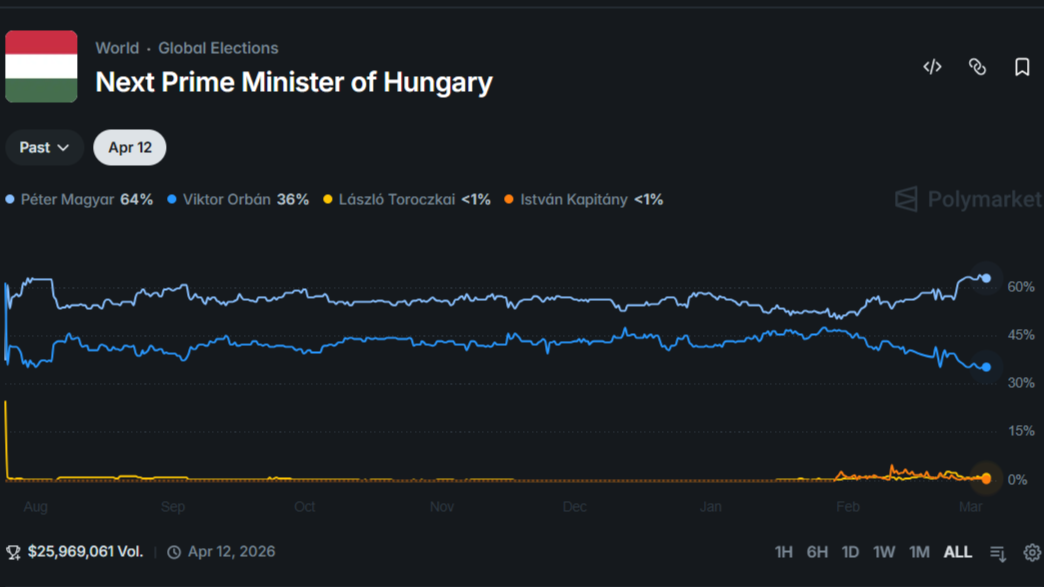
Hungarian opposition politicians and supporters are over the moon about their leader, Péter Magyar’s lead over Viktor Orbán on Polymarket, which they constantly describe as a sign of inevitable victory in the country’s upcoming parliamentary election.
On social media, entirely wild conspiracy theories have begun to circulate based precisely on Polymarket predictions. One account, supposedly linked to the opposition Tisza party, wrote that ‘according to their information’ it is seriously being discussed within the inner circles of Fidesz, the main Hungarian governing party, that Orbán should be ‘replaced’ due to unfavourable polling. In the same post, the user also presents Polymarket as one of the most trustworthy sources for measuring public perceptions and political support ahead of an election.
MP of the progressive Momentum party Márton Tompos recently shared the Polymarket standings with the caption ‘the gap is widening, and Orbán’s floundering is shifting into an even higher gear.’ Similarly, the opposition Facebook page Vakmajom (Blind Monkey) praised Péter Magyar’s lead on Polymarket, stating that ‘it is game over’ for Orbán and his governing party alliance.
Polymarket Is Far from Infallible
Many of these posts correctly describe what Polymarket actually is: a cryptocurrency-based prediction market platform where users trade on the outcome of real-world events such as elections, economic indicators, wars, sports results, or cultural developments. It essentially functions as a market for probabilities, where users buy and sell shares representing whether a future event will occur. The price of those shares reflects the crowd’s estimate of the probability.
Despite understanding what Polymarket is, many of Tisza’s enthusiastic supporters treat it as some kind of infallible predictor—which, obviously, it is not. Several of these posts also cite the example of US President Donald Trump, arguing that Polymarket defied traditional pollsters by predicting his 2024 victory when many polling firms failed to do so.
However, Polymarket has proven far less accurate when it comes to European politics. As the Hungarian opposition often refers to Poland as a model for how they intend to take power and ‘restore the rule of law’ in Hungary, it is worth starting there.
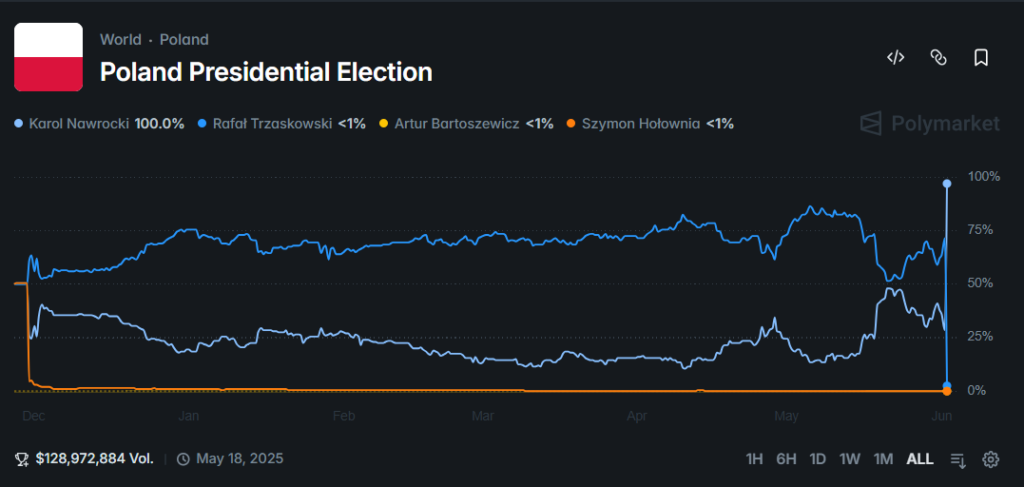
On the eve of the Polish presidential election run-off in June 2025, both Polymarket and many pollsters favoured liberal-progressive Warsaw mayor Rafał Trzaskowski over PiS-backed candidate Karol Nawrocki. Just hours before the vote, Polymarket gave Trzaskowski more than a 70 per cent chance of victory, while Nawrocki’s chances stood below 30 per cent. In reality, Nawrocki won the second round and became President of Poland with a razor-thin margin of 50.89 per cent.
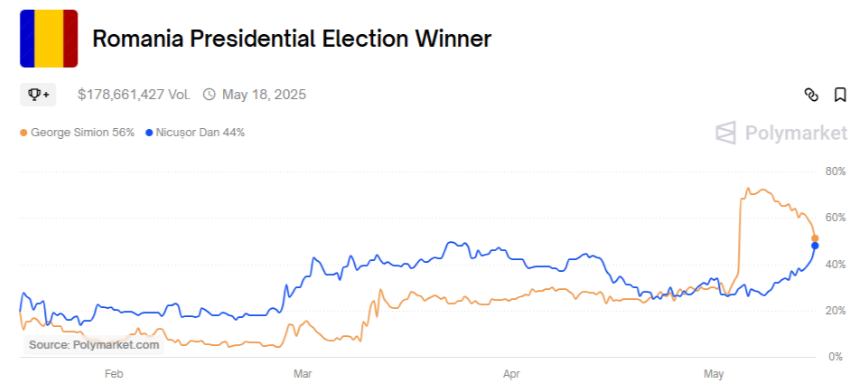
Polymarket also failed to predict the outcome of the Romanian presidential election in May 2025. A month before the first round on 4 May, Polymarket gave Nicușor Dan a 39 per cent chance of winning and George Simion a 29.5 per cent chance. However, when Simion finished first by a large margin in the first round, his odds quickly overtook those of Dan. Between the two rounds, Simion’s chances rose above 70 per cent and remained above 50 per cent until election day. In the end, Dan won the presidency by a relatively comfortable margin in the second round, securing 53.6 per cent of the vote.
A similar misjudgment occurred during the Dutch parliamentary election in 2025. Bettors overwhelmingly favoured Geert Wilders’s Party for Freedom (PVV), giving it over 80 per cent odds just days before the vote. Meanwhile, Rob Jetten’s social liberal Democrats 66 (D66)—which ultimately won the election—stood between 0.5 and 5 per cent in the final weeks, reaching only around 8 per cent on election day.
Why Polymarket May Misread Hungary’s Election
The Polymarket event ‘Next Prime Minister of Hungary’ currently gives opposition leader Péter Magyar a 63 per cent chance of victory, with Viktor Orbán trailing at 36 per cent—almost exactly mirroring the situation seen in the Polish presidential race in 2025.
The liquidity of this market is relatively high—yet nothing compared to the Polish or Romanian examples—standing at around $26 million at the time of writing, which in theory could indicate a higher degree of predictive reliability according to historical Polymarket data. However, the market is also heavily influenced by so-called ‘whales’—large traders heavily distorting probabilities. Some users have reportedly placed more than $200,000 on a Péter Magyar victory. In general, bettors who use Polymarket tend to be more liberal-progressive leaning, politically anti-incumbent, younger, and predominantly urban—demographics that are unlikely to favour Orbán.
‘Investigations into other elections have revealed that large offshore wallets can influence prediction market odds’
It is also important to remember that traders on Polymarket participate from all around the world. Investigations into other elections have revealed that large offshore wallets can influence prediction market odds in favour of particular candidates. In the Hungarian case, it would hardly be surprising if international capital were to favour a candidate perceived as more aligned with globalist interests—an image often attributed to Magyar and his party.
Moreover, traders frequently base their bets on prevailing media narratives rather than direct political knowledge. Many participants are not Hungarian voters and have little understanding of domestic dynamics. Western mainstream media coverage, which is often highly critical of Orbán, therefore plays a significant role in shaping perceptions. Stories and polling data that favour Orbán’s opponents tend to receive disproportionate attention. This likely contributes to Magyar’s lead on Polymarket, particularly as several opposition-leaning polls also place him comfortably ahead—despite the reality of a far more competitive race between the two candidates.
Related articles: