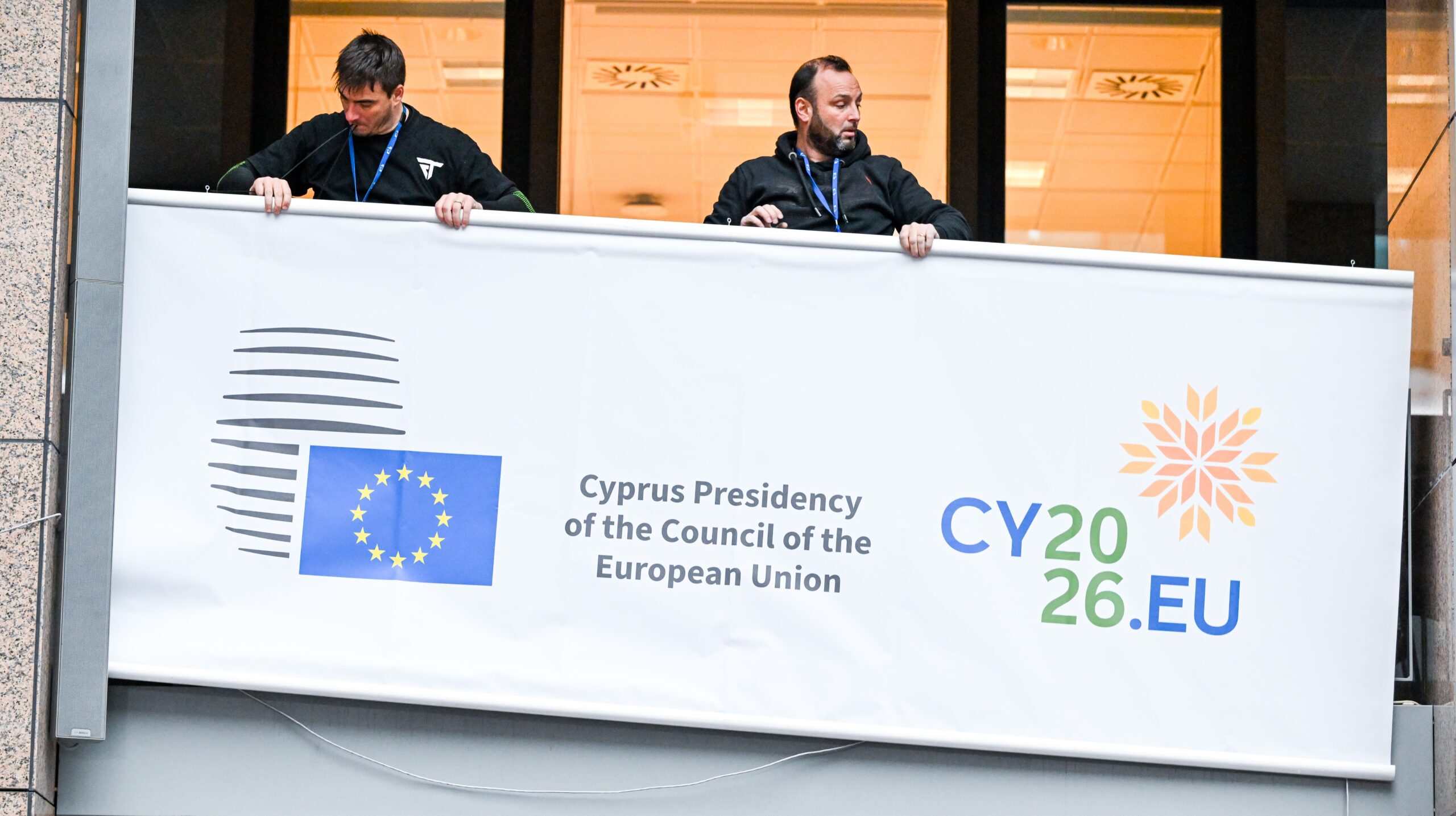
The following is a translation of an article written by Réka Zsuzsánna Máthé, a research fellow at the Europe Strategy Institute of the University of Public Service, originally published on the Five Minutes Europe blog of Ludovika.hu.
The Priorities of the Cypriot Presidency Are Organized Around Autonomy
Cyprus, which assumed the presidency of the European Union in January, envisions an autonomous Europe that is open to the world and intends to shape its programme accordingly. Its primary objective is to strengthen the EU’s autonomy, security, competitiveness, and global role in times of geopolitical turmoil and unpredictability. The Cypriot Presidency does not define EU autonomy. Still, it wants to achieve it in a number of areas, including security and defence, energy and trade, competitiveness, green transition, digital innovation, and even social cohesion.
The island nation has organized its priorities around five major themes. First, they emphasize security, defence readiness, and preparedness. Accordingly, key defence initiatives and priority projects of common interest are treated as priorities, such as the White Paper on European Defence — Readiness 2030 and the accompanying Defence Readiness Roadmap 2030. Cyprus has also put the implementation of the EU Maritime Security Strategy on the agenda, primarily representing its own national interests. In this context, the European Water Resilience Strategy will also be a priority, as well as the full implementation of the Pact on Migration and Asylum, which is planned to be promoted under this chapter, too.
The second pillar of the priorities set by the Cypriot Presidency revolves around competitiveness, which was supported by the Hungarian Presidency in the same way. The new Presidency aims to strengthen competitiveness by consolidating and expanding the single market. It plans to achieve this by deepening capital markets and accelerating the creation of a savings and investment union. At the same time, it emphasizes the importance of strengthening energy security, diversifying supply networks and routes, and ensuring affordable and predictable prices. In addition, the new Presidency will focus on key technologies, including artificial intelligence (AI), cloud-based infrastructure, and cybersecurity.
The third priority is being ‘open to the world’, which primarily refers to openness to enlargement, with Ukraine being highlighted among the candidate countries—naturally, they wish to provide all further assistance and support. An interesting point is that the programme stresses the following: ‘Enlargement has proven to be one of the EU’s most transformative tools, including within candidate countries, reflecting their willingness to reform and solve longstanding problems with their neighbours based on European law, values and principles.’ In the spirit of openness, the issue of the India–Middle East–Europe economic corridor is also on the agenda, which could bring huge benefits primarily to Greece, Italy, and France.
The fourth priority is the ‘autonomous union of values’, which combines issues such as the rule of law and democracy, social cohesion and affordable housing, child welfare, gender equality, and mental health—in other words, a number of areas in which the EU has no jurisdiction.
Finally, they will work on developing a long-term budget for an autonomous Union. The Presidency’s goal is to produce a well-developed, mature negotiating framework document that can pave the way for the timely conclusion of negotiations.
The goal of the Cyprus Presidency of the European Union, which began in January, is aligned with the concept of strategic autonomy: a union that would strengthen the EU’s global role amid geopolitical turmoil. The emphasis on security, defence, energy, and competitiveness could yield positive results, but it should be noted that while the programme is ambitious in areas such as social cohesion and the rule of law, it also stretches beyond the EU’s traditional scope. Support for an open Europe, particularly for Ukraine, is unsurprising. The negotiations over the multiannual budget may prove crucial for the Union.
The Presidency’s programme is organized around comprehensive priorities, yet Cyprus does not define the concept of autonomy. Thanks to the concept’s inherent flexibility, it is acceptable to groups with widely varying interests. This flexibility is reinforced by the overarching strategy that ‘autonomy gives strength, and from this strength will come even more autonomy’. One can only hope that the circular reasoning exists only in the text and that a concrete plan for creating autonomy—whatever that is meant to signify—exists somewhere.
Read more:
Click here to read the original article.