This article was originally published in Vol. 6 No. 1 of our print edition.
How the War in Ukraine Is Reshaping Moldova
Moldova has moved from the margins of Europe’s imagination to the centre of its eastern frontier. The Russian invasion of Ukraine transformed a small state long considered peripheral into a test case for European security as well as enlargement. The country now sits between a warzone to the east and an increasingly cautious European Union to the west, while member states allocate growing resources to defence budgets and assess whether further expansion of the EU is compatible with stability. Moldova also illustrates the new logic of EU enlargement. Integration is no longer only a technocratic checklist, but has become entangled with geopolitics, hybrid competition, and the credibility of Europe as a normative power. The country entered the 2020s as one of Europe’s poorest and most depopulated states. The resident population has been shrinking for decades as young people have left in large numbers and rural districts have emptied. The causes are clear: persistent economic decline, chronically low wages, and an unfavourable demographic profile.
The war reshaped this picture. Moldova, traditionally a country people leave, became a receiving country for large numbers of people fleeing conflict. If the war in Ukraine were to escalate, Moldova could rank among the most exposed countries in the region. We can only hope that never happens, but if it does, the country’s unresolved minority issues would likely play a central role in Moscow’s geopolitical game. To capture these transformations, the article analyses the war’s impact on the social, economic, and political spheres. Taken together, these dimensions show how the war has redirected Moldova’s trajectory, creating new momentum towards Europe while deepening vulnerabilities that could yet stall or reverse it.
The Social Consequences of the War
The country was already facing long-term demographic decline, but the conflict in neighbouring Ukraine intensified existing patterns and created new ones. These shifts are most visible in how people move, how families are organized across borders, and how remittances keep many households afloat.
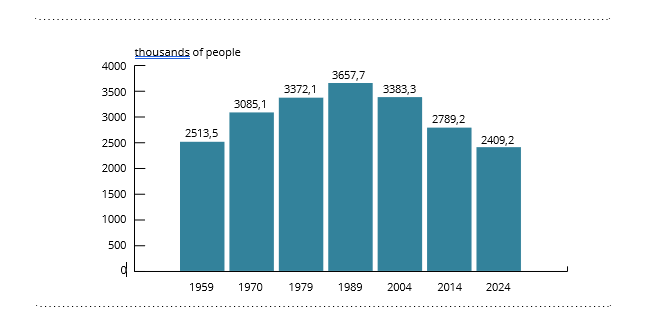
Moldova’s resident population fell by 13.6 per cent1 between 2014 and 2024, with a diaspora exceeding 1 million people, larger than the country’s domestic workforce. Since 1989, when Moldova reached its highest recorded population under the last Soviet census, the country has lost about 1.25 million people. As Figure 1 suggests, this is a decline of 34.2 per cent.2
Russia’s invasion of Ukraine in 2022 reshaped Moldova’s migration map almost overnight. The Odesa–Chișinău corridor became a lifeline, with over 800,000 Ukrainians crossing in the first nine months of the war.3 Moldova’s demographic landscape, which used to be defined by outmigration, suddenly became one of simultaneous departure and arrival. Most refugees moved on, but many families from Ukraine stayed, drawn by proximity. Another reason many Ukrainians stayed was linguistic familiarity. In parts of Moldova, Russian still functions as a common language for everyday interaction, much as Koine Greek did across the eastern Roman Empire in the time of Jesus. The use of Russian lingers even though ethnic Russians now make up only a small share of Moldova’s population (excluding Transnistria) and are concentrated mainly in a few urban centres—a lingering legacy of the Soviet era. The inflow of Ukrainians did not slow Moldovan emigration,4 but instead intensified it. Economic uncertainty encouraged many Moldovans who had already considered leaving to act quickly. Labour migration is a stabilizing strategy for numerous families. The household model built on working abroad shows up in remittances equal to 12.27 per cent of GDP,5 among the highest in Europe.
‘The war has redirected Moldova’s trajectory, creating new momentum towards Europe while deepening vulnerabilities that could yet stall or reverse it’
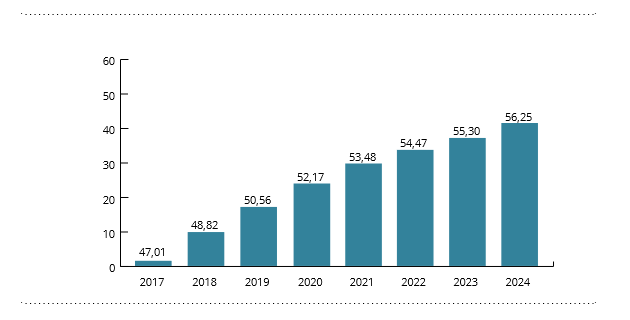
The war added unpredictability, which increased the incentives to depart. Moldova thus became a rare example of a country that was losing people and receiving people at the same time. The dual flow created demographic turbulence that continues today. The long-term consequence of migration is a more fragile demographic structure. Moldova’s working-age population is declining while the number of dependants—minors, pensioners, and adults outside the labour force—is rising. According to World Bank data, the age dependency ratio reached 56.25 per cent in 2024, up from 55.3 per cent in 2023. As Figure 2 indicates, there are now more than 56 dependants for every 100 people of working age.6
Ukrainian refugees brought temporary relief to the labour market, but most arrivals did not stay permanently. The average net monthly pay in Moldova—around €7707 in 2025—still lags far behind the EU’s lowest earners. Among the EU members with the lowest average net monthly salaries, Greece stands at €1,060, Bulgaria at €1,230, and Portugal at €1,290.8 Initially open to staying, many Ukrainians eventually moved on to EU member states where labour conditions are more favourable.
Besides migration and demography, the war also intensified an existing social pattern in Moldova: dispersed families. Many children now grow up with grandparents, while parents work abroad. Refugee flows reproduced this pattern in a new form. Ukrainian families often became split between Moldova, the EU, and Ukraine itself. Video calls replaced direct contact.9 Remittances sustained households separated by thousands of kilometres. Belonging to a so-called ‘video-chat family’ is less a celebrated utopia of twenty-first-century technology and more a lived dystopia that reflects the social costs of long-distance life. It is hardly surprising that these fractured families underpin Moldova’s fragile economy.
The Economic Consequences of the War
The war exposed and intensified Moldova’s structural economic vulnerabilities, accelerating trends that were visible even before 2022. A decade of outward migration had thinned the domestic labour market, weakened local production, and increased dependence on income earned abroad. The invasion added a new layer of uncertainty: it disrupted trade, shifted investment decisions, and further deepened the divide between Chișinău and the rest of the country. Chișinău, the capital, experienced a rapid increase in demand for housing, driven partly by Ukrainian entrepreneurs and professionals who continued running their businesses inside Ukraine while managing operations from nearby Moldova, the closest safe location from which they could work without relocating to a more distant EU country.
This business class has quietly reshaped the housing market. While rural Moldova is dotted with tens of thousands of abandoned houses—some selling for under €5,000—prices for apartments in the capital have doubled since 2019. The upward trend began during the COVID pandemic and continued after the start of the Russian invasion of Ukraine in February 2022.10 Limited new construction amplified the squeeze, turning the capital’s property boom into one of the country’s most visible paradoxes, creating two Moldovas: one prosperous and urban, the other depopulating and forgotten.
Demographic decline and refugee inflows placed hospitals, schools, and welfare systems under pressure. Moldova’s fiscal capacity was already limited. The increased need for social support and healthcare strained institutions that were dealing with shortages even before 2022. Many qualified workers continued to seek employment abroad, further weakening the domestic labour pool.
‘The conflict accelerated Moldova’s path toward the EU but also fuelled hybrid threats and domestic polarization’
Remittances strengthen household income but also institutionalize mobility as a core element of Moldova’s social structure. Dependency on external labour markets widens the gap between local wages and expectations. The war reinforced these patterns by disrupting traditional routes and creating new ones.
This dynamic is reflected in Moldova’s tourism paradox. The country’s travel agency sector is overwhelmingly oriented toward outbound mobility, facilitating the departure of workers to destinations across Europe, including distant labour markets such as Spain. According to data from the National Bureau of Statistics of the Republic of Moldova on travel agency activity in 2024, outbound migration dominates both operations and turnover. Outbound trips represent the bulk of organized tourism and generate more than 90 per cent of total revenue for travel agencies and tour operators.11 The structure of the market thus mirrors a wider reality: Moldova’s travel industry is geared toward sending domestic workers abroad rather than attracting visitors in.
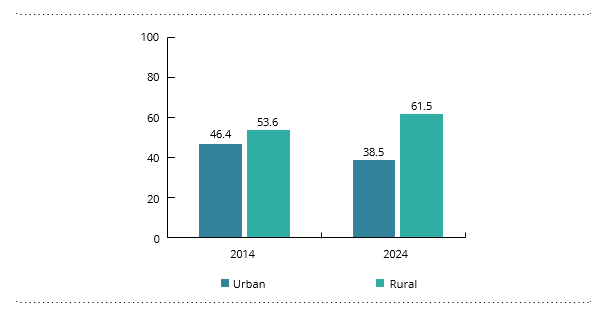
Moldova’s economic geography is now defined by spatial imbalance. The capacity to meet EU standards depends on functioning institutions across the country, yet large parts of rural Moldova are losing people at a dramatic rate. The 2024 Population and Housing Census confirms that Moldova has 2.41 million residents, of whom 53.6 per cent live in rural communities and 46.4 per cent in urban areas (Fig. 3). When compared with the 2014 census, where 61.5 per cent of the population lived in rural areas and 38.5 per cent in urban centres, the scale of rural depopulation becomes striking.12
Moldova remains one of Europe’s most rural countries, and its agricultural districts continue to require a stable labour force that is increasingly difficult to sustain. Almost all regions except Chișinău have registered population decline over the past decade. This tension complicates accession and raises questions about the long-term viability of rural Moldova unless new economic strategies emerge that can support services and infrastructure in regions with rapidly shrinking populations.
The Political Consequences of the War
The war reshaped Moldova’s politics as deeply as its society and economy. It forced the country to adopt a clearer strategic direction and exposed the limits of a weak state. Long-standing tensions between ambitious reforms and limited capacity sharpened, and questions of sovereignty, territorial control, and foreign influence moved to the centre of public debate. The conflict accelerated Moldova’s path toward the EU but also fuelled hybrid threats and domestic polarization, making progress both more urgent and more difficult.
The political effects of the war are therefore no less significant than the demographic and economic ones. Moldova’s relationship with the EU changed, but so did the obstacles to integration. Moldova submitted its application for EU membership on 3 March 2022, shortly after the start of the full-scale invasion of Ukraine. The European Council granted candidate status on 23 June 2022, a decision shaped as much by geopolitical urgency as by institutional evaluation. Accession negotiations were formally opened on 25 June 2024,14 and Moldova has since completed the screening process for all clusters and chapters.15
Yet no negotiation chapter has been formally opened. The country has moved closer to the EU politically, but the practical work of accession remains at an early stage and is constrained by limited budgetary, infrastructural, and administrative capacity. Progress in securing judicial independence and combatting corruption is uneven. Even before the war, Moldova was under pressure from information manipulation, external interference, and competing narratives of identity.16 Since 2022, these have intensified, tying the domestic debate ever more closely to questions of geopolitical alignment and Europeanization.
‘For the EU, Moldova has become a litmus test of whether enlargement can be redesigned for an era of permanent instability’
Territorial issues seriously affect the EU accession process, and none more than the dilemma posed by Transnistria. Wedged between Moldova and Ukraine, Transnistria—officially the Pridnestrovian Moldavian Republic (PMR)—remains a breakaway state unrecognized by the international community. Unlike a de jure state, which is legally recognized, it exists only de facto—functioning independently but without international recognition.
Today, Transnistria operates with all the state-like features—it has its own parliament, army, police, and currency—yet none of the recognition. Its population holds a mosaic of citizenships—Moldovan, Russian, Ukrainian, and even Romanian—mirroring its divided loyalties. Alongside the two other de facto entities in Eastern Europe, Abkhazia and South Ossetia, Transnistria forms part of the post-Soviet ‘frozen conflict’ archipelago, where the Soviet past has not vanished but merely solidified into a geopolitical paradox.17
The region’s modern story began within the 1924 Moldavian Autonomous Soviet Socialist Republic inside the Ukrainian Soviet Socialist Republic. In 1990, local Soviet elites declared the establishment of the Pridnestrovian Moldavian Soviet Socialist Republic to avoid potential unification with Romania. Moldova declared its independence in 1991, largely through its own decision-making process within the collapsing USSR. This unilateral declaration culminated in the 1992 civil war, followed by an enduring Russian-backed ceasefire. Russian soldiers are still stationed in the country, divided between peacekeepers and the Operational Group of Russian Forces.
Transnistria covers an area of 4,163 km², almost twice the size of Moscow, and is home to around 367,000 people. Its capital, Tiraspol, stands as the administrative and symbolic centre of this self-proclaimed republic and is arguably the world’s largest open-air Soviet museum. Gigantic Lenin statues and red stars dominate the cityscape; even its most famous restaurant, Back in the USSR, is lavishly decorated with relics of the era, from veteran Soviet cars to portraits of Stalin.
The unresolved status of Transnistria creates uncertainty for Moldova’s EU path. The question is whether a politically divided state can enter the EU when one region is outside the control of the central government. The EU addressed a similar issue when Cyprus joined, but the context is different. Moldova’s conflict zone is larger, closer to Russia, and more strategically exposed. The experience of Cyprus provides a revealing precedent for such pragmatism. Cyprus acceded to the EU in 2004 despite the island’s de facto partition since 1974 and the absence of a comprehensive settlement with the Turkish Cypriot community in the north. In that case, the EU chose to extend the Acquis Communautaire only to the government-controlled areas, effectively ‘freezing’ its application in the north until reunification could be achieved.
This approach demonstrated the EU’s willingness to prioritize political momentum and regional stability over absolute territorial consolidation, embedding flexibility within the enlargement framework. For current candidates such as Moldova and Ukraine—both facing unresolved conflicts and external occupation—the Cypriot example offers a politically relevant and legally instructive model. It suggests that, under certain conditions, the EU may decouple progress in governance and institutional reform from the full resolution of sovereignty disputes, allowing accession processes to advance while maintaining the principle of eventual territorial integrity.
A practical scenario often discussed is sequential integration. Moldova could integrate into the EU while retaining its claim to Transnistria. The acquis would apply only in government-controlled areas. The door to reintegration would remain open. This model reduces short-term risk but introduces long-term ambiguity that EU capitals view cautiously.
Transnistria has always been Moldova’s most complex territorial issue. Before 2022, the region maintained an open land route to Russia through Ukraine. This route is now blocked. The enclave is isolated from its main patron, and has been forced to reorient its economic channels westward. Trade patterns confirm this shift. Transnistrian firms now export far more to the EU than to Russia. The EU’s autonomous trade preferences and Moldova’s customs framework shape these flows. The conflict removed Transnistria’s traditional logistical pathways. Economic survival increasingly requires integration with Moldovan and European markets. A customs regime introduced by Moldova has reinforced these patterns. Companies in the region18 use Moldovan documentation for international trade. This arrangement did not begin with the war, but it became far more consequential once Russia lost its overland corridor.
While Transnistria represents Moldova’s most visible externalized conflict, it is not the only regional fault line shaping the country’s political stability. Gagauzia presents a different, internally rooted challenge that illustrates Moldova’s unresolved minority issues.19 Although it is a legally recognized autonomous region, political tensions with Chișinău have increased since reforms are perceived locally as threats to autonomy, language rights, and fiscal powers. Such minority grievances are also a well- established channel through which Russia seeks to undermine stability in neighbouring states, making these concerns relevant not only domestically but also for Moldova’s EU accession process and external scrutiny.
Conclusion
Moldova is now closer to Europe than at any point since independence. Russia’s invasion has fast-tracked its European trajectory and turned accession into a central state project. At the same time, the war has stripped away any illusions about the country’s fragility: demographic decline continues; territorial inequality widens; institutions are under strain; and unresolved conflicts, amplified by hybrid threats, make day-to-day governance harder. Moldova needs hard investment in state capacity, infrastructure, administrative depth, and energy security, but it also needs something less tangible: a demographic and social pact that restores trust in public institutions and manages territorial questions with clarity and patience.
For the EU, Moldova has become a litmus test for whether enlargement can be redesigned for an era of permanent instability. Successful integration would anchor the eastern flank, signal that the EU can still shape its neighbourhood, and close off a key corridor for Russian influence. Failure would expand the grey zone of uncertainty on Europe’s borders and leave another vulnerable state trapped between promises of accession and the realities of great-power competition.
The window opened by the war will not stay open forever. Whether Moldova can pass through it will depend on sustained reform, careful conflict management, and the resilience of a society already stretched by migration and hardship. For its part, Europe will need to match grand rhetoric with long-term engagement and resources. The task is demanding, but the strategic, moral, and security stakes make it a gamble neither Moldova nor the EU can afford to lose.
NOTES
1 Marina Gridina, ‘Moldova’s Population Declines by 13.6% Over Ten Years, 2024 Census Confirms’, MoldovaLive (16 July 2025), https://moldovalive.md/moldovas-population-declines-by-13-6-over-ten-years-2024-census-confirms/.
2 ‘Final Results of the 2024 Population and Housing Census: Geographical Distribution of the Population’, Statistica.gov (15 July 2025), https://statistica.gov.md/en/final-results-of-the-2024-population-and-housing-census-geographical-distributio-10121_61877.html?utm.
3 ‘Ukraine Response 2022—Moldova: Surveys with Ukrainian Refugees and Third-Country Nationals. Data collected from 6 September to 6 October 2022’, Relief Web (28 November 2022), https://reliefweb.int/report/moldova/ukraine-response-2022-moldova-surveys-ukrainian-refugees-and-third-country-nationals-data-collected-6-september-6-october-2022.
4 Diego Muro, Géza Dobó, and Róbert Gönczy, ‘Exodus—How the Ukraine War Rewired Moldova’s Mobility’, Europp (15 November 2025), https://blogs.lse.ac.uk/europpblog/2025/11/13/exodus-moldova-emigration-ukraine-war-russia/.
5 ‘Remittances, Percent of GDP—Country Rankings’, The Global Economy (2024), www.theglobaleconomy.com/rankings/remittances_percent_gdp/Europe/.
6 ‘Moldova: Age Dependency Ratio’, TheGlobalEconomy (2025), www.theglobaleconomy.com/Moldova/Age_dependency_ratio/?utm.
7 ‘Minimum and Average Wages in Europe’, Wage Centre (2025), https://wagecentre.com/immigration/country/wages-in-europe?utm.
8 ‘Minimum and Average Wages in Europe’.
9 Muro, Dobó, and Gönczy, ‘Exodus—How the Ukraine War Rewired Moldova’s Mobility’.
10 Valeriu Pronitchi, ‘Real Estate Market Development in Chisinau 2019–2024’, German Economic Team, 4 (October 2024), 8, www.german-economic-team.com/wp-ontent/uploads/2024/12/GET_MDA_ PB_04_2024.pdf.
11 ‘Tourism Activities of Travel Agencies and Tour Operators in Year 2024’, Statistica.gov (14 February 2025), https://statistica.gov.md/en/tourism-activities-of-travel-agencies-and-tour-operators-in-year-9491_61657.html?utm.
12 ‘Final Results of the 2024 Population and Housing Census: Geographical Distribution of the Population’, Statistica.gov (15 July 2025), https://statistica.gov.md/en/final-results-of-the-2024-population-and-housing-census-geographical- distributio-10121_61877.html?utm.
13 ‘Final Results of the 2024 Population and Housing Census’.
14 ‘EU Opens Accession Negotiations with Moldova’, Council of the EU (25 June 2024), https://www.consilium.europa.eu/en/press/press-releases/2024/06/25/eu-opens-accession-negotiations-with-moldova/pdf/.
15 ‘Moldova Successfully Completes Its Screening Process’, European Commission (22 September 2025), https://enlargement.ec.europa.eu/news/moldova-successfully-completes-its-screening-process-2025-09-22_en?utm.
16 Géza Dobó, Diego Muro, and Róbert Gönczy, ‘Beyond the Red Zones—How Moldova Uses Gagauzia and Transnistria in the Politics of EU Accession’, Hyper & Hyper, 12 (2025), 48–52.
17 Dobó, Muro, and Gönczy, ‘Beyond the Red Zones’, 48–52.
18 Anatolii Dirun, ‘Parliamentary Elections in Transnistria: Internal and External Dynamics, Including Rising Tensions with Moldova and the Influence of Russia’, De Facto States, (21 November 2025), https://defactostates.ut.ee/parliamentary-elections-in-transnistria-internal-and-external-dynamics-including-rising-tensions-with-moldova-and-the-influence-of-russia/?lang=et.
19 Dobó, Muro, and Gönczy, ‘Beyond the Red Zones’, 48–52.
Related articles: