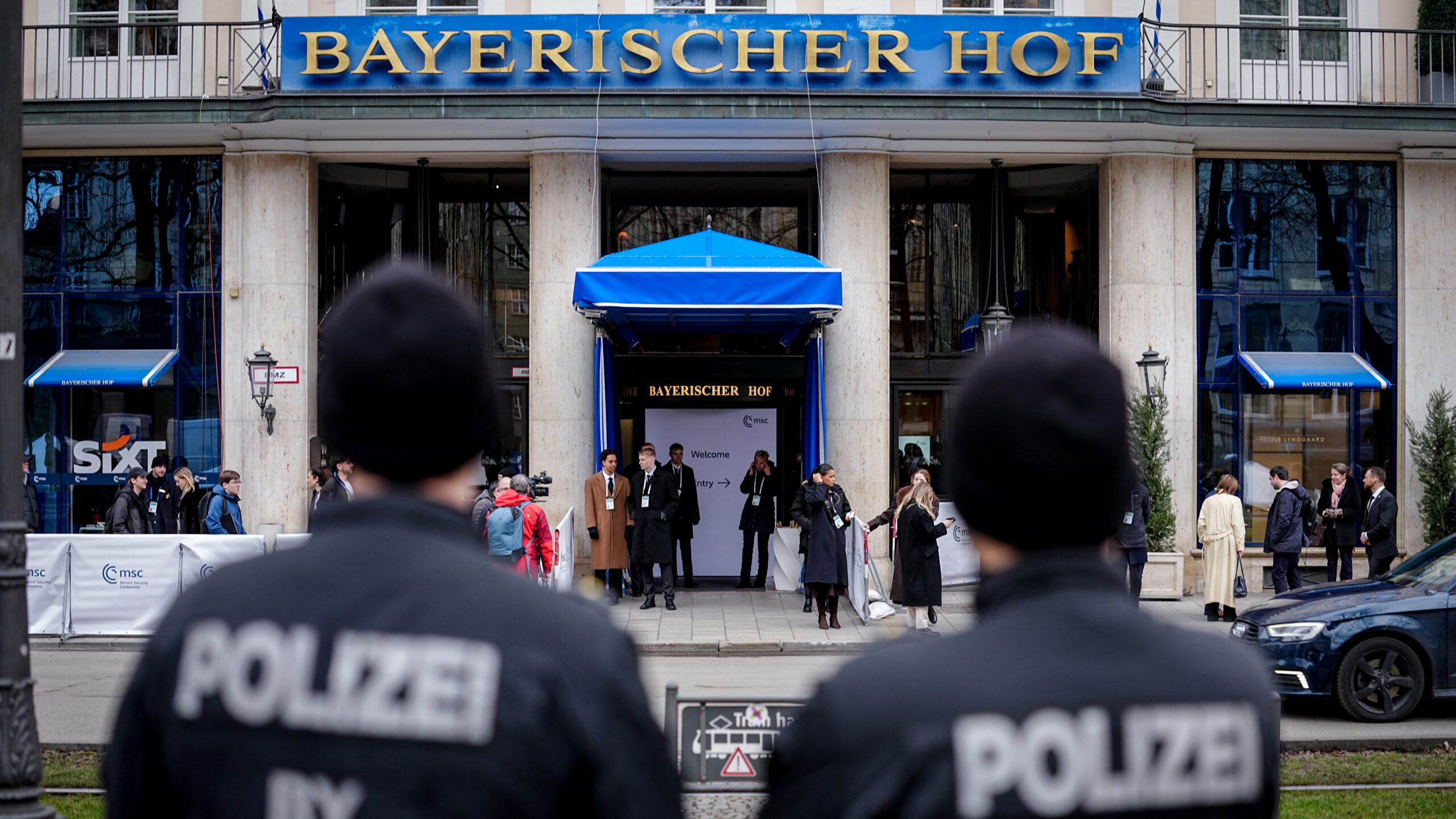
Perhaps the most interesting thing in the latest report from the Munich Security Conference is the gigantic photo of the US Capitol in the 8th page of the brief. One would assume that a conference based in Europe would primarily focus on some European imagery.
But as one reads, the aesthetic choice is clarified. ‘The world has entered a period of wrecking-ball politics. Sweeping destruction—rather than careful reforms and policy corrections—is the order of the day,’ the report’s preface states.
‘The most prominent of those who promise to free their country from the existing order’s constraints and rebuild a stronger, more prosperous nation is the current US administration. As a result, more than 80 years after construction began, the US-led post-1945 international order is now under destruction.’ The culprit according to MSC is the United States. ‘The result is a new climate in which those who employ bulldozers, wrecking balls, and chainsaws are often cautiously admired if not openly celebrated. The most powerful of those who take the axe to existing rules and institutions is US President Donald Trump.’
Perhaps a closer look at home should be in order. The European strategic elite remains fixated on the United States, yet fails to ask why intra-European rivalries are now returning. Divisions within the European Union have become increasingly visible as geopolitical pressures intensify and long-simmering institutional rivalries resurface.
‘The European strategic elite remains fixated on the United States, yet fails to ask why intra-European rivalries are now returning’
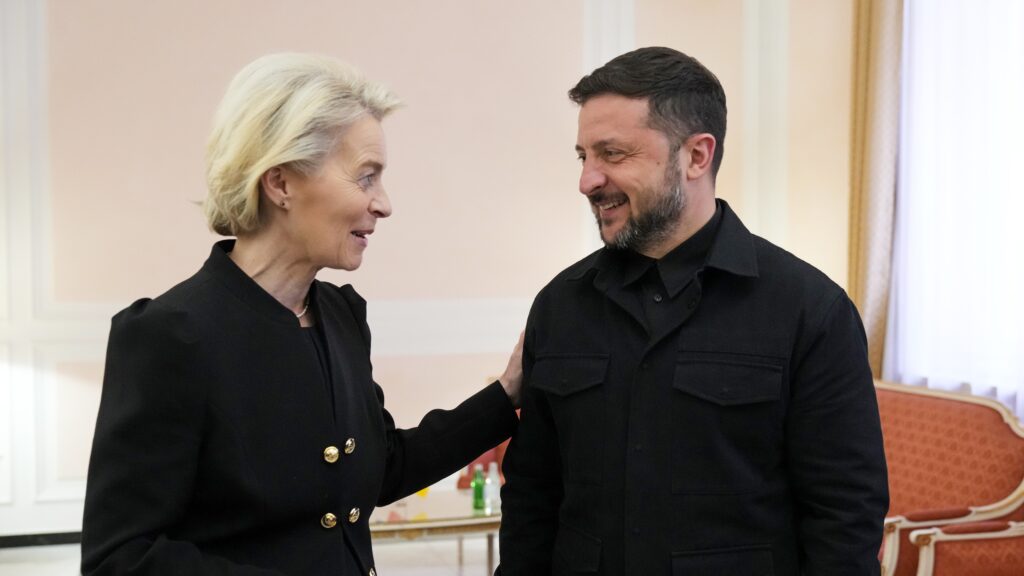
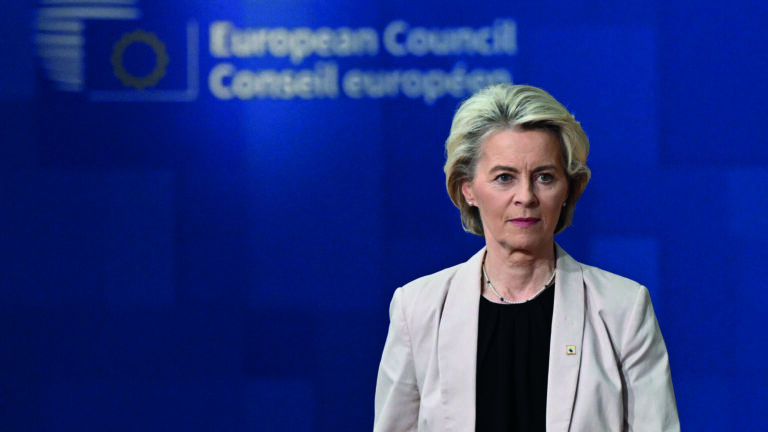
A recent example of a vertical intra-elite dispute is one between European Commission President Ursula von der Leyen and High Representative for Foreign Affairs Kaja Kallas. Von der Leyen had advanced the idea of establishing a small intelligence cell within the Commission, reporting directly to her, to consolidate and analyse classified information from national agencies. The aim was to streamline decision-making in response to mounting hybrid threats from Russia, including cyberattacks, sabotage, and disinformation, particularly at a time when transatlantic intelligence cooperation appeared less predictable. By concentrating analysis in a tightly controlled structure, the Commission hoped to circumvent the slow and often fragmented coordination mechanisms that characterize cooperation among the EU’s 27 member states.
Yet the proposal quickly encountered resistance, exposing the deep fault lines between supranational ambition and intergovernmental control. Kallas, whose European External Action Service already oversees the EU Intelligence and Situation Centre, objected that the plan would duplicate existing capacities and divert scarce resources. National governments, and diplomats sympathetic to closer cooperation also noted that existing intelligence-sharing frameworks are underutilized, raising doubts about the need for an additional structure. Influential leaders such as Italy’s Giorgia Meloni and Germany’s Friedrich Merz signalled support for reinforcing current mechanisms rather than creating new ones. Confronted with institutional pushback, von der Leyen recalibrated her initiative, scaling it down to a modest unit designed to complement, rather than rival, the EEAS. The episode underscores the limits of centralization in a union where questions of power distribution remain unsettled.
In another axis, intra-national rivalry is also back. French President Emmanuel Macron has emerged as the most forceful advocate of a European reorientation, framing the current moment as a geopolitical emergency demanding a revolution in European ambition. He recently argued that the Union must now unite not merely to regulate markets or prevent war among its members, but to project power collectively in a competitive world. In his view, achieving competitiveness with the United States and China would require vast annual investments, financed in part through joint borrowing instruments modelled on the post-pandemic recovery fund. To that end, Macron argues that Europe’s substantial private savings should be mobilized toward continental priorities, and that common debt issuance would both fund innovation and strengthen the euro’s global standing.
Naturally, German Chancellor Friedrich Merz and Italian Prime Minister Giorgia Meloni recently opposed several key proposals from French President Emmanuel Macron aimed at enhancing the European Union’s strategic autonomy and reducing reliance on external powers, particularly in light of uncertainties surrounding US policy under a potential Trump administration, ongoing Russian aggression, and competition from China. Perhaps, as a sign of reluctance to see a French hegemony within EU, in recent weeks, they have both rejected Macron’s push for a strict ‘buy European’ clause in new EU funding mechanisms dedicated to weapons purchases, arguing that such restrictions could limit flexibility in urgent defence needs, such as acquiring arms for Ukraine, and potentially alienate key partners.
Similarly, they have dismissed calls for issuing new joint EU debt to finance massive investments in defence, artificial intelligence, quantum technologies, and the green transition. Merz and Meloni, aligning with more fiscally conservative views, prioritize deregulation and productivity improvements over additional common borrowing, viewing it as a distraction from core economic challenges.
They have also resisted efforts to accelerate a shift away from dependence on American technology and digital infrastructure, which Macron sees as essential to safeguard Europe if US leverage were used to disrupt the continent’s economy, preferring instead to maintain strong transatlantic ties rather than pursue rapid decoupling that could harm trade and investment flows. Finally, they have opposed establishing a clear preference for European companies in public procurement rules, especially in strategic sectors like defence and clean technologies, warning that such measures risk deterring foreign investments, provoking trade retaliation, and disrupting global supply chains, while advocating for a lighter regulatory approach focused on free trade and competitiveness.
‘These internal tensions unfold against a broader backdrop of transatlantic uncertainty that has sharpened European debates about autonomy’
Ultimately, the challenge facing the MSC and the European elite is not Russia, the United States, or China. It lies in their inability to grasp the core character of the European Union: simultaneously too large and unwieldy for growth and defence, yet too small and too weak to function as a hegemon or an empire.
These internal tensions unfold against a broader backdrop of transatlantic uncertainty that has sharpened European debates about autonomy. Under President Donald Trump’s renewed administration, many European policymakers perceive the United States as increasingly disruptive to the liberal international order it once championed. Trade disputes, tariff threats, and ambiguous commitments to territorial integrity have unsettled long-standing assumptions about American reliability. Surveys discussed at the Munich Security Conference suggest a striking shift in global threat perceptions, with a growing number of countries placing the United States alongside China and Russia as a potential source of instability. ‘Last but not least, effectively pushing back against the demolition men requires much more political courage and innovative thought,’ the MSC report suggests. Perhaps, it would be best if that political courage is directed inward first.
Related articles: