2026 has barely begun, and the world already feels like a centrifuge in whole spin. Great powers are moving faster than analysts or allies can comprehend. Yet last year was hardly eventless.
The trigger for this year’s political upheavals spells, as so often in the past decade, Donald Trump. Within ten days, the US president sent special forces to Venezuela, captured Nicolás Maduro, and announced that the trial would be held in New York.
What followed were two developments. First, the Venezuelan success was leveraged as kindling for an implicit threat to topple the Cuban regime. Second, threats emerged that the US would seize Greenland from its Danish allies for ‘security reasons’.
That’s not even all of it. Moreover, the US naval forces have intercepted Russian oil tankers in the Atlantic, patrolled the Indian Ocean to monitor mass protests in Iran, and in Latin America, Cuba’s regime teeters on the brink after Caracas’s collapse.
Thus, nothing lies beyond the scope of potential US actions. As Americans themselves say: ‘The bets are off the table.’ That these events unfold simultaneously is no coincidence.
‘The multipolar order is inevitable, and [Trump] is adjusting America to it’
America’s actions are not spasmodic but part of a larger pattern. Trump understands that Washington can no longer both defend Taiwan from China and prevent Russia from swallowing eastern Ukraine. The multipolar order is inevitable, and he is adjusting America to it.
A Paradoxical Move but a Logical Strategy
In hindsight, the experts’ warnings of Trump ‘the isolationist’ seem almost comical. Never has a so-called isolationist operated in so many corners of the globe.
Yet Trump’s policy can indeed be described as ‘isolationism’. Not in the stereotypical sense but in a new form that doubles as imperial strategy, military manoeuvring, and economic retrenchment. On the surface, a withdrawal; in practice, a ruthless consolidation.
Hints were there for the attentive in the National Security Strategy (NSS) unveiled in November 2025.
For the Western Hemisphere, the signal is unequivocal: the United States will reassert and enforce the Monroe Doctrine to restore American pre-eminence, protecting the homeland and key geographies. As President Trump dubbed it, the ‘Donroe Doctrine’. It’s the most striking formulation.
In Asia, the headline reads: ‘Win the Economic Future, Prevent Military Confrontation’. No one can help but notice how the NSS downplays the high-drama, military-centric showdown with China that defined the prior two administrations. Instead, it is reframing Sino–American rivalry almost entirely through an economic lens. Also, practically speaking, no one knows what this will actually mean for Taiwan when China decides to attack it. Is it really in America’s interests to go into conflict with its rival and essential trading partner?
Moreover, for Europe, the US strategy has shifted. The continent is downgraded from a strategically autonomous subject to an object in great-power competition. It would not be unfair to assume this justifies actions deemed necessary to secure Europe—not its sovereignty, but its relevance to America.
The strategy highlights Europe’s vulnerability to ‘various civilizational threats’, underscoring a shift: no longer exporting American values, but securing American assets. This also partly explains the Trumps’ approach and attitude toward the Danes regarding Greenland.
Imperialism’s New Face
From these initial weeks’ happenings, it is not an overstatement to say that the era of American geopolitical overextensions and hollowed-out industrial base is over. One can call it an ‘unapologetic consolidation-oriented’ phase, marked by hard transactionalism and prioritization of national interests.
‘The era of American geopolitical overextensions and hollowed-out industrial base is over’
In one sense, this pursuit of national interests is hardly isolationist; it’s only, maybe, compared to what came before. But for geographically proximate allies or enemies, it feels like imperialism.
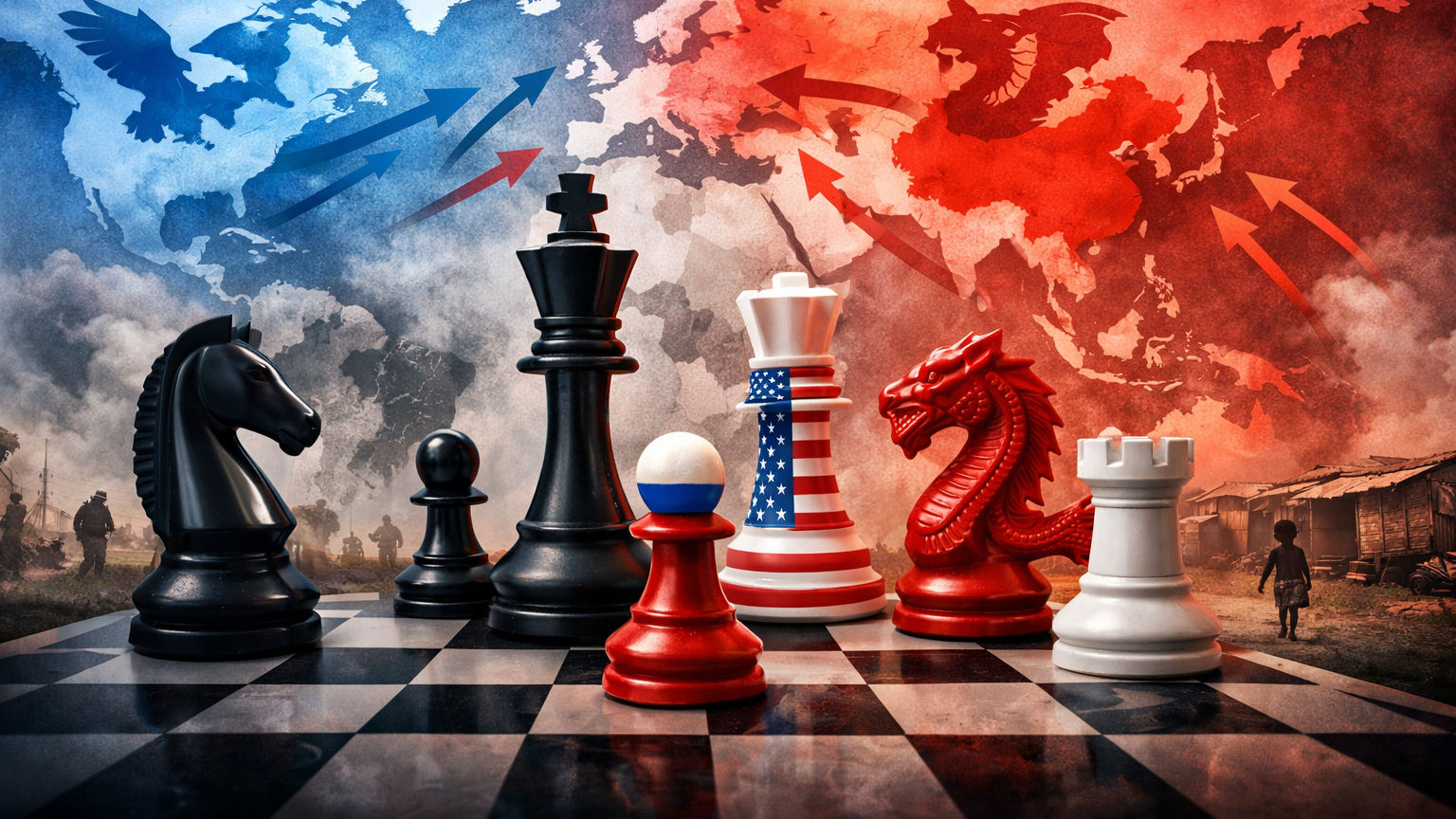
The natural conclusion, therefore, is that the praxis of the liberal international order is gone, and spheres of interest have returned—not only for the US, obviously, but also for China and Russia.
The honest takeaway from the year’s first two to three weeks is this: to the American Empire, everything remains on the table. Yet its interest in the world has never been narrower. The United States is not retreating from the globe, but from those regions that no longer yield dividends. For the same reasons, China and Russia will likely follow suit.
Paradoxically, imperialism has become the new isolationism.
Related articles: