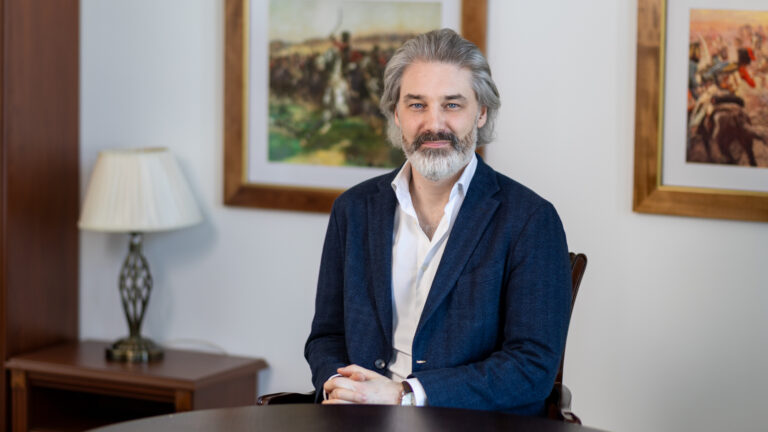
A peaceful vacation in Zanzibar turned into a war-torn Omani quarantine. The childhood friend of the writer of these lines, Péter Újvári and his family were returning home to Hungary via the Middle East just as the Iran war broke out. A glimpse into a drama that happened to tens of thousands of tourists in the first days of March. Our protagonist, a Budapest entrepreneur, has since returned home safely.
***
What did you do in Zanzibar in February?
We took a long-planned family vacation to Zanzibar. The whole trip was exactly as one would imagine: calm, recharging, a bit of a dream. Right up until the flight home.
On the way back, you were supposed to transfer to Hungary in Dubai, but air traffic control diverted your plane to Oman in the air. How did it happen?
We took off from Zanzibar at 8am. It started out as a completely normal day. There was nothing to indicate that anything extraordinary would happen. At around 1:30pm, we were already in the United Arab Emirates area. On the on-board display, we saw that the plane was starting to make a strange curve. We thought it was some kind of routine manoeuvre, but then suddenly they announced: we were turning back. We were about 150–200 kilometres from Dubai when the plane turned around. It was all strange. The crew was calm, there was no panic, more of a curious silence. Not long after, the information came: we were being redirected to Salalah, Oman.
What was going through your minds in this not-so-usual situation?
We tried to think rationally. At first, we guessed it was something technical. During my vacation, I only followed world political events with one eye, so eventually the Iranian conflict and the American military preparations jumped in, but we didn’t understand what this had to do with Dubai. I wouldn’t have thought that this would spread so quickly and directly to the surrounding countries.
‘The crew was calm, there was no panic, more of a curious silence’
Meanwhile, the mood on board also noticeably changed. The crew suddenly directed everyone back to their seats, the flight attendants put on that well-known, slightly tense smile, and all their movements sped up spectacularly. One of them said in a low voice: ‘The only thing for sure is if the plane is on land. Then we’ll be safe.’ At that moment, we felt that this was not just a simple delay. We found out afterwards that we had been in the air at roughly the same time as the Iranian drones heading towards Dubai.
What did the airline representatives tell you after landing in Salalah? What did you learn about what would happen with your further travel or accommodation?
After landing, we were greeted by a completely deserted airport in Salalah. Ours was the only plane on the tarmac, and we were the only passengers in the waiting room. This itself said a lot about the situation. With the help of WIFI and information from home, we began to piece together what was happening around us. It quickly became clear that the airspace closure was no coincidence and that it could last for days. We also understood that an airline—where safety comes first—cannot perform miracles in such a situation. A few hours later, about 150 people were taken by bus to two or three nearby hotels. It was quite a mixed group: Italians, Slovaks, Austrians, Russians, Lithuanians, Asians and us, 13 Hungarians. The FlyDubai representative explained the situation at the hotel: they also couldn’t do anything about the airspace closure, and their airline only flies to Dubai from there, and nowhere else. This meant that we would have to wait until Dubai airport reopened. He also made it clear that we would be able to travel onward in a few days, and asked us to always be ready to leave, because they could come pick us up at any time.
What was the mood like on the first night?
The mood was definitely optimistic on the first night. We thought it would be a forced rest for a day or two, and FlyDubai would get us home safely. As time went on, we felt more and more uncertain about the situation.
Was it clear then that you were in the middle of the Iranian war, and that it wouldn’t be easy to get out of there?
We started to piece together what we had gotten ourselves into on the plane. But I think what caught everyone by surprise was that Iran was not only focusing on one target, but was also targeting neighbouring countries, for example, with drones. This kind of expansion of the war became really tangible for us there, on the spot. At that point, we already felt that it would not be easy to get out of there.
How were you able to mentally process day by day that this could be a life-threatening situation with the escalation of the war?
One of the first things we did in Oman was to register with the Hungarian Ministry of Foreign Affairs and request foreign protection. On 1 March, the news came through the app that Iran had attacked Oman and that the country’s security classification had been changed from Category IV to Category II. This is not the message you want to see at a time like this.
‘This kind of expansion of the war became really tangible for us there, on the spot’
We were constantly monitoring developments. We shared the news with the Hungarian team in a joint chat at the hotel; every little piece of information mattered. In the first few days, we always found something to hold on to, some news that gave hope. Then we had to realize that the only way to deal with this mentally in the long term was to consciously give the days a framework. We tried to keep our little boy busy with programmes so that it would be more of an adventure for him, not a tension.
In the meantime, we started looking for contacts through all possible channels: we contacted acquaintances who we thought could help us, and we tried to indicate our situation. For example, we wrote emails to the Minister of Foreign Affairs and the Omani ambassador. We were in daily contact with our travel agency, the airline, and the Omani embassy. A friend of ours who had insight into the inner workings of the foreign ministry told us that there was a huge amount of work going on in the background: they were trying to coordinate airports, airlines, embassies, and passengers stranded in different parts of the world. This was a bit reassuring—we saw that they were working on the matter. And also that in this situation, patience is at least as important as information.
There must have been psychological ups and downs between hope and hopelessness. How did you deal with it?
We arrived at the hotel in Salalah on Saturday, 28 February. At first, we thought this was a temporary situation. On Monday, however, the airline representative made it quite clear: while we were at the hotel, we would enjoy FlyDubai’s hospitality, but once we checked out, they would no longer be responsible for us. He then added: There would be no Salalah–Dubai flight available for us in the foreseeable future. The foreign ministry’s focus was on Dubai, where thousands of people were stranded, so we could mostly rely on ourselves.
Meanwhile, a Lithuanian mother told us that they had watched Tuesday’s drone attack from their window. The drone flew about 100 metres from the hotel and exploded in the industrial port nearby. Then they ran down to the street with shaky legs, with their children in their arms. That evening, another twist came. FlyDubai informed us to pack up, be ready by 11:00pm, they would take us to the airport by bus, and fly to Dubai. Hope was rekindled. We stood in the hotel lobby until 1:00am in the morning. The children were already sleeping on their suitcases, everyone was tired, but we were ready. The first bus arrived, but then the new information: the airspace was closed again. From then on, we switched to ‘paramilitary’ mode, a situation not unfamiliar to our family: our little boy was born on the first day of the Covid lockdowns, and even then, we had to cope with a completely uncontrollable situation, without any external help.
‘The drone flew about 100 metres from the hotel and exploded in the industrial port nearby’
Interestingly, the fact that there were three of us also stabilized us. If we had been alone or two, the internal pressure to get out immediately would probably have been much greater. So we built a system around ourselves.
How many days did you end up spending in Salalah? What was the place like? What did you do with your time?
We ended up spending a whole week in Salalah. Oman had previously been completely off my radar, but it showed a surprisingly beautiful side to it: beautiful, white sandy beaches, pleasant weather, a relaxed atmosphere, and very nice locals. The whole thing had a unique, restrained Muslim cultural atmosphere. Our hotel was ideal for being ‘stuck inside’ for a week. Nice park, pool, safe environment—with a small child, this matters a lot. We tried to structure the days as if it were a strange, slightly extended vacation. We also visited two different beaches in the city. One was near the Sultan’s local residence, Al Hosn Palace, and it was during Ramadan. Driving there was a completely surreal experience: it was like driving through a perfectly constructed but empty set of a film studio; everything was tidy, clean, but lifeless. There was a moment when we tried to get a taxi driver to take us to the site of the drone attack, and we even offered him a hefty tip. But he flatly refused. They didn’t need disaster tourists there.
How did you finally manage to organize the trip home?
We pulled practically every possible string—the Hungarian ambassador to Oman received a minor ‘diplomatic DDoS attack’ from us. After many attempts and requests for help, we suddenly received a call from the Hungarian ambassador—he assured us that they were working on getting the Hungarians stranded in Salalah home. This was the first point when we felt that we really had a concrete direction.
‘It was like driving through a perfectly constructed but empty set of a film studio; everything was tidy, clean, but lifeless’
On Thursday, we finally managed to buy three tickets for a Salalah–Budapest charter flight with Kartagó Tours. With the embassy’s help, we were put ahead of the waiting list, and as a family with small children, we had an advantage. Meanwhile, the embassy was collecting data on who was still in Oman through an app. They had also organized a relief flight for 9 March—this would have been our plan B if the Saturday charter had not taken off. However, the flight took off on Saturday morning, 7 March, flew over Saudi Arabia, with a stopover in Hurghada, thus avoiding the airspace closure, and returned to Europe. We arrived at Budapest Ferihegy Airport exactly one week late, on Saturday afternoon.
Thinking back on it from home, how do you evaluate this unsolicited Middle Eastern adventure?
As an adventure. If someone is even a little interested in world politics, follows events, or maybe has a bit of a journalistic attitude, as my partner has, then a week like this stuck in a conflict zone is definitely an experience of a lifetime. At home, we deal with self-awareness a lot anyway, so it was especially interesting to observe how everyone reacted in this unusual situation. The primary consideration throughout was that our little boy would experience as little of this uncertainty as possible. Since we returned home, the child’s room has been a space constantly opening and closing, where paper aeroplanes come and go.
Related articles:
At a time when public debate is increasingly polarized and superficial, Hungarian Conservative remains committed to depth, intellectual honesty, and independent conservative thought.
Producing high-quality journalism requires resources. Your contribution helps us expand our coverage, reach new audiences, and keep our content accessible.

Please consider supporting our mission.