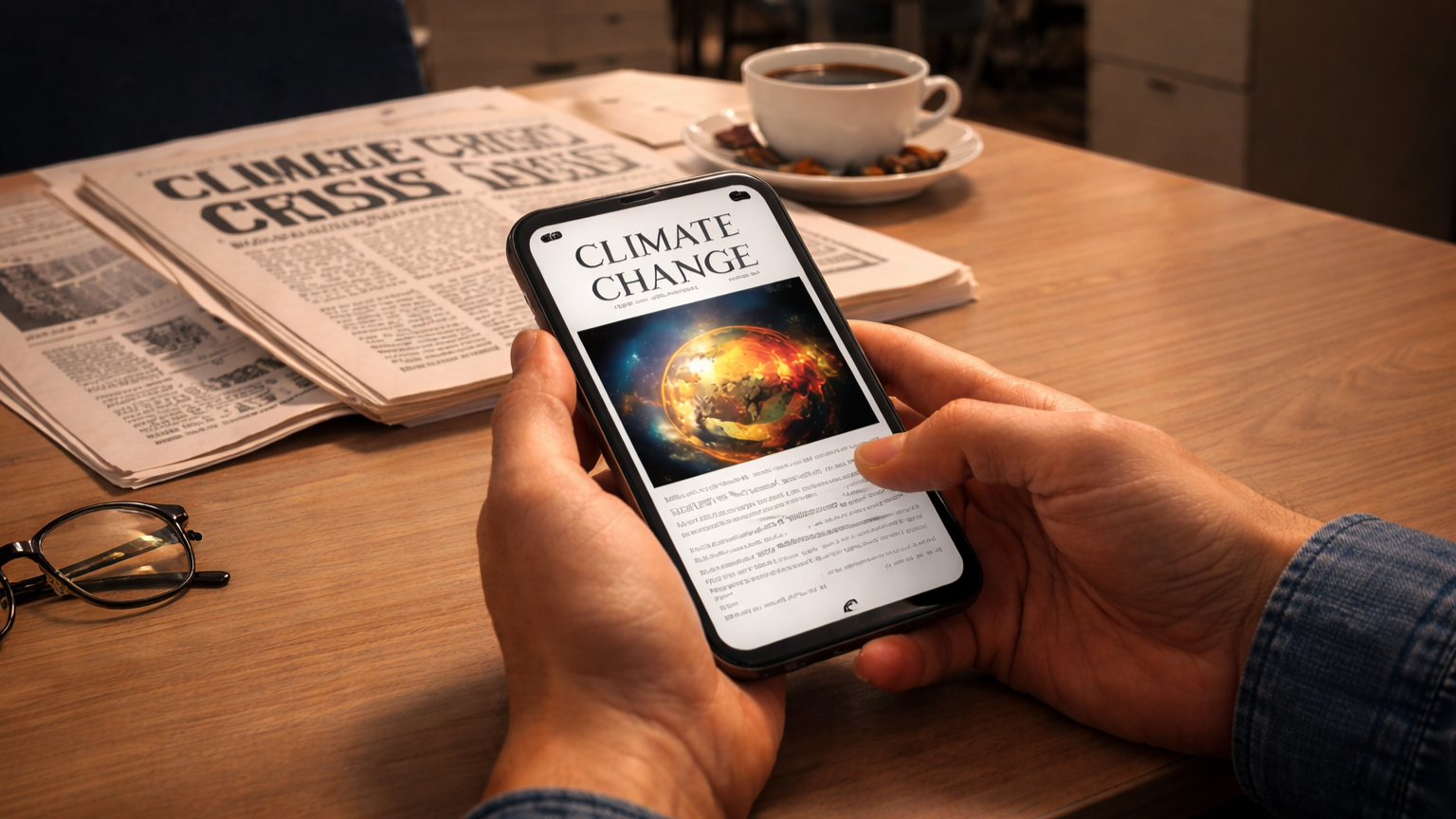
Over the past decade, climate change has been one of the defining topics on the political agenda and in the media. Today, however, it is increasingly pushed to the background—partly because it is perceived as a politically divisive topic: public attention is captured by rising living costs and energy prices, as well as other issues perceived as more urgent. Media attention intensifies from time to time, such as during UN climate summits or environmental awareness days, but these waves quickly subside. What is driving this shift, and what does a weakening public climate discourse mean for global action?
Rising Heat, Declining Attention
A few years ago, the issue of climate change was omnipresent. In October 2021, media coverage peaked, with around 1,100 articles per month published on the topic in daily newspapers across North America, Europe, Africa, and Asia. Climate change played a central role in political campaigns, and between 2020 and 2021, nearly 300 new climate and environmental measures were introduced worldwide. In 2022, over 2,000 companies reported science-based climate targets—more than in the previous seven years combined.
Since then, however, public attention to climate issues and the political momentum behind them have noticeably declined. According to the latest global media monitoring by the Media and Climate Change Observatory (MeCCO), the number of climate-related news stories fell by 14 per cent in 2025 compared to the previous year, and was 38 per cent below the 2021 peak. Based on 22 years of measurements, 2025 ranked only tenth overall. The decline was particularly significant in North America, Europe, Africa, and the Middle East, while Asia, Latin America, and the Pacific saw more modest decreases. In the United States, the volume of climate-related press coverage dropped by almost two-thirds between 2021 and 2025.
This trend is all the more striking because the underlying climate indicators continue to deteriorate. The World Meteorological Organization (WMO) confirmed that 2025 was among the three warmest years on record. This brings the world closer to crossing—and potentially sustaining—the 1.5°C global warming threshold set in the Paris Agreement, beyond which the likelihood and expected severity of extreme climate impacts significantly increase.
‘This trend is all the more striking because the underlying climate indicators continue to deteriorate’
Interest in climate issues has not disappeared, but it has become harder to sustain. A 2025 Reuters Institute study covering eight countries found that climate news consumption is strongly linked to social background, political orientation, and how much people feel overwhelmed by a constant stream of negative news. The report emphasizes that many avoid climate news not because they are indifferent, but because they are repeatedly exposed to discouraging narratives that offer no clear avenues for action. Over time, this can reduce public attention and weaken the capacity for political pressure. In the countries surveyed—including France, Germany, and the United Kingdom—only 47 per cent of respondents in 2025 said they had encountered a news story about climate change in the previous week, continuing a downward trend observed since 2022.
How Climate Change Faded from Public Discourse
In politics and the media, there is constant competition for attention. In recent years, climate change has often been overshadowed by problems perceived as more immediate, such as inflation, rising energy prices, or armed conflicts. MeCCO data show that during the pandemic, global climate coverage fell by 59 per cent. In the United States, this trend was also confirmed by a Washington Post analysis: in 2025, not only did Republicans and the media discuss climate change far less, but the Democratic Party’s communication priorities also shifted markedly. Mentions of climate change declined, while energy and electricity costs became more prominent in political messaging.
According to a 2025 Gallup survey, Americans still worry about global warming, but the topic has slipped to the very bottom of the list of environmental issues. A similar shift can be observed in Europe: while the societal relevance of climate change did not vanish overnight, public priorities have visibly changed. The 2024 Eurobarometer survey found that living costs and inflation remain among the top concerns, while environmental and climate issues have dropped compared to previous years—now ranking only fifth among day-to-day concerns.
This points to a recurring problem: climate communication has long been too abstract and complex, often failing to align with voters’ direct experiences. In times of economic hardship, climate messages can easily become campaign risks, especially if they are not linked to issues of livelihood, health, and security. This explains why interest in climate change news remains much more stable in parts of the Global South—such as Brazil or India—where local media often discusses climate change through concrete social and developmental issues. In contrast, highly polarized, theoretical debates in the Global North can easily lead to news fatigue and apathy.
‘Climate communication has long been too abstract and complex, often failing to align with voters’ direct experiences’
The decline in interest in climate news has also been reinforced by shrinking television reach. According to Reuters Institute data, the share of people over 55 who encounter climate-related content on a weekly basis has fallen by around 10 percentage points since 2022. This group has traditionally relied on television for information. Although online platforms and social media have partly taken over this role, their reach has not fully compensated for the retreat of television channels. The research also shows that trust in politicians and the media is declining, further weakening the climate discourse. While trust in scientists remains high (71 per cent on average), only about one-third of respondents consider political decision-makers to be credible actors on climate policy. Social media and traditional media platforms—such as television, radio, and print—often rank near the bottom in terms of trust.
The Consequences of Declining Media Attention
The reduced visibility of climate change is not merely a communication issue—it also has political and practical consequences. When the topic drops out of the media, the public is less likely to perceive it as an urgent problem. This diminishes its political weight, which in turn generates even less news attention. A negative spiral emerges, and its effects are already visible in policymaking and corporate communication.
Ten years after the adoption of the Paris Agreement, 2025 was expected to become a turning point in the implementation of global climate goals—yet progress ultimately remained limited. By the end of the Belém COP30 climate summit, only 119 countries—less than two-thirds of signatories—had submitted new or updated nationally determined contributions (NDCs). According to data from the Grantham Research Institute on Climate Change and the Environment at the London School of Economics, fewer than 50 new climate and environmental regulations were adopted worldwide in 2024, in stark contrast to the intense legislative wave of previous years. In the corporate sector, pressure is also easing: fewer and fewer companies publicly emphasize net-zero targets, and references to ESG in corporate earnings calls have dropped to about one-third of their 2021 peak.
At the same time, societal support for climate action remains notably high. A representative survey of nearly 130,000 people published in Nature Climate Change in 2024 found that 89 per cent of respondents believe their own government should do more to combat global warming. The 125 countries covered by the survey account for roughly 96 per cent of global CO₂ emissions. Several studies draw attention to this ‘silent majority’ problem: many people support climate measures around the world, but they assume they represent a minority view, and therefore they rarely voice their opinions publicly—which in turn exerts less political pressure on decision-makers.
The media can play a key role in making the majority position visible and thereby restoring momentum for collective action. Climate change can be brought back to the centre of attention if abstract reporting is replaced by practical analyses connected to everyday life. Positive framing and showcasing examples that actually work can help transform uncertainty into a sense of agency—and passivity into participation.
Related articles: