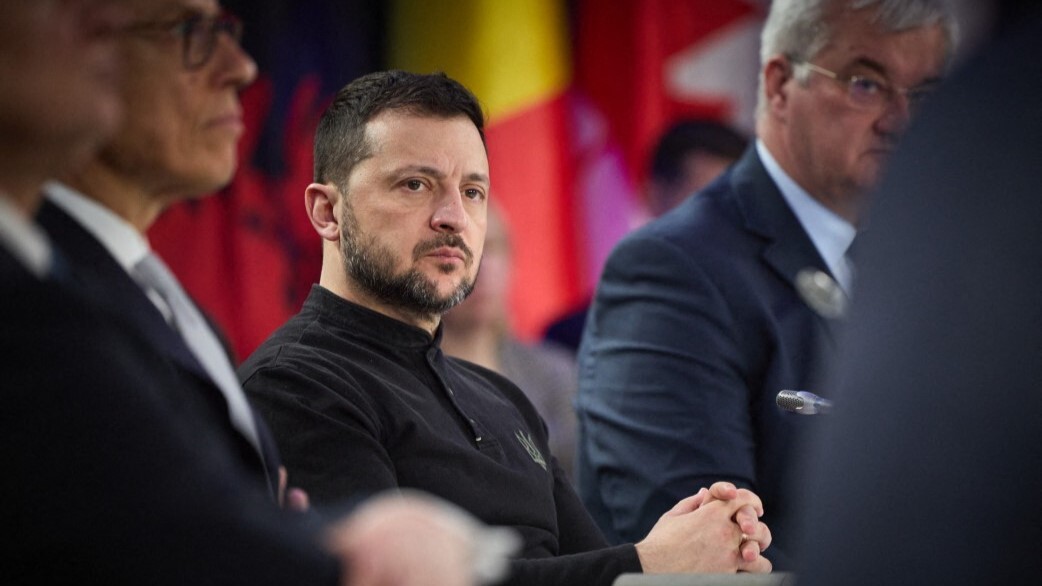
President Volodymyr Zelenskyy of Ukraine travelled to London, United Kingdom, to meet with UK Prime Minister Kier Starmer, President Emmanuel Macron of France, and Chancellor Friedrich Merz of Germany on Monday, 8 December and discuss continuing war aid to Ukraine.
‘The leaders all agreed that now is a critical moment and that we must continue to ramp up support to Ukraine and economic pressure on Putin to bring an end to this barbaric war,’ PM Starmer’s press office released the public statement after the meeting.
Meanwhile, President Zelenskyy told reporters in a WhatsApp group that Russia wants Ukraine to give over land, however, he believes that his country has ‘no such right’ under its constitution, and added: ‘and to be frank, we don’t have a moral right either,’ as reported by the Associated Press.
All this is taking place while US President Donald Trump is reportedly putting increasing pressure on Ukraine to accept his proposed peace deal, as his patience is starting to wear thin while the conflict in Eastern Europe drags on. Famously, President Trump vowed to end the Russo–Ukrainian war ‘in one day’ if elected during his winning 2024 presidential campaign.
Dr Sándor Seremet, Senior Researcher at the Hungarian Institute of International Affairs, has appeared on the morning show Napindító (Day Starter) on the Hungarian news channel HírTV to discuss the latest developments.
He started his musings by challenging President Macron’s claim that Europe still has ‘a lot of cards’ in the Russo–Ukrainian war. Dr Seremet believes that prolonged, increased sanctions and the frozen Russian assets are the only two leverage points Europe still has in the conflict. However, sanctions are ‘double-edged swords’ that also hurt Europe’s economy, and seizing Russian assets held in Europe would make the continent’s nations lose credibility with foreign investors, especially from Middle Eastern monarchies. He also made the point that tens of billions of Euros spent on Ukrainian aid are an increasingly bigger burden on the European economy.
As for President Zelenskyy’s claims that he has no right to cede land to Russia, Seremet pointed out that the Ukrainian constitution claims that changes of the nation’s territory can only be determined by refendums, and thus, an international treaty cannot transfer land. However, there are no sufficient conditions for a referendum in Ukraine right now. The expert then explained that the peace deal does not stipulate that Ukraine officially recognize the annexation of its territories by Russia, it only calls for a ‘de facto’ recognition.
Also, the Ukrainian government could first accept an agreement to cede territory, which would then be confirmed by a referendum, Dr Semeret also stated.
He went on to note that territorial concessions remain deeply divisive within Ukrainian society. According to Dr Seremet, Ukrainians who have remained in the war-torn country—especially those living near the front line—tend to support an immediate freezing of the front, with many even willing to accept ceding territory if it would bring an end to the fighting. In contrast, those who fled the country or live farther from the battlefield are generally more inclined to continue the war and oppose giving up any land, he told the audience.
Related articles: