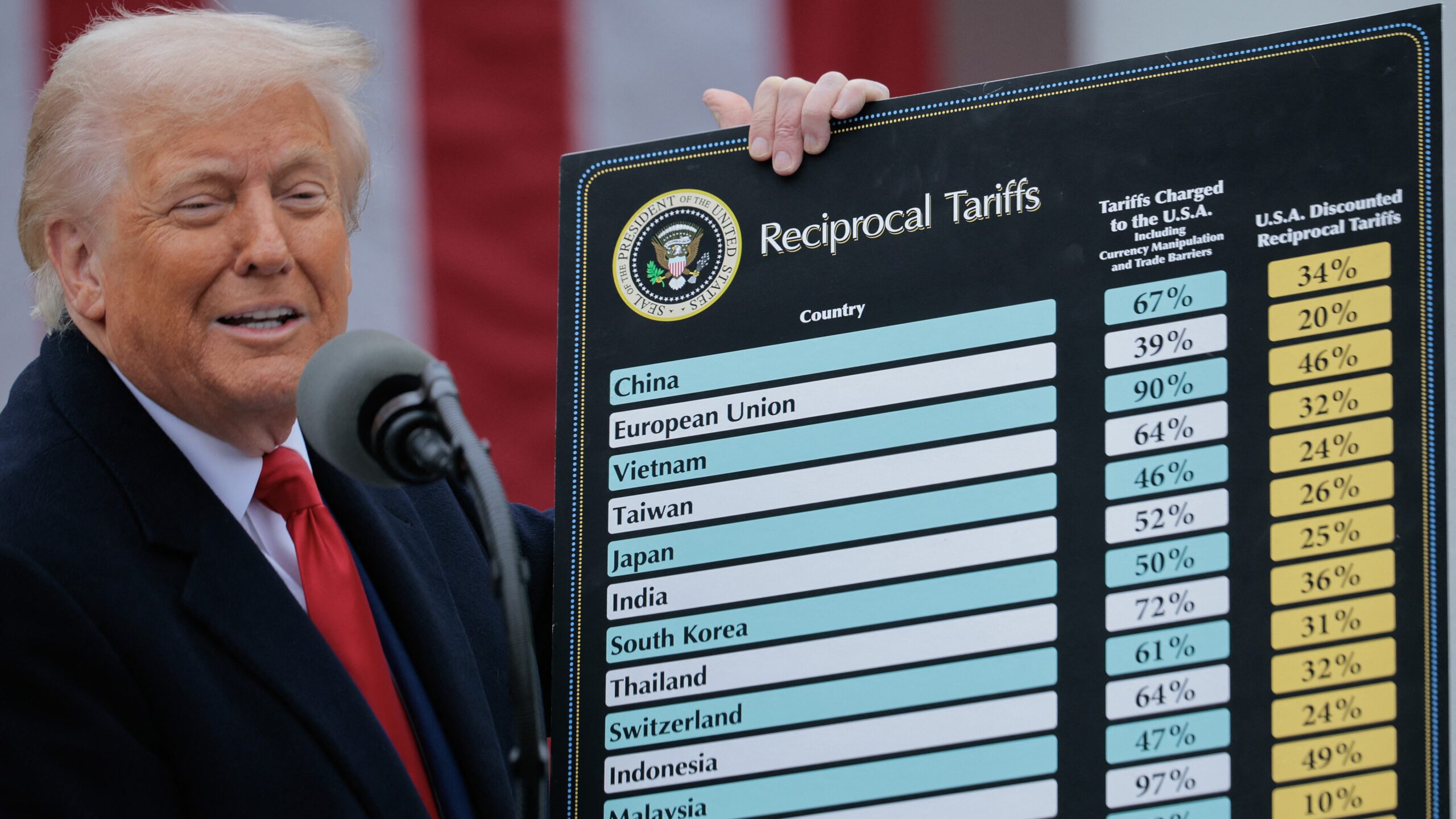
In a 6–3 decision, the United States Supreme Court has ruled that President Trump does not have the unilateral authority to set tariff rates under the 1977 International Emergency Economic Powers Act (IEEPA). The ruling came down on Friday, 20 February, after long deliberation by the nine justices.
While the decision took long—oral arguments were heard by the Court on 5 November 2025—it certainly did not come as a surprise.
Most legal analysts understood that the plaintiffs had a strong case appealing to Article I, Section 8 of the Constitution, which states that ‘The Congress shall have Power To lay and collect Taxes, Duties, Imposts and Excises’; and the fact that historically, Congress had set the tariff rates as well. We here at Hungarian Conservative also foresaw a likely ruling against the Trump tariffs in our piece from last November.
Markets also anticipated such a decision. Therefore, on the day it was announced at last, on Friday, the Dow Jones gained 0.47 per cent, the S&P 500 gained 0.69 per cent, while the tech-heavy NASDAQ Composite—which has been under pressure from the AI disruption all year—gained 0.90 per cent.
President Trump’s sweeping tariffs issued under IEEPA came into effect back on 2 April 2025, ‘Liberation Day’, as he liked to call it. This sent the overall US stock market into a free fall, with the Dow Jones being down 13 per cent YTD before the temporary lifting of the tariffs was announced a week later. Then, countries (starting with the United Kingdom) and the European Union began to sign new trade deals with the US one by one, based on the tariff rates set by President Trump under IEEPA—these trade deals can now be considered null and void.
President Trump, after taking some jabs at the Justices, was quick to announce new, 10-per cent global tariffs using his powers as per Section 122 of the US Trade Act of 1974 this time. He then quickly raised the rate to the maximum 15 per cent the following day. This clause gives the President explicit powers to raise tariffs up to 15 per cent—however, only for a temporary, 150-day period.
Furthermore, Section 301 of the same act gives the United States Trade Representative the power to ‘impose tariffs’ with no time or rate restriction in order to ‘remedy a foreign trade practice’. Thus, President Trump could invoke that section if the temporary, 150-day tariff measure expires.
The more curious question pertains to the about $180 billion the federal government had collected in tariff revenue under President Trump’s IEEPA tariffs. Companies are already queuing in line to sue the administration for reimbursements, arguing that those levies were illegal, according to the SCOTUS’ decision.
The SCOTUS majority opinion actually makes no mention of the revenue collected, despite it being a hotly debated issue in the press in the lead-up to the decision. Likely another set of litigations, spanning over a year, will have to follow to reach a conclusion on the matter.
Democrats may be ill-advised to root for another decision against the Trump administration in this case—the nearly 200 billion of essentially tax refunds to American companies may just end up being a very effective short-term stimulus to the economy.
Related articles: