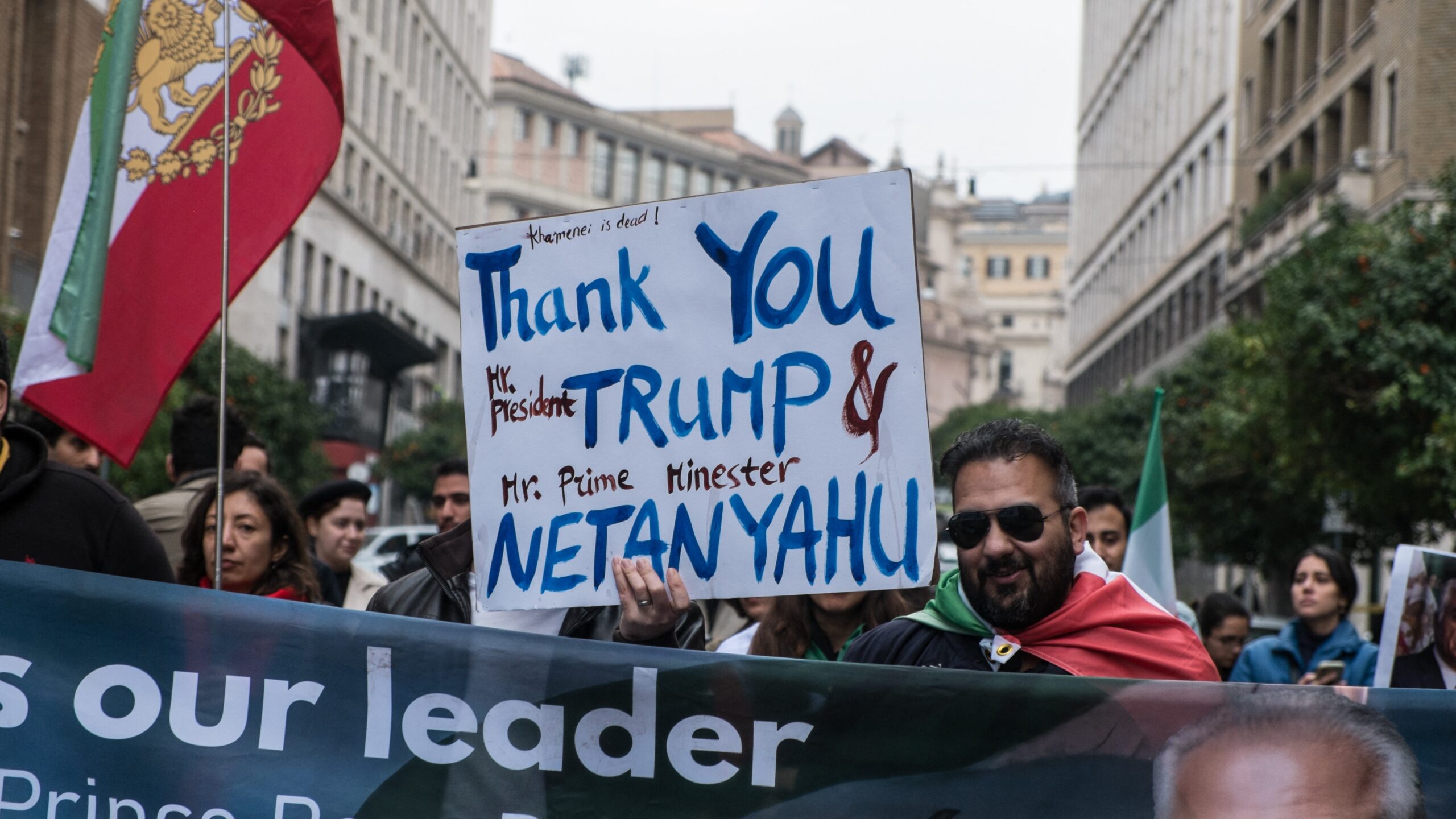
In late February, the Islamic Republic of Iran faced one of its most serious external and internal crises in recent years. The coordinated operation carried out on 28 February by the United States and Israel targeted Iran at a moment of significant domestic instability. However, the aim of the operation should not just be to weaken Iran’s military capability but also to change the regime that is based on a hostile ideology against Israel and the West. As long as the current regime remains in power, these views can serve as a basis and propaganda tool to legitimize its authority.
The Revolutionary Ideology: The Anti-West and Anti-Israeli Approach
The Iranian hostility against Israel and the entire West stem from the ideology developed mainly by Ayatollah Ruhollah Khomeini, the founder of the Islamic Republic of Iran. The Shia leader, whom the Shah exiled to Iraq with the Revolution in 1979, brought Islam as the essential foundation of the new regime and used it as a legal tool to confirm his hostility against the United States and Israel.
The hostile ideology against Israel and the entire West created by Ayatollah Khomeini has elements of Islam, but it is not the religion itself. The Revolution of 1979 in Iran had the natural element of all revolutions, meaning the existence or creation of an external enemy to maintain revolutionary enthusiasm, strengthen the internal identity among the supporters of the new regime, and explain the failures of the revolutionary power.
Western Imperialism
Israel, the non-Arabic state, the presenter of Western imperialism and capitalism, has been fulfilling the external enemy’s role to this day. According to the Iranian regime, the Zionist state is the source of the problems in the Middle East and sees the removal of the ‘cancerous tumour’, meaning the destruction of Israel, as the only solution for the problems of the region.
The core features of the Iranian anti-Israel ideology consist mainly of three elements: anti-Westernism, Holocaust denial and Iran as the defender of the Palestinians. The primary strategy behind the Iranian tactic was not to make a Persian or Shi’ite revolution, but to widen their influence in the region after 1979 as a freshly established Republic as much as possible.
Iran’s approach to Israel is a part of the Muslim world’s anti-Westernism. The conflict between Iran and Israel is an element in the more significant confrontation between Islam and, from the Iranian regime’s perspective, the imperialist and materialistic Western world.
The Muslim countries’ historical experiences with Western countries and the conquest and exploitation of various regions in the last decades contribute to the strengthening of the anti-West view of some Arab nations.
Khomeini, as the first spiritual leader of the Islamic Republic, used religion to explain the colonization of Arab states as Allah’s punishment for the sins of the Muslims, and according to him, the reason for the colonization is the Muslim leaders’ observation of the commandments of God.
Thus, Khomeini turned the essential elements of his revolutionary teaching to return to Allah’s right way and the observation of all his commandments as the solution to end Allah’s punishment in the Muslim world.
Creating Enemies
The first supreme leader made the West, the cooperation of Jews and Christians, even the biggest enemy of Islam, stating that the followers of these two failing religions cooperate to harm and undermine Islam, causing confusion in the hearts of Muslims and opposing the primary goal of Islam, namely, to spread to the four corners of the Earth.
‘Holocaust denial became an official policy of Iran’
Khomeini described Jews as the agents of the West, and the mass Jewish presence in the Middle East in their country, established on the ideology of Zionism, is the expression of the Judeo–Christian conspiracy against Islam. Ayatollah Khomeini often gave names based on this Western hostility, like Israel was ‘the little Satan’, and the United States was called ‘the great Satan’.
The Holocaust as the US–Israel Collaboration
The denial of the Holocaust serves as part of the unrecognition of the State of Israel by Iran.
Since the genocide of Jewish people by Nazis could justify the need for a Jewish state, Iran, as an opponent to the existence of such a country, should argue with any fact that can justify or contribute to the maintenance of a state like this.
Holocaust denial became an official policy of Iran, and it appeared in the Iranian official media many times as a ‘big lie’ and a ‘myth’.
The Holocaust is strongly connected to the US–Israeli collaboration, stating that the Zionists’ absurd justification for the death of six million Jews served as a misleading tool for convincing the public that a Jewish state was necessary[1]. Thus, the United States could strengthen its position in the region.
The Protector of the Palestinians
The last part of the Iranian Revolutionary government’s ideology of the conflict with Israel and the West is claiming that the Persian state is the closest ally of the Palestinians.
Khomeini and his successor Khamenei stated that the occupation of Palestine by the Jews was part of a satanic plot by the Western powers, first Great Britain and then the United States. The main aim of the superpowers was to undermine Muslim unity and create division among the Muslim community by using Israel as a sword to crush any attempts to restore Islam in the Middle East.
For Iran, the anti-Israel sentiment and the Palestinian cause are not just an ideological issue but a geopolitical strategy that helps to legitimize its regional leadership in the Islamic world. In accordance with Tehran’s ideological and strategic aims, Iran always vehemently opposed peace processes between Palestinians and Israel as it would enable the expansion of Israeli influence in the Arab world, which Iran perceives as a threat.
The anti-Western ideology promoted by the Islamic Republic of Iran over the past 40 years has shaped the way many people think about Israel and the US. At the same time, a large part of the Iranian population has opposed the regime, which has been criticized for suppressing and punishing those who disagree with its views. The recent operation carried out by the United States and Israel is difficult to understand without considering the regime’s hostile approach toward the West. In the case of a possible regime change, this ideology could hopefully move into the background, which is in the interest of the whole West.
[1] Meir Litvak, ‘Iran and Israel: The Ideological Enmity and its Roots’, Iyunim be-Tkumat Yisrael, Vol 14 (2004), pp. 367–392.
Related articles: