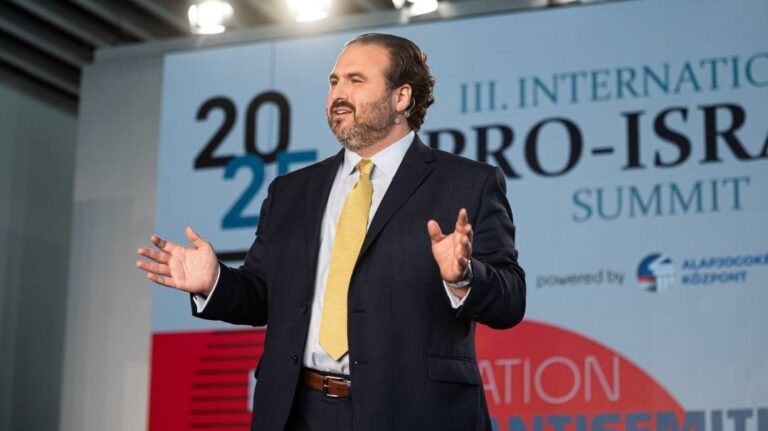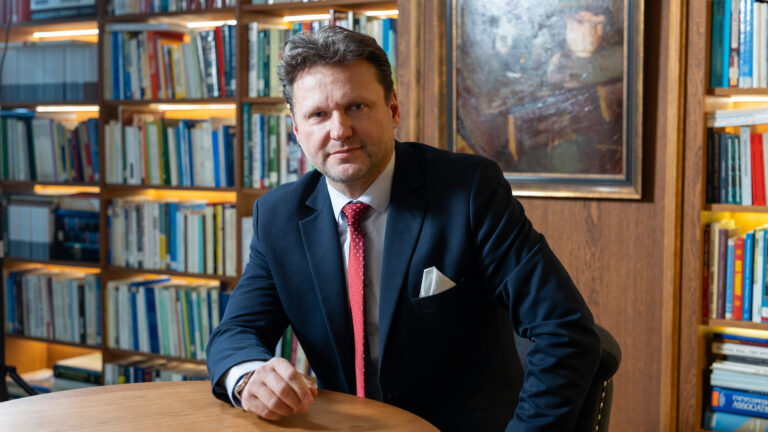
Christopher DeMuth is a Distinguished Fellow at the Hudson Institute and former President of the American Enterprise Institute. He was a White House official during Ronald Reagan’s first term, directing the Presidential Task Force on Regulatory Relief. Mr DeMuth is also the Chairman of the National Conservatism Conference. He granted us the following interview at the National Conservatism Conference 2022, held in Brussels in March.
Nowadays, the free world celebrates not only the heroism of the Ukrainians, but also the right to national identity and nationalism. Those who add the Ukrainian flag to their profile picture on social media not only subscribe to a trend but also to an idea that just a few months ago was deemed discriminatory. Do you think attitudes in general will change in terms of support for national sovereignty and nation states? Can the double standard previously applied to leaders like Viktor Orbán or Donald Trump when they supported national self-determination be done away with?
The Ukrainian people are giving us a historic lesson in self-determination. People in the West, people in my country, in America say that the Ukrainians are fighting for democracy. They say they are fighting for civilization. Actually, the Ukrainians are fighting for Ukraine. What they are fighting for is their ability to govern themselves. The Ukrainians have a proud and admirable civilization and political system. It is distinctive; it is different from America’s, it is different from Hungary’s, it is different from Poland’s. What we want to learn from this episode is that we respect the sovereignty of the independent self-governing nations and different nations with different histories, languages, and mixes of ethnic identities. We have some very religious nations; we have some very secular nations; we have nations with radically different historical experiences that inform their judgments. The principle of nationalism means that we respect differences, which does not mean we do not argue about them. It means that we try very hard not to fight about them and respect a wide diversity in approaches. And while you can admire the civilization that the French have built, the Swedes have built, the Hungarians have built, none of our civilizations is perfect. I am from America, and I can tell you a lot about our imperfections. But I love my country; I would fight for my country if we were invaded. So, the order of nation states is not heaven on earth; that is not perfection. But it is the most successful and progressive form of political organization that we have ever seen. So, with regard to this current war, it is about national self-determination. And I think that it should lead to a greater appreciation of the importance of national self-determination in ordinary political and civic affairs. I said in my talk at the National Conservatism Conference that it is disgraceful that in the course of this war, when Hungary and Poland are taking in hundreds of thousands of refugees from Ukraine, welcoming them, and caring for them as best they can, and struggle with these masses of people, that the EU bureaucracy should be imposing penalties on these two nations for—pretty obviously—partisan and ideological reasons. The EU is not respecting national self-determination. Can you imagine that a member of the EU would engage in behaviour that would be so offensive to the conscience of mankind that the EU would have to step in? It would be easy to come up with such a hypothetical case, but the disagreements between the EU and the elected political leadership of Poland and Hungary is of an entirely different sort. In fact, it involves matters where other larger and more powerful nations in the EU—I will not name names here, we know who they are—are at fault; they routinely violate EU rules, and they are never sanctioned. So, we are seeing not only a lack of respect for local self-determination, but discrimination. I believe the EU says that these sanctions are about the rule of law. Well, equal treatment is an essential part of the rule of law, and equal treatment among nations does not seem to be a guiding principle of what the EU often hands down.
It is disgraceful that while Hungary and Poland are taking in hundreds of thousands of refugees from Ukraine, the EU bureaucracy should be imposing penalties on these two nations for partisan and ideological reasons
In your speech at the National Conservatism Conference you noted that ‘free market can cause division and can lead to empires’. Could you elaborate on that?
I am a strong free-market man. I believe strongly in individual liberty; I think that markets are a very important force, they have led to tremendous prosperity. They give us a cornucopia of goods, and to many of us a good and important employment. Most of us spend most of our lives in organizations that are part of a market of one form or another. So, I am a big market man. But the emergence of global markets of international organizations that seem not to belong to one nation or another, we have technology companies in America that have closer relations with the Chinese government than they do with the American government. This is a new phenomenon. In recent years, we have seen many countries, especially China, manipulate the foreign trade regime of the World Trade Organization and bilateral agreements in such a way that, for example in America, has greatly contributed to a lot of social division. It has been very good for some Americans, and very bad for other Americans. This is a situation where the national government has a responsibility to step in, because it has to work for the welfare of all of its citizens, not just some. And we have seen, I think, especially in the case of Russia, which is essentially a petroleum state, the use of energy as a tool of gaining acquiescence in many nations, and has severely restricted a lot of nations who would probably be acting differently in response to the invasion of Ukraine, simply because in many nations, for example, in Hungary, you have to keep the lights on. Spring is coming, but you still need electricity to live one’s life. Ideally, we would be in a situation where even smaller nations would have a sufficient diversity of energy supplies to give their national governments greater latitude of action. I am not saying how they might exercise that latitude. If you are responsibly in pursuit of the sovereignty of your nation, you do not simply declare that you are sovereign. You actually take steps to fortify your sovereignty. One thing that I should say Hungary has been a lot better at than my own country, the United States, is sound and stable public finance, keeping control over debt. The Hungarian government has done a good job with that. It had to run up the data in the course of the coronavirus response, but all countries have to do that. You keep steady finance and a low-level public debt, to get ready for emergencies; the pandemic is an emergency, a war is an emergency. But you want to maintain your freedom of action, and having a diversity in the supply of energy and other aspects of your economy, to give you some degree of independent action, is an important principle. It is very important for smaller nations, but it is important for the United States as well; we have an insufficient diversity in manufacturing capacity. For example, in high technology manufacturing. In pharmaceuticals, we found out in the early parts of the COVID-19 pandemic that we were dependent on China for masks and for testing kits of one kind or another. Pharmaceuticals used to be manufactured somewhere in the United States, or in Puerto Rico, and now they are in China, which has constrained our freedom of action. We do not want a world where every nation tries to be completely independent, in the sense of being able to produce everything one needs at home. That would be an invitation to immiseration, we would all be poor if we tried to do that. But each nation should attempt to have sufficient diversity, and energy is obviously a critical aspect of that these days.
What conflicts are inevitable for conservative-sovereigntist political leaders and their countries and is there a way to prepare for these?
Our culture has declined in America, and many of us in the ranks of conservatives and intellectuals have come to look upon Hungary as a great leader
I am not very good at answering that question. I know the question. It is something that has always on people’s minds. In my view, the important thing for statecraft or for thinking about the future in general, is to realize that there are going to be surprises: you make plans for things, and what we have learned in the last two years with the pandemic, and with Ukraine is that our ability to plan for the future is limited. You know, human beings are pretty intelligent beings, and we can think through problems, we can make preparations. But the important thing is to expect to be surprised, to know that whatever you plan for, something else is going to happen. So the important thing is not to plan for the future. I mean, I can give you these statistics on the likelihood that a large meteorite will strike Earth and extinguish the human race, just as a meteorite extinguished the dinosaurs a long time ago, it could happen. It is actually something that in the United States, we are making plans for, we are looking at the ability to send rockets up to detonate a nuclear weapon on a meteorite to deflect it away from Earth. Do I think it makes sense to plan for that? Yes. I mean, if you look at the statistics, it is a rare event, but not an impossible one. And the consequences are catastrophic, like the end of the human race. An impact that would be the equivalent of a nuclear war. That is worthwhile, especially for a very big, technologically advanced country, like America. I do not expect Hungary or Switzerland, or, Finland, or Brazil, to be making big investments in meteorite strike prevention. Although in America, we are always trying to look for ways to pass the hat and get a lot of people to contribute to our causes. But that is something we should prepare for, and there are many other contingencies. America is a pacific nation, and I am particularly concerned about the rise of China. I regard the future of the independent, sovereign nation of Taiwan to be an important issue, both for maintaining the order of nation states, and for preventing China from establishing its own empire that spreads throughout the Pacific of which Taiwan would be an important building block. So that is something that I worry about and take seriously. I think we have many serious problems in our democracies, I think our political institutions have declined. Our culture has declined in America, and many of us in the ranks of conservatives and intellectuals have come to look upon Hungary as a great leader. There is robust political debate in Hungary, but it is not dominated by hatred of one’s own nation and a sort of romantic, progressive Marxism and wokeism to the degree it is in the cultural and political establishments of America. And America is not Hungary, but the steps that are suitable for Hungary, they have lessons for us, but we would have to do things in different ways, as our nations are different. But I worry about the decline of cultural cohesion and seriousness in our politics, I think that those are our big problems. But most of all, looking to the future, you want to hope for the best, but be prepared for the worst. And being prepared for the worst means, as I said before, maintaining a strong treasury. Because the one thing you know is that what you will need is finance. Another thing you know you are going to need is to be able to keep the lights on and to have a certain amount of domestic industry, agriculture, and a diversity of resources. I think that rather than trying to imagine the future and plan for it, it is better to keep oneself strong and sovereign, and have the ability to solve problems that you cannot anticipate.
What are the current driving forces of EU-US relations in your opinion, and how do you see the future of the relations?
There is a great deal of talk in America about how we should pivot to Asia. That was what President Obama said, we ran a pivot to Asia. I have never believed that that would be possible. Our demographics have changed. We have become more Latino than we were in the past. We have a lot of migration from Asia, there are many Asians, Indians in senior leadership positions in America. My family came from Moravia, that was three centuries ago. You know I do not have a Moravian flag or anything in my house. But our political institutions are predominantly European and predominantly, actually, British. We had had a little disagreement with the British about who was going to rule America. But when we got our independence, we mostly made use of the Anglo-American tradition in the common law, the separation of powers. So, we have a judiciary, a legislature and an executive branch, due process, civil juries and criminal trials, things like this. A lot of our heritage that African Americans and Latino Americans and Asian Americans are devoted to came from the continent of Europe and from the UK. I think the strength which is startled many people have sympathetic reactions and our provisions of support for the Ukrainians. I think the strength, which startled many people have sympathetic reactions and our provisions of support for the Ukrainians. I do not want to say that our heart is in Europe because we only have one heart and we have sympathies. But an engagement with Europe has been a big part of the American political ethos. The post-war arrangements lasted too long, helping to rebuild Europe, NATO, these were all excellent ideas. But Europe has come to depend much too heavily on American defense. And one of the reasons we were unprepared for many of Russia’s aggressive initiatives in recent years is that the European nations, and I would say, especially Germany, they just thought, well, the Americans will take care of it. We do not have to take care of that. No, that is wrong. Europeans have to take care of these things. And America will help. But the nations on the frontlines have to take primary responsibility. So, in a way, I think America has been too devoted to Europe in recent decades, so as to create, especially in the Western European nations, a sort of a welfare dependency. They hate America, but they rely on America to provide their defence. So, they can pretend to be nations, even though they are not really prepared to defend themselves. It has led to a love-hate relationship on both sides of the Atlantic, and I am hoping that one result of the Ukrainian war, indicated by Germany’s change of stance on its defence preparedness and changes in Sweden, for example, is that the European nations are going to take their defence more seriously. And if they do, I think that will lead to a more productive relationship with the United States.