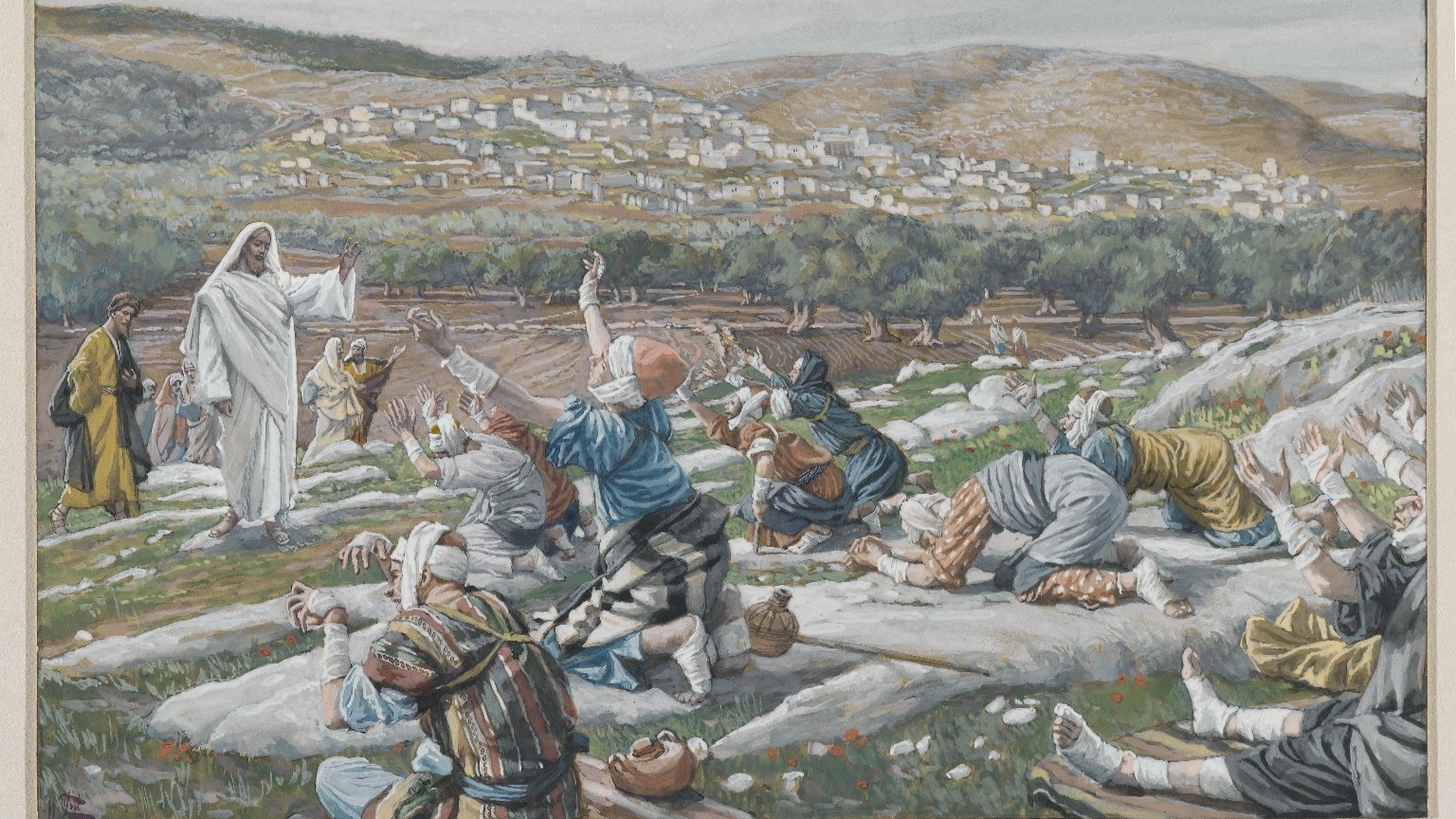
‘…as he entered a village, ten men with leprosy met him, who stood at a distance…’ (Luke 17:12)
—
The ten lepers were incurable; there was no remedy for their ulcerous disease at the time. They lived in constant physical pain and, due to the contagious nature of the illness, were forced to reside in camps outside settlements, ostracized from society. They were left to watch the slow progression of death in their bodies, and, presumably, the overwhelming rise of panic in their souls.
Those who have no chance of escape are also determined to die. If there is time to face death, one can even resign oneself to the inevitable; yet the instinct for life—like a magnet built into us—nourishes a person’s attachment to life until the last moment. Until the last straw.
It is good to live. The lepers must have known this better than their fellow human beings who were forcibly separated from them, since the one from whom life is taken experiences more severely the value of what they are losing.
When the ten lepers unexpectedly encountered Jesus on a road on the outskirts of a settlement on the border between Samaria and Galilee, they were struck with astonishment. They recognized the situation immediately, for they knew who Jesus was. Suddenly, an opportunity presented itself; they were aware of what this already well-known and widely followed rabbi was capable of.
‘The one from whom life is taken experiences more severely the value of what they are losing’
Examining the chronological order of events in the New Testament, this incident could have occurred at the end of 31 AD, two-thirds of the way through Jesus’ three-year public ministry, just six months before his execution, at a time when the news of his activities had already spread throughout Israel. By then, he had been teaching for more than two years, touring northern Galilee, attending the Temple in Jerusalem on several major Jewish festivals, and thus visiting Judea, Perea, and Samaria several times.
He had such miracles behind him as turning water into wine in Cana, healing the royal official in Capernaum, restoring a severely demonized man in the Gadara region, raising the dead son of a widow in Nain, healing scores of people (deaf and dumb, blind, lame, etc), walking on the water of the Sea of Galilee, entertaining 5,000 of his listeners by miraculously multiplying the loaves, and so on. He had even healed a leper earlier—probably many of them, but the Bible recorded this incident (Matthew 8:2-4).
‘Jesus, Master, have mercy on us,’ the ten lepers cried out. Obeying the quarantine rules, they did not go any closer, but they shouted. They called Jesus by his name, calling him Rabbi. They were asking for mercy. That is, they knew that Jesus could do what they needed.
However, unlike in a previously recorded case, Jesus did not go to them or pray for their healing; the ten men were not healed on the spot. Instead, he simply instructed them to go to the priests and ‘show themselves’, in accordance with the requirements of the Mosaic Law—an instruction that carried a clear message within the Jewish community: Jesus had declared them healed. According to the laws of purification, the priests were responsible for officially certifying such healings. In this case, this meant that, upon recovery, the patient could return to the ordinary life of society, regaining his place in the community, his human relationships, and his capacity for self-sustaining work.
‘They were asking for mercy. That is, they knew that Jesus could do what they needed’
The interesting thing about the situation, however, was that Jesus did nothing with the lepers, meaning that the ten patients had to comply with his request without their bodies being healed; when they went to the priests, their skin was still covered with ulcers, and they were still walking in pain. Yet, they set out, and presumably out of faith: they believed that if they did what this miracle rabbi said, they would be healed.
They calculated well, because halfway along the way they suddenly experienced that the symptoms of the deadly disease had disappeared. The miracle happened. Just as it could have been deduced from Jesus’ words, if they had believed in him. These people experienced a supernatural miracle: at the level of medical science at that time, there was no human way to heal them. Yet something happened that could not be experienced without ecstasy.
However, the story does not end here, as one of the ten sick people reacted differently to this life-altering event: praising God’s goodness out loud, he ran back to Jesus and thanked him personally for what he had done. ‘He fell on his face at Jesus’ feet,’ the text says. Considering the dramatic nature of the situation, it is difficult to imagine how it could have been done differently. However, another dramatic twist in the story is that the majority of the healed sick people, nine out of ten, did not do so. The biblical text leaves it unclear as to what happened to them: did they go up to the priests to receive confirmation or not? To what did they attribute this miracle that went beyond human expectations that they had experienced? We do not know. However, they did not go back to Jesus; somehow they did not feel that they had to thank him for it.
‘The miracle happened. Just as it could have been deduced from Jesus’ words, if they had believed in him’
The only leper who remained pure in heart was a Samaritan, a member of a group whom the people of the Law—the Jews—did not consider their equals. From the context, it may be inferred that the nine men who did not return were Jews who, according to the Law, ought to have recognized the magnitude of what had happened to them. The Samaritan, however, perceived the greatness of grace beyond the Law.
In doing so, he acted contrary to the Law and, in a sense, even contrary to Jesus’s instruction—which, notably, affirmed the Torah. Rather than going to the priests, he returned to Jesus, thus involuntarily confessing that the Master is above all human affairs.
But even more happened to the ‘stranger’ who expressed his gratitude, humbled himself, and understood the depth of the healing: the text suggests that this man saw in his heart that the Master who had healed him physically could not only save his body, but also his whole being, his soul and spirit, to salvation. ‘Your faith has saved you,’ Jesus tells him, and the original Greek expression also suggests redemption; that is, the grateful Samaritan also received salvation, in an unexpected way.
Another contextual interesting fact of the story is that by reading the text chronologically, it can be concluded that Jesus performed this miracle while on his way to Jerusalem for the festival of Hanukkah. Hanukkah celebrates the victory of the Maccabean revolt and the rededication of the desecrated Temple—and Jesus spoke of the Temple as a body (the temple of the Holy Spirit) that would be destroyed, but He would raise it up on the third day (John 2:19), referring to His own future death and resurrection in the body.
On the other hand, shortly after the healing of the lepers, on the eve of the Hanukkah festival, Jesus was in the Temple in Jerusalem when, in response to a question from the Jews, he declared: ‘I and the Father are one.’ This was an extraordinary statement, as it was considered blasphemy according to the principles of Judaism. However, if Jesus was indeed the Messiah—the Christ, the Son of God—then it was not blasphemy, but rather a revelation of reality.
So, one in ten lepers returned to Jesus; one in ten felt that what Jesus did moved them to respond out of love for God. This is a very small proportion, but we know that ‘many are invited, but few are chosen’: God invites everyone to fellowship with Him, yet only a small number grasp the significance of this invitation.
We are like that too. At Easter, we may take a little time to reflect on the things of God, and then forget everything, continuing on our own paths. Yet the holiday of Easter commemorates a historical event of salvation that determines the fate of all of us, whether we acknowledge it or not. Ultimately, we are confronted with the weight of this at the moment of death, when one question remains: if we step into the unknown, what awaits us?
‘One in ten lepers returned to Jesus; one in ten felt that what Jesus did moved them to respond out of love for God’
For Christians, this is not unknown, but a reality reported by the only person who returned from there: Jesus. He declares that there is salvation and there is damnation, eternal communion with God and, conversely, final separation. He paid the price of our salvation—our sins—through His death, and His resurrection made entry into this communion possible for all people.
The cost of the resurrection was therefore unbearably high. He who easily passes by this sacrifice is a prodigal son. This is what every Christian does who loves the Master only at Easter. After all, a follower of Jesus is one who lives a Christian—Christ-like—life, laying down his life every day for the One who gave His for us. Otherwise, we will be like the nine lepers who were healed but not saved, failing to understand that life is not merely what we receive, but that we can know the Giver of Life.
Related articles:
At a time when public debate is increasingly polarized and superficial, Hungarian Conservative remains committed to depth, intellectual honesty, and independent conservative thought.
Producing high-quality journalism requires resources. Your contribution helps us expand our coverage, reach new audiences, and keep our content accessible.

Please consider supporting our mission.