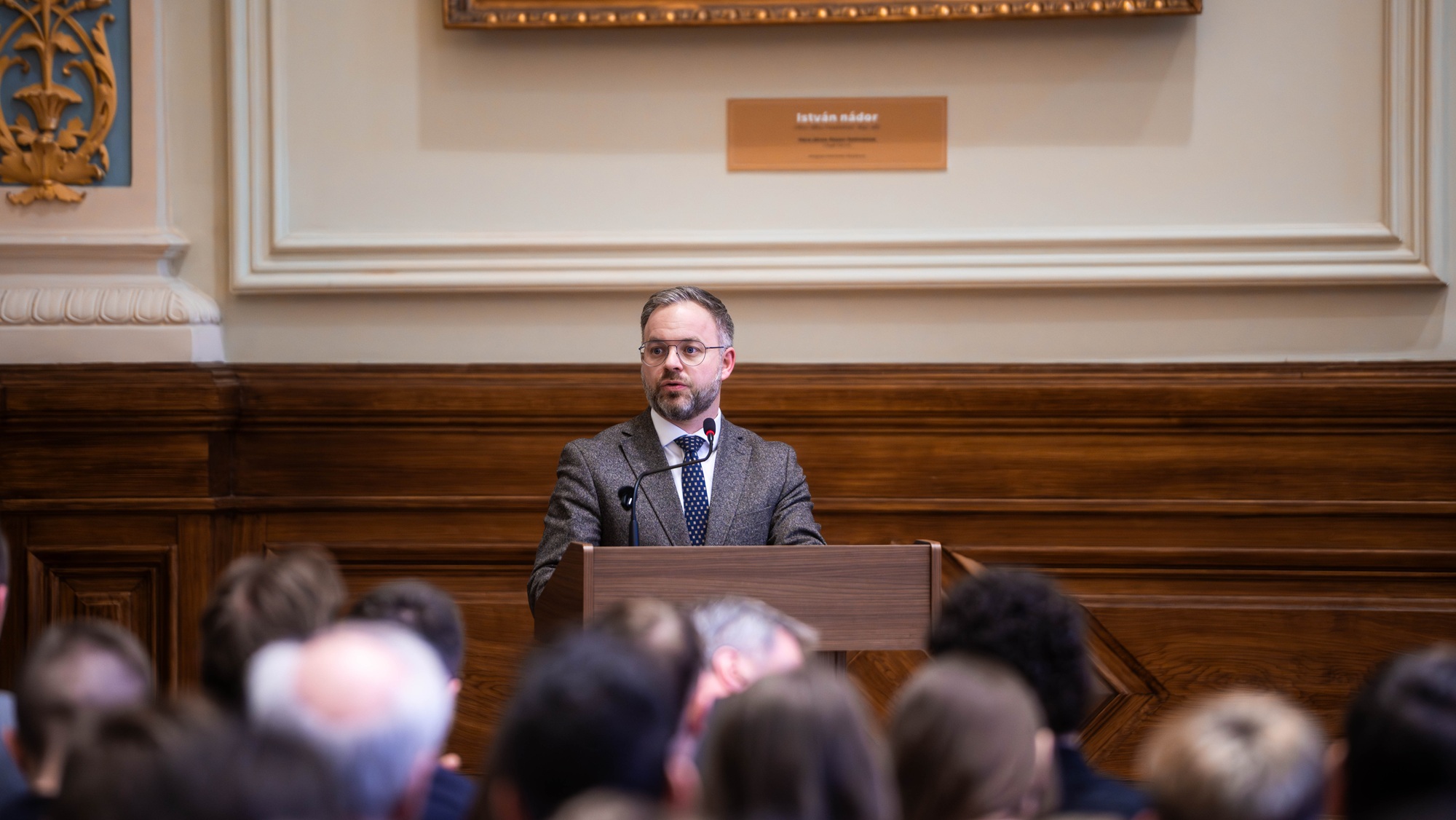
The Ludovika University of Public Service is celebrating the 15th anniversary of its foundation. To commemorate the occasion, they are hosting a series of events. The first of them took place at their Budapest campus on Monday, 2 March, with the title Our Nation as a Keystone State in a Changing World.
Political Director for the Prime Minister of Hungary Balázs Orbán gave the keynote address. Director Orbán started by congratulating the university on its anniversary, and said that it has been ‘nicely developing’ ideologically, professionally, and—in the physical sense—infrastructurally as well. He added that these developments are possible because the national government of Hungary views Ludovika University as a ‘strategic investment’.
Mr Orbán defined the main purpose of the university as a ‘place where people are thinking about what the world looks like from Hungary’s perspective’. As he explained, all major world events can have a number of interpretations, and thus, we need a unique Hungarian one for each.
For instance, he continued, the Russo–Ukrainian war has been raging on for four years in Hungary’s neighbourhood. The EU has spent €200 billion in aid to Ukraine already, according to the speaker, and has a €1.5 trillion package planned for further assistance. Meanwhile, Mr Orbán pointed out, the United States has withdrawn from financing Ukraine’s war efforts with the new administration coming in.
He also shared that it would be in the vital interest of Hungary to end the war in Ukraine. That would eliminate the war threat on our Eastern border, and would prevent losing the EU funds due to Hungary to Ukraine. Also, as the speaker pointed out, ethnic Hungarians in Transcarpathia are being forced to serve in the Ukrainian military through nationwide conscription.
As for the recently erupted Iran conflict, Mr Orbán shared that it has raised the terror threat levels throughout Europe. However, Hungary’s migration policy has paid off here, as countries with higher Muslim populations face higher levels of threat, he told the audience.
The Director also stated that the Iran war has led to a dramatic increase in crude oil and natural gas prices on the commodities markets, which he believes will not be a brief, temporary hike that followed the US’s raid on Iranian nuclear facilities back in June. Alas, this is putting a new strain on the Hungarian government’s utility price reduction programme.
He went on to say that in this emerging world order, liberalism no longer serves as a universal organizing principle in political and economic systems. Instead, he argued, the world is entering what he described as an ‘age of sovereignty’, in which the sovereign state once again becomes the primary unit of geopolitics. In this context, he added, the quality of political leadership and the security of energy supply are of paramount importance for national success.
Following Mr Orbán’s speech, a panel of four experts gathered for an insightful discussion. Levente Magyar, Deputy Minister at the Ministry of Foreign Affairs and Trade of Hungary; Zoltán Kovács, Secretary of State for Public Diplomacy and Relations of Hungary, and Csaba Zalai, Professor at the Faculty of Public Governance and International Studies at Ludovika University, took the stage. Vivien Pesztericz-Kalas, Head of the Europe Strategy Research Institute at the University of Public Service, served in the role of the moderator.
Mr Kovács kicked off the discussion by telling the audience that he was present at the foundation of Ludovika University 15 years ago. He also opined that the key question in the new geopolitical era is whether a country’s leeway is increasing or decreasing, and that President Trump is aiming to create ‘Pax Americana’ by the end of his term. Mr Kovács also stated that Hungary has stood up for itself and developed a special Hungarian perspective of the world, which also serves as an alternative to the Brussels elite’s view.
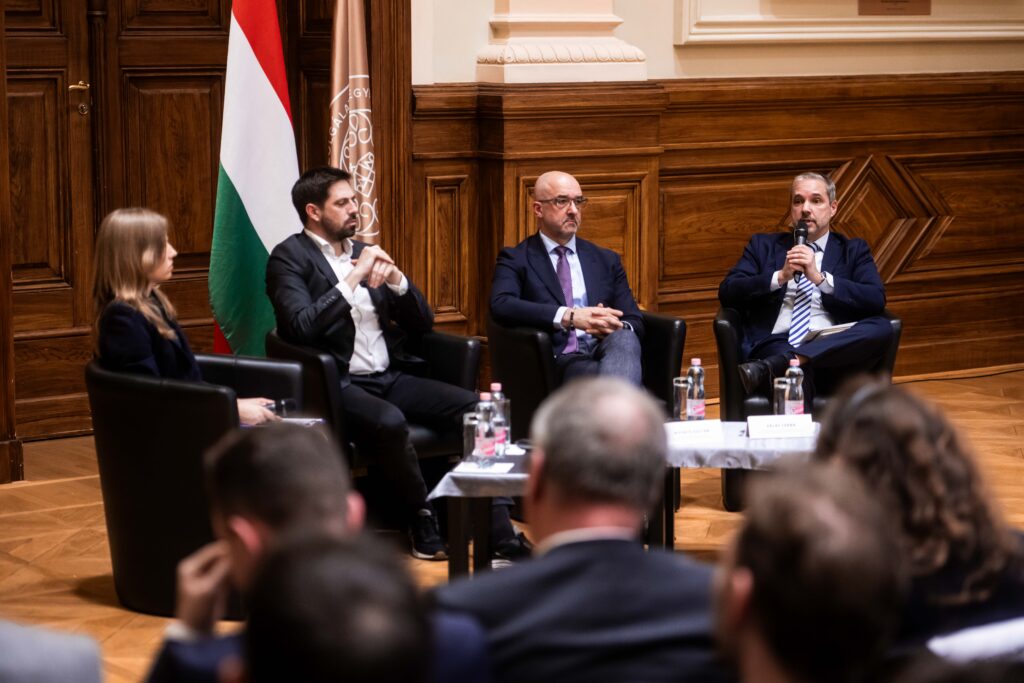
Mr Magyar provided a definition for what Mr Kovács meant by ‘leeway’. He defined it as ‘the ability of a country to assert its own interests in relation to international actors’. He also stressed that this is a ‘life or death question’ for nations. The speaker also pointed out that Hungary has always had to rely on its ability to build defence coalitions to stay alive in the ‘turbulent place’ that is the Carpathian Basin, and declared that the state’s primary duty is to defend the nation.
Meanwhile, Mr Zalai said that we are living through the biggest geopolitical transformation since the end of the Cold War. He also opined that Hungary’s joining the EU has brought migration, energy, and sovereign debt crises as well, but Hungary was able to use its leeway to create its own policies to mitigate those crises, such as in the case of strict migration control and seeking Foreign Direct Investment from China.
Related articles:
At a time when public debate is increasingly polarized and superficial, Hungarian Conservative remains committed to depth, intellectual honesty, and independent conservative thought.
Producing high-quality journalism requires resources. Your contribution helps us expand our coverage, reach new audiences, and keep our content accessible.
Please consider supporting our mission.