With less than five weeks to go until the Hungarian election on 12 April, Viktor Orbán and his Fidesz party have been dealt a wild card: a chaotic war in the Middle East that threatens to disrupt energy prices. At the time of writing, shipping traffic is not passing through the Strait of Hormuz. Normally, around one-fifth of global oil production and one-fifth of global LNG production pass through the Strait. In addition to this, there is now evidence that Iran is attacking energy production and refining facilities to drive up global energy prices and put pressure on the United States.
Markets seem taken aback by what has happened. This has always been thought of as the worst possible outcome from the perspective of the energy sector. Prices have risen sharply. At the time of writing, Brent Oil is up 8–9 per cent, and EU natural gas spot prices are up around 25 per cent. But these price increases do not factor in a secession of seaborne energy coming from the Middle East. This means that, unless the war stops and the Iranians are convinced to reopen the Strait, prices are almost certain to rise further in the coming days. There is even the possibility of shortages of the likes we saw last time Middle Eastern energy markets were shut down in 1973.
The question in Hungary right now is: how will this impact the election? The politics and the economics of the situation are quite different here. Typically, we would expect a sharp rise in energy prices to be a major negative for the incumbent party, but the specific situation in Hungary this election cycle does not favour this interpretation. Orbán has made energy security a core plank of his election platform. He has consistently warned his opponents in Brussels of the dangers of sacrificing Hungary’s energy security on the altar of war. Péter Magyar, on the other hand, has been very cautious about criticizing the war policies of Brussels.
The situation that is developing in the Middle East is proving Orbán right. Since the beginning of the war in Ukraine, and especially since the destruction of the Nordstream pipeline in September 2022, the EU has switched from buying reliable, cheap Russian-piped gas to buying LNG, much of which is shipped from the Middle East. Orbán has consistently stated that this is a terrible policy and risks the energy security of the continent. He is now being proved correct in real time and can credibly go back to Brussels and say he told them so. He can also tell the Hungarian people that only he has the credibility to push Brussels on this, as he has been the one screaming about European energy security for years.
‘The situation that is developing in the Middle East is proving Orbán right’
Likewise, the situation with the Druzhba pipeline gives Orbán a strong political hand to play. The Ukrainians have attacked the pipeline to try to increase energy prices in the run-up to the election in the hope that this will negatively impact Fidesz. The Brusselians have thrown all European norms out the window and cynically looked the other way. Orbán can now once again make the case for why pipelined oil is important in an unstable world. Europe is now threatened with oil shortages, and allowing the Ukrainians to attack the pipeline is only making the situation worse. Oil prices are set at the European level, so such attacks are only exacerbating the looming energy crisis. Magyar has no credibility on this issue as he, too, cynically ignored Ukrainian aggression against energy infrastructure that Hungary relies on—a stance that could be argued to be almost treasonous.
That is the politics, but what about the economics? Here, there are two separate questions. The first one relates to the energy price itself, while the second relates to the knock-on impact a rise in energy prices will have on inflation.
Let us start with energy prices. These will rise quickly. Consumers are likely to feel increases in petrol and diesel prices at the pump first. The lag between a rise in the spot price of crude oil and the prices offered to drivers at petrol stations is only a few days. We should expect these prices to rise quickly in the coming days and weeks. The Orbán government should immediately revert to the price controls that were implemented in November of 2021, when a price cap was set on both 95-octane petrol and diesel at 480 forint per litre. As with the previous cap, this one will not be able to hold forever. Rather than removing it quickly this time around, the government should have a plan to gradually phase it out in line with rising energy prices. This will allow consumers a smooth transition to the new price structure.
The Orbán government already maintains an extremely popular household energy price cap policy in place. There is no need to alter this, but the government will now have to come up with a credible plan for how to manage it as it becomes more expensive. This is a complicated question and beyond the scope of this short article, but perhaps the government should consider once again tapping the profits of energy companies like MOL, while trying to ensure that this does not result in the companies paring back their investment in critical projects.
This brings us to the second question: inflation. Last time energy prices rose, prices soon followed them upward. What the Orbán government’s interventions in the energy market last time around showed is that you cannot legislate away inflation, you can only redistribute it. The caps on energy prices meant that households had higher incomes than they otherwise would have, and this money flowed into the economy, driving up prices. This is why the inflation in Hungary was worse than in neighbouring countries: energy bills remained low, and the additional purchasing power freed up by this drove up other prices more dramatically. For all the complaints about Hungarian consumer price inflation relative to the regional average, inflation in Hungary was simply redistributed away from energy bills and into shopping bills.
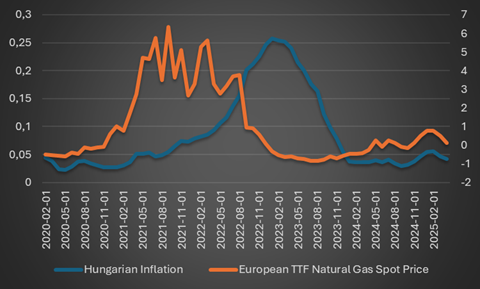
The following chart shows Hungarian inflation and European natural gas prices together. As we can see, gas prices rise first, and then inflation follows. The gas prices take time to ‘feed into’ the inflation. The data shows that the initial inflation increase takes around ten months, while the more dramatic impact takes around 16 months. This means that if price caps are put in place, we should not expect to see an uptick in inflation until the end of 2026, long after the election. Fidesz should not be concerned with overall inflation impacting the Hungarian economy in the run-up to the election. They should focus solely on insulating consumers from the impact of rising energy prices.
Overall, the Hungarian economy is better placed than other economies in the region to deal with inflation. Countries like Romania and Poland have been aggressively increasing their government borrowing in recent years—with Romania on the brink of bankruptcy—while Hungary has tried to get its borrowing under control. This will give Hungary some fiscal headroom, at least relative to other economies in the region. Rising inflation will mean that the forint will have to weaken so that Hungary can protect its competitiveness. No doubt, Hungarians will complain about their holidays being more expensive, but it is worth it to maintain competitiveness, especially as much of Europe deindustrializes. The forint has been rising since last April, meaning that allowing it to decline due to inflation will be less painful for holidaymakers and consumers of foreign goods.
As inflation rises, so too will interest rates. Recently, the Orbán government has put in place its enormously popular Otthon Start programme that allows first-time homebuyers to borrow up to 50 million forint at 3 per cent. This programme will have to be readjusted as interest rates rise. If the government does not want to scrap it altogether, it should adjust the subsidized interest rate in line with overall interest rates to keep them proportional.
Energy subsidies will put pressure on the government budget. The government can save money by taking the subsidies off the government’s balance sheet and asking the Hungarian central bank to subsidize these interest rates instead. They can do this by either setting an alternative interest rate for Otthon Start borrowers and offering this interest rate to participating banks, or they can set up an Otthon Start Bank within the central bank that will operate in the secondary market for Otthon Start mortgages much in the way that Fannie Mae and Freddie Mac do in the United States. These mortgages can then be packaged into securities, but given the elevated risk, these securities should be bought only by the Hungarian central bank—they should not be offered to pension funds or private investors.
The coming months will not be easy. For the second time in less than five years, Hungary is facing down the consequences of a war economy. But the Orbán government are now seasoned veterans at managing war economies and should pitch themselves as the natural stewards of the Hungarian people over the next four years. So long as Hungarian voters understand the magnitude of the problems facing their country, they will no doubt see the wisdom of entrusting leadership to experienced managers like Fidesz rather than amateur upstarts like Tisza, who have already shown themselves willing to allow the Druzhba pipeline to be weaponized simply to win an election. We are in for another few hard years, but Orbán has proven himself as the leader to steer the ship of the Hungarian state through the stormy seas of global turbulence.
Related articles:
At a time when public debate is increasingly polarized and superficial, Hungarian Conservative remains committed to depth, intellectual honesty, and independent conservative thought.
Producing high-quality journalism requires resources. Your contribution helps us expand our coverage, reach new audiences, and keep our content accessible.

Please consider supporting our mission.