The following is the English translation of a press release kindly provided to us by the Center for Fundamental Rights.
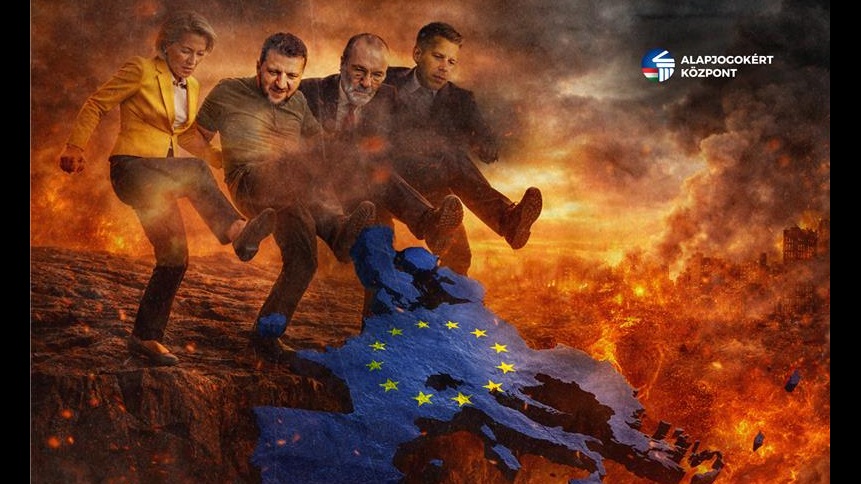
The escalation emanating from Brussels has entered a new and accelerating phase. This is no longer simply about ‘supporting’ the war in Ukraine. It is a reflection of the consolidation of a European political and economic course that permanently aligns public opinion, institutions, and budgets with the logic of war, drawing the continent incrementally closer to direct involvement. Escalation is no longer the result of ad hoc decisions; it has evolved into a self-reinforcing system.
The trajectory of this process weakens Europe’s capacity for peace, narrows sovereign decision-making, advances a federalizing shift within the European Union, and increases the long-term financial burden borne by Member State societies.
These developments directly affect Hungary’s security and geopolitical options. At the same time, Brussels is increasingly and openly intervening in Hungarian domestic politics, backing Péter Magyar of the Tisza Party. The emerging war-oriented alliance does not seek a prime minister in Budapest who consistently defends Hungary’s national interests. Instead, it favours leadership that is compliant and unwilling to challenge prevailing policies. In this regard, the leader of Tisza appears aligned with those objectives.
Five key factors are accelerating escalation in Brussels:
- A flawed geopolitical premise.
The war coalition operates on the assumption that Russia can be decisively defeated on the Ukrainian battlefield and that such a defeat would ultimately trigger regime change in Moscow. - Entrenched war rhetoric.
Years of increasingly uncompromizing rhetoric have turned into a fatal spiral of lies, fostering emotional and ideological commitments that have led to unconditional alignment with Kyiv. - Political self-preservation.
For segments of the Brussels and Kyiv leadership, continuation of the war has become intertwined with political survival. A peace settlement short of Russia’s total collapse would inevitably raise questions about the financial and moral accountability of EU and Western elites—including the use of the hundreds of billions of euros sent to Ukraine in war aid—and could bring about an eventual election loss for President Zelenskyy of Ukraine. - Agenda displacement.
Continued escalation reshapes Europe’s political priorities, diverting attention from the social consequences of mass migration, debates over gender policy, and the economic strain associated with sanctions. - The emergence of a war economy.
A consolidated military-political-industrial structure has taken shape, generating significant profits from prolonged conflict. Elements of this logic are increasingly reflected in EU budgetary planning, which could necessitate potential major tax hikes in European countries.
From a Hungarian perspective, the factors of escalation are particularly visible in three areas:
- Communication warfare.
Western European leaders are progressively preparing the public opinion for further escalation, while marginalizing pro-peace positions. Countries advocating for de-escalation—including Hungary—face growing political pressure. - Institutionalizing the ‘Europe pays, America delivers’ model.
A procurement framework is emerging in which European states finance the transfer of key US military capabilities to Ukraine. This arrangement reinforces Europe’s structural dependence on external production and logistics while limiting its strategic and fiscal autonomy. - Long-term financial commitments.
Support for Ukraine is becoming embedded in multi-year structural budgetary frameworks. These obligations are increasingly incorporated into the EU’s long-term financial plans and are likely to place sustained pressure on Member State budgets through austerity measures, new revenue mechanisms, or higher contributions. It is an ‘economic checkmate’.
The broader pattern is evident: Europe is becoming progressively more oriented toward sustaining conflict rather than preparing for peace. Hungary’s position remains consistent: advocating for de-escalation, preserving sovereign decision-making, and strengthening national defence capabilities based on Hungarian interests rather than external political expectations.
Related articles:
At a time when public debate is increasingly polarized and superficial, Hungarian Conservative remains committed to depth, intellectual honesty, and independent conservative thought.
Producing high-quality journalism requires resources. Your contribution helps us expand our coverage, reach new audiences, and keep our content accessible.
Please consider supporting our mission.