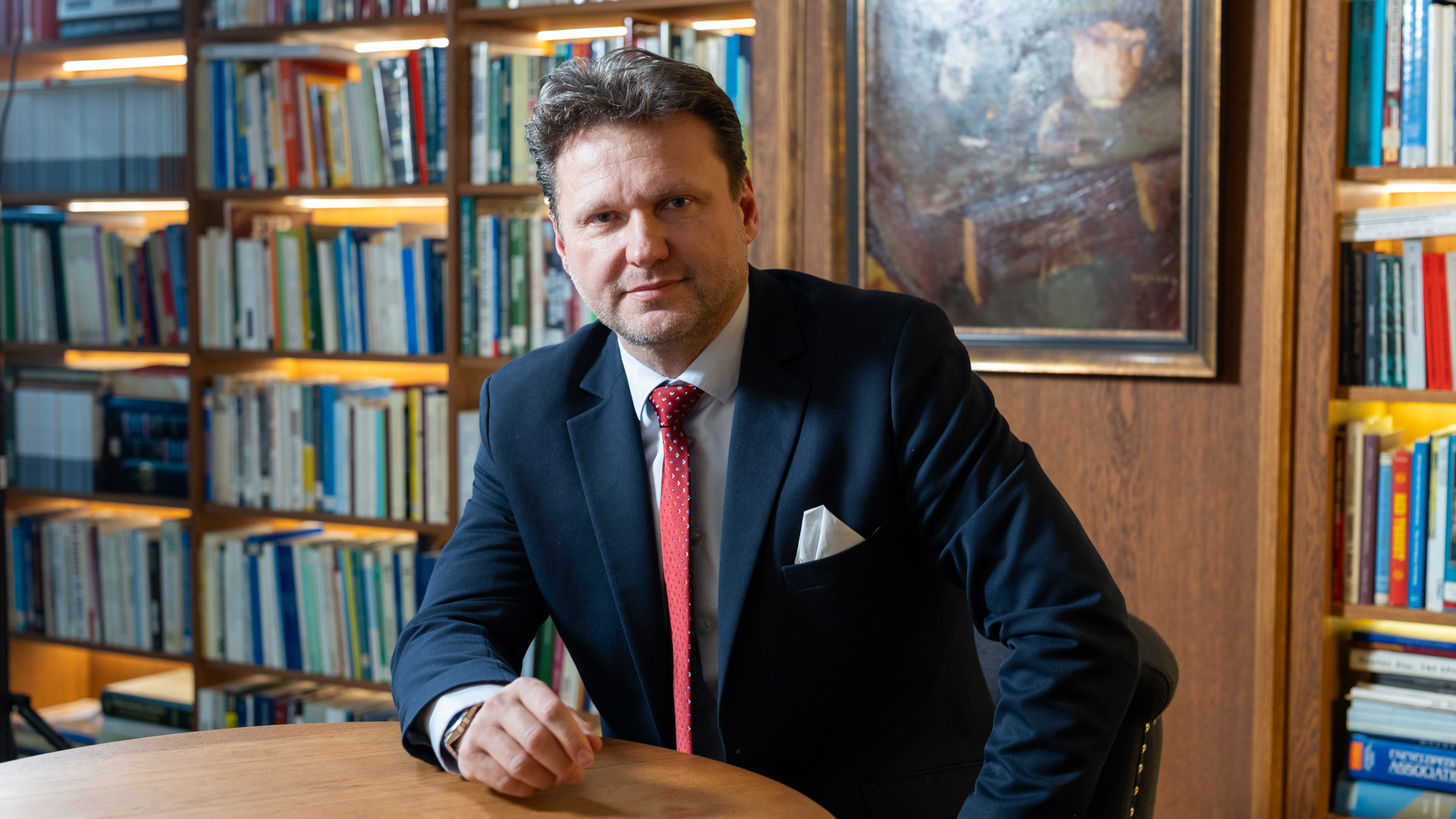
Radek Vondráček is a Czech lawyer and politician, the Chairman of the Foreign Affairs Committee at the Chamber of Deputies of the Parliament of the Czech Republic and Vice-Chairman of the ANO party. He graduated from the Faculty of Law at Masaryk University, Brno. He was first elected as a Member of the Lower House in 2013 and was re-elected in the 2017, 2021, and 2025 elections. From 2014 to 2017, he was a member of the municipal assembly and deputy mayor of the city of Kroměříž, and from 2017 to 2021, he served as President of the House.
***
I checked ANO’s policies: anti-migration, anti-gender, pro-peace stance favouring the agreement between Russia and Ukraine, opposing Ukraine’s EU membership, and protecting national sovereignty from Brussels. Am I correct?
Yes, absolutely. I might not agree with the notion of opposing Ukraine’s EU membership. I would rather say, I hope one day the conditions will be absolutely equal for all the candidate countries. So we are not opposing it, just having a rational attitude to this topic.
The fast-track accession to the EU is what you don’t support then.
Because it could be the end of the European Union. The EU is not rich enough to take Ukraine as a member state immediately. Ukraine has a lot of trouble with corruption, with economics, with all the standards of rule of law, and when you compare it, for example, to Serbia—I’m a member of the Group of Friendship with Serbia at the Czech Parliament, and as a former speaker of the Czech lower chamber, I’m the only Czech politician who held a speech in the Parliament of Serbia, so I know how much they sacrificed in these years—it would not be right if Ukraine had this fast-track access, while Serbia, Northern Macedonia, and Albania had not.
‘The EU is not rich enough to take Ukraine as a member state immediately’
I understand that there’s a political vision for Ukraine, and it’s a gesture for them, but it’s a dangerous and expensive gesture. European Union policies need fewer gestures and more rational steps and solutions.
You talk about rationality, and that European law requires all candidate countries to go through a due process of accession.
Ukraine is a great country, a very rich country. They’ve got a lot of natural resources and human power. We actually cannot survive without the Ukrainian working force. Right now, there are thousands of them, and some work in important areas of industry.
Still, you say that the accession of Ukraine to the EU would be a catastrophe. What consequences do you see as catastrophic? What are you afraid of?
Well, the answer is very simple: they are not ready to join the Common Market, and we are not ready to open our borders to Ukraine. There are standards in agriculture, but there are also scandals about antibiotics and pesticides. Then, the rule of law versus corruption. We can see new scandals on a regular basis, almost every week. And now there is a misunderstanding between Ukraine and the Czech Republic: our speaker of the Chamber of Deputies, in his New Year’s speech, mentioned the corruption in Ukraine; the criticism was about the last scandal about Tymur Mindich and the gold lavatories. Then the Ambassador of Ukraine protested, he commented on social media, and it was not a very intelligent reaction—there was no respect. I understand that Ukraine is at war; I respect it. But if Ukraine wants to be part of the Western world, they are supposed to behave like a Western country and respect our rules and habits.
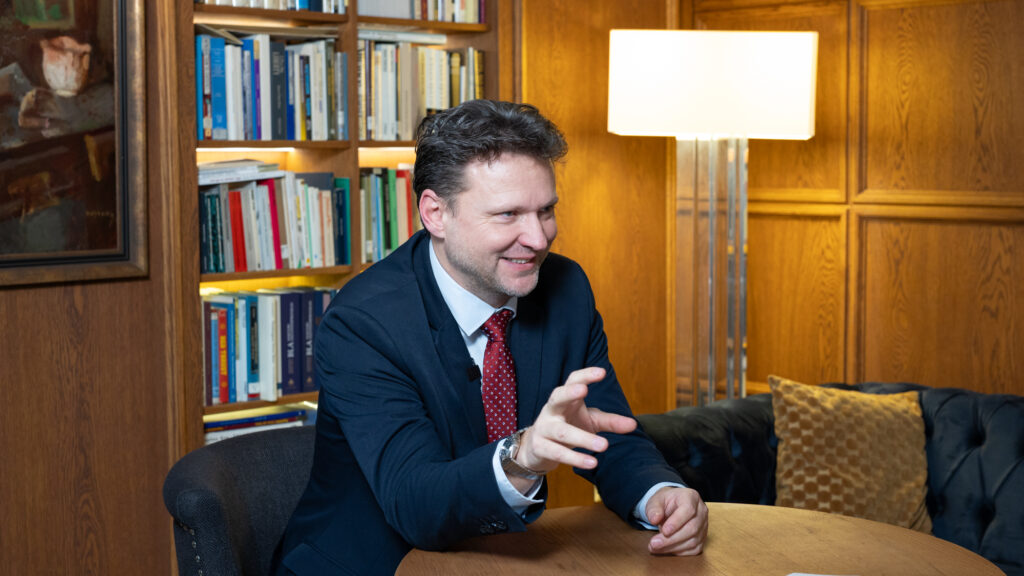
Last year, there was a general election in your country. What were the main topics in the campaign? What do Czech people consider the most important issues in European affairs?
Our opponents spent a lot of money and energy to make the war their main topic, saying that we, the Czech opposition, are heading to the East, while they are heading to the West. We tried to concentrate on economic issues, because we are in the middle of stagnation. We spoke about the Green Deal and the ‘Fit for 55’ programme, and we said it was a disaster for the Czech industry, because the Czech Republic is an industrial country, and we have a completely different situation from that of other member states. This is a problem with the European Union. The Brussels bureaucracy is trying to create a new European identity—a kind of ‘average European’—by trying to unite us, to federalize us. My movement has a very clear message: we want to go back to the roots of the European Union: sovereign, independent, national states on an equal level.
The ANO party started more than ten years ago as a centrist, technocratic, anti-corruption party. Why have you given up the liberal roots of the party?
In the very beginning, it was an anti-corruption movement, indeed. We’ve got some corruption scandals at that time; Prime Minister Petr Nečas resigned because of that. We had early elections, and we just wanted to fight against corruption and to create a more effective state. But later, we were pushed by the progressives and by Brussels; their narrative was that they were the good, they were the democrats, and the others, the rest of us, were the bad. Because we were more critical about Brussels, and about the new, false ideologies like the woke, or the Green Deal, and so on.
‘We want to go back to the roots of the European Union: sovereign, independent, national states on an equal level’
Over the years, there have been more and more ‘European values’ that nobody had even heard of 20 years ago. Now it’s the only opinion which is allowed. I used to think of myself as a liberal centrist, but one morning I realized that I’m conservative.
You just woke up to that?
There was no other alternative, because there is no centre. That’s the problem with European politics overall: we have no centre, and without it, you have no communication. So it’s a fight now instead of discussions.
ANO left the Renew, the ALDE, and, with Fidesz and the Austrian Freedom Party, it founded a new fraction in the European Parliament, the Patriots for Europe. Why did you join the National Conservatives?
We’ve spent ten years in ALDE, and leaving them was a relief for me, because it was an everyday struggle. They criticized us, and the Hungarian member, a lady, heavily criticized Andrej Babiš, so there was no point in maintaining our membership. And I was happy when we joined the Patriots for Europe, because they mean something similar to what Donald Trump calls ‘revolution of common sense’. I believe that the Patriots are the common sense in Europe. You know, I’m Moravian, so I’m a Moravian patriot, then I’m a Czech patriot, and I’m also a good European one. But it’s hard to be a centrist in my movement. Because we are a ‘catch-all’ party. We are not on the right or on the left. We are a party for everyone. We have a reasonable programme for all people in the Republic.
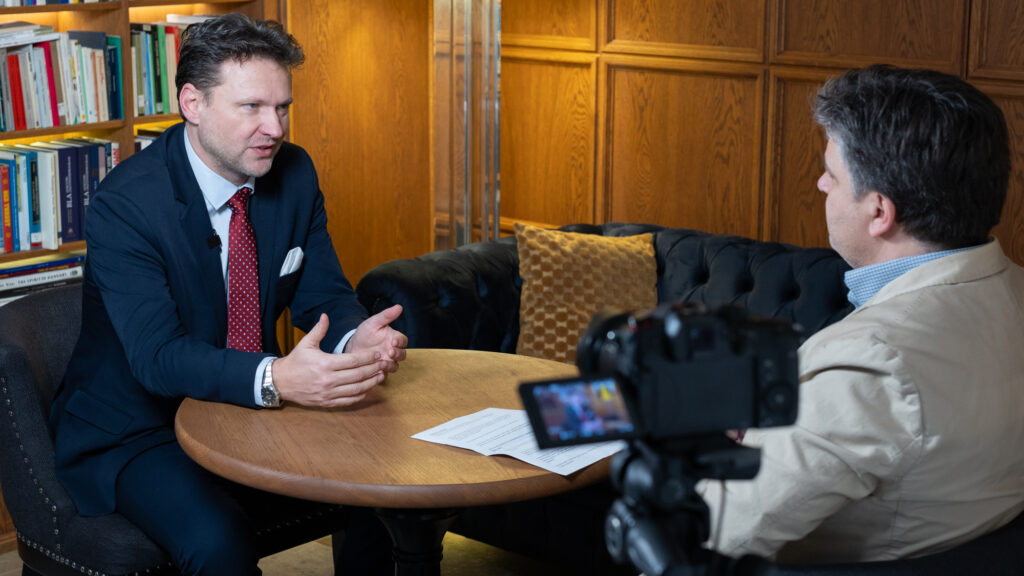
What’s the main vision of the Patriots?
Common sense, and to change Europe. I think the great motivations behind it were the Green Deal and the illegal migration—these two issues. Because sometimes what’s going on in Brussels is just insane. It’s not reasonable politics anymore.
The Czech, the Hungarian, the Polish and the Slovak voices could be louder in the EU, if these countries—the Visegrád Four—kept together and continued the cooperation that they had in the past. How important is this framework for the Czech Republic?
I believe that we share the same mentality in Central Europe. We share the same history, and we share similar values. We put it in our government programme as one of the priorities, and it’s part of our foreign affairs programme. The renaissance of V4 is important, and it’s improving. A year ago, we spoke about its clinical death, and unfortunately, the former Czech government played a very active part in this process, which was a great disappointment for me.
‘Because sometimes what’s going on in Brussels is just insane. It’s not reasonable politics anymore’
Do you have hope that V4 will shine again?
I believe that. V4 is one of the pillars of Czech foreign policy, and the other one is the membership of the European Union. We still have no other options, and there is still some hope that we can rebuild and reverse certain processes in the EU. The membership of NATO is another question. V4 and the cooperation in Europe, not only in the EU, is very important. And we have a very strong transatlantic relationship with the United States of America, and somehow this mixture works. You can see that the United States can communicate better with the leaders of Central Europe than with those of Western Europe. And I believe, in the midst of all these geopolitical changes, there is a chance for Central Europe to make its own security architecture. We can make coalitions, not only in Europe, but with Israel, and so on. There are many possibilities.
Why is it important for the Czech Republic to be a close ally with Israel?
It’s quite an interesting question how it happened, how it started, but it’s just a fact that the Czech Republic has always had an excellent relationship with the State of Israel. We have a special bond with Israel dating back to the time of the late Czech President Tomáš Masaryk, who was a supporter of establishing a state for the Jewish people. We helped Israel in the crisis in 1948 with arms. During the communist era, relations with Israel were frozen because Israel was not a puppet of the Soviet Union. Perhaps this is also why, after the Velvet Revolution, we did the opposite and re-established relations. I remember when I visited Jerusalem with former President Miloš Zeman, and Benjamin Netanyahu told our president: ‘Welcome, my friend, the second best friend of Israel in the world.’ And Zeman answered: ‘Bibi, why the second?’, and there was a silence for a few seconds. Then Netanyahu said: ‘Well, welcome, my best friend in the Eastern hemisphere.’
‘V4 is one of the pillars of Czech foreign policy, and the other one is the membership of the European Union’
Very diplomatic.
That is an example of how our relationship was. I’m a proud member of the Group of Friendship with the State of Israel. I’m also a member of a Group of Allies, which is organized directly from the Knesset. I believe that Israel can inspire Central Europe in many ways. I’m so proud that the Czech Republic has no problem with antisemitism. When I discussed this with my Austrian colleague, Wolfgang Sobotka, former Speaker of the House, he was very disappointed with what’s happening in Austria, the new wave of antisemitism which is connected to Muslims and migration.
My last question is rather about analysing your party’s name, ANO: in English, it means ‘Action of Angry Citizens’. How can a governing party like ANO avoid being worn out in government, and prevent angry citizens from getting fed up with it?
Because it started 12 years ago, and we have transformed, and now we are the major political force in the Czech Republic. We have mayors, members of parliament, prime ministers, and governors. We are fresh, and we have better human resources. Traditional parties have problems finding new, high-quality people. So I think we are a better team right now. And the question number one is about the strong leader, and Andrej Babiš is very strong and visible. You cannot say in the Czech Republic that you don’t know Andrej Babiš.
Watch the full podcast below:
Related articles: