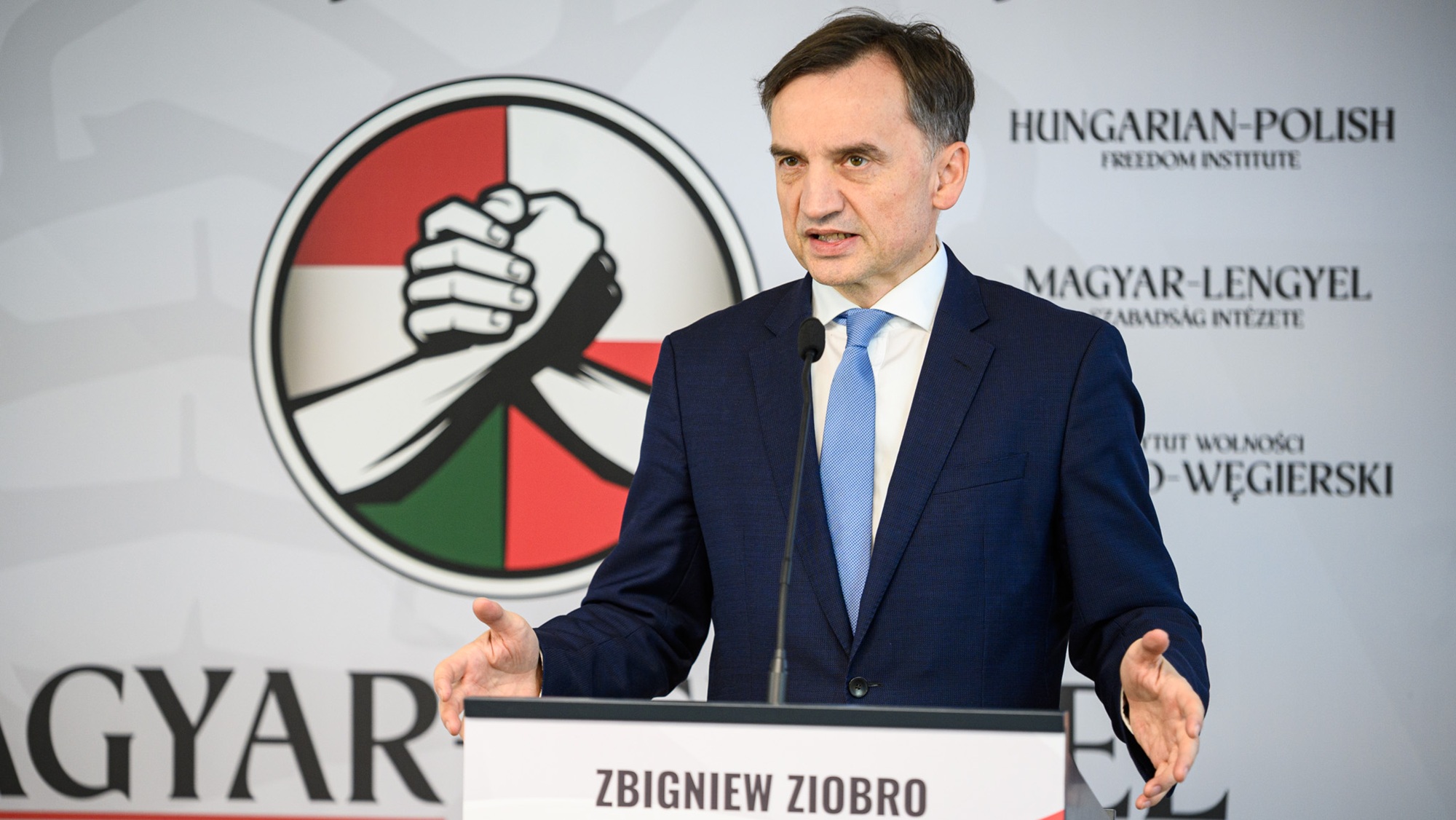
In December 2025, the Court of Justice of the European Union (CJEU) found in a ruling that the Constitutional Tribunal of Poland is not a legitimate, independent court. To comment on the momentous and highly controversial decision, Marcin Romanowski, President of the Hungarian–Polish Institute of Freedom and Former Deputy Minister of Justice of Poland, spoke at a press conference organized by the Center for Fundamental Rights on Tuesday, 3 February in Budapest, Hungary. He was joined by Former Minister of Justice Zbigniew Ziobro of Poland and Oskar Kida, Polish constitutional law expert.
Mr Romanowski took the stage first. He told the audience that what the globalists are doing in Poland today should be a warning to the people of Hungary. He stressed that the recent CJEU ruling is not simply about events that took place ten years ago, referring to the nomination of judges to the Constitutional Tribunal back in 2015; rather, it is about the EU’s Court of Justice overruling the highest court in one of its Member States, Poland.
Thus, the European Union is forcing its will onto the people of a sovereign nation, Mr Romanowski pointed out, and is not respecting a country’s constitutional system.
Minister Ziobro followed, starting his piece by saying that Poland is just ‘the testing ground’ for globalists on how to tackle the united right. He also shared that he believes that these globalist forces want a federalized, centralized European Union; and are trying to interfere in Polish and Hungarian elections to achieve that goal.
The speaker further argued that the liberal elite is advancing toward their end game of centralized Europe ‘step by step’, and ‘dismantling the Polish legal system’ was just one of those steps. He described this development as a ‘dangerous process’ which could eventually take place in every Member State; and warned that those Member States who ‘believe their sovereignty is important’ will lose their funding from the EU.
Minister Ziobro went on to speak about Prime Minister Donald Tusk of Poland next. He claimed that his campaign was nothing but clichés and marketing, and pointed out that the vast majority of promises he pledged to the electorate were never fulfilled. He opined that this would likely be the case with Péter Magyar of the Tisza Party, if he were to win power in the upcoming Hungarian parliamentary elections in April.
He also warned that electing pro-EU politicians has an impact on all aspects of the voters’ lives. Energy policy is one of those aspects: according to the speaker, the Polish people are now paying the highest electricity and gas prices in Europe, about twice as much as Hungarians. The speaker also urged Hungarians to choose the incumbent Prime Minister Viktor Orbán in the upcoming election, whom he described as a strong leader who prioritizes Hungary’s interest over the Union’s interest.
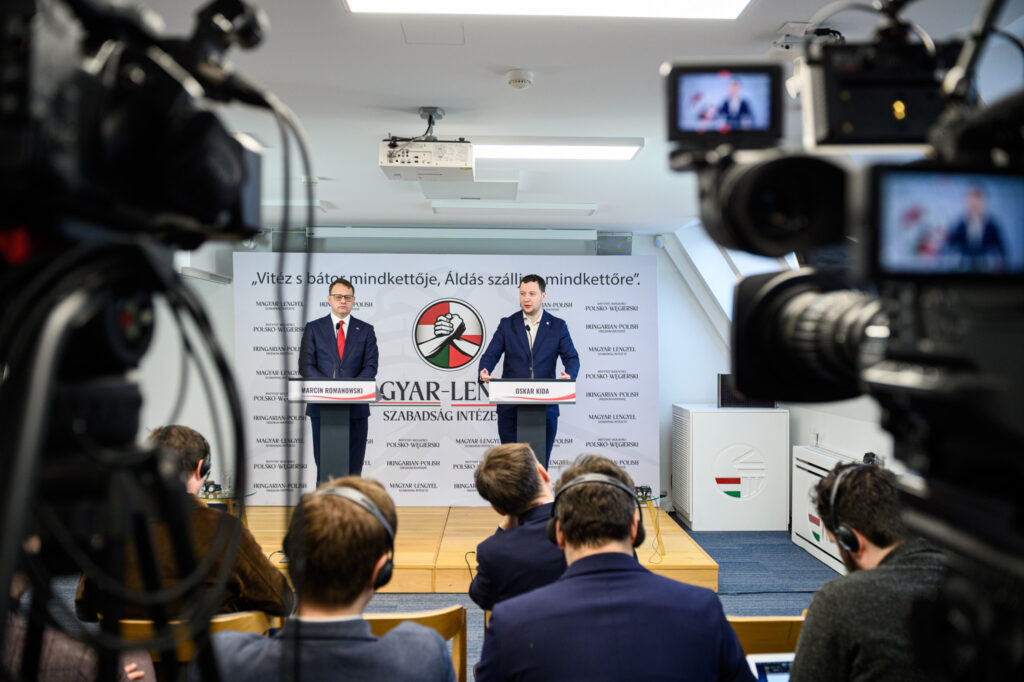
Mr Romanowski returned to the stage, this time with Mr Kida on his side, to give further details about the CJEU ruling on Poland’s Constitutional Tribunal.
Mr Romanowski shared that in 2015, then-President Andrzej Duda of Poland refused to accept the oaths of five new justices nominated to the Tribunal by the outgoing Platforma Obywatelska (PO) administration, led by then-Prime Minister Ewa Kopacz. Instead, the new PiS government nominated five new justices, whose oaths were accepted. This is where the dispute over the Constitutional Tribunal stems from.
Mr Kida stated that this matter was thought to have reached its conclusion in Poland. However, the left-wing powers in the country got ‘a new weapon in their hands,’ as he put it: appealing to the Court of Justice of the European Union. As a result, he shared, rulings by the Tribunal are now routinely ignored by the Tusk administration, and the funding of the court has been completely scrapped, to literally 0 PLN in the latest budget plan.
Related articles: