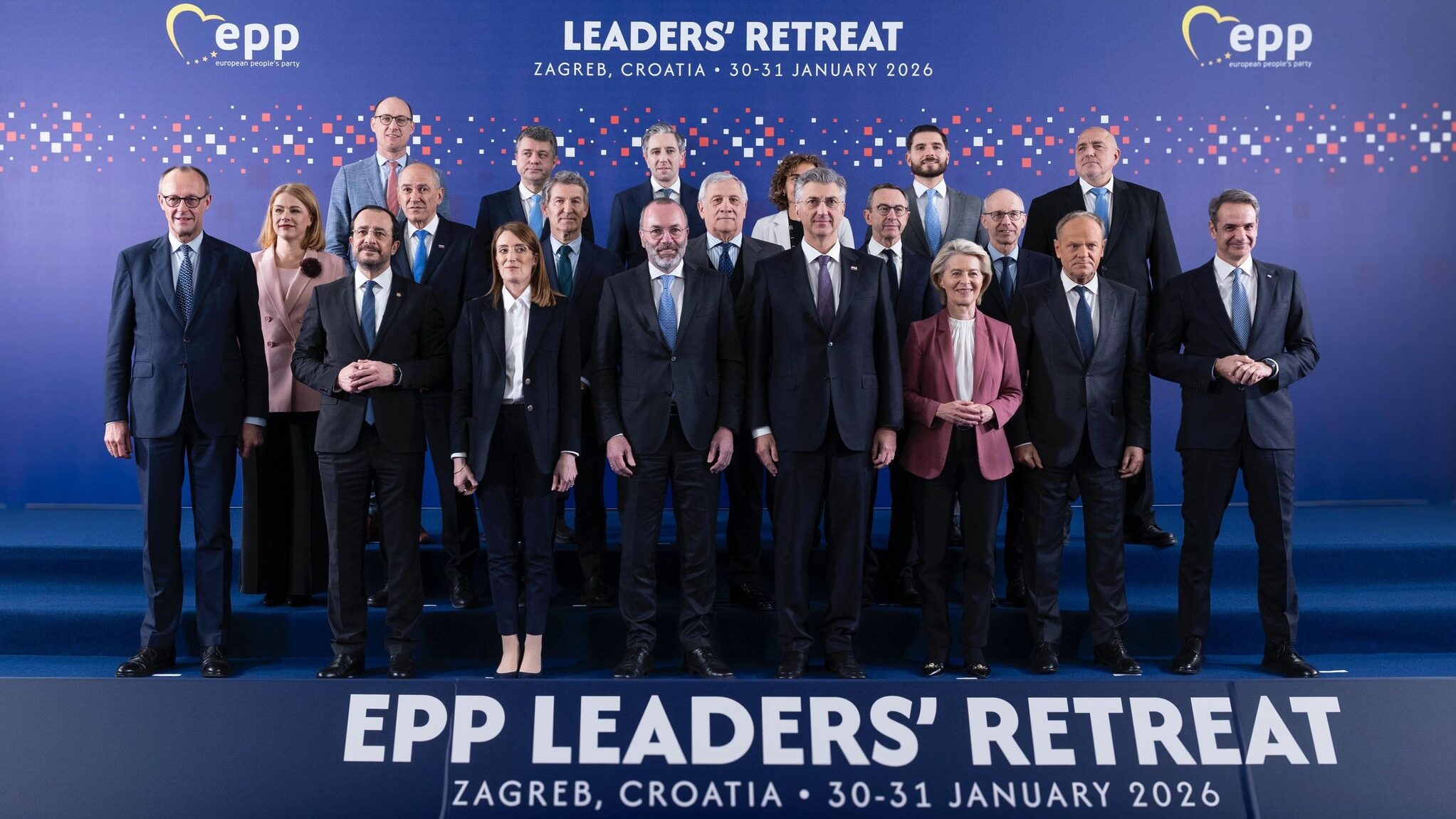
The European People’s Party (EPP) held its ‘Leaders’ Retreat’ over the weekend in the Croatian capital of Zagreb, a closed-door gathering of senior figures from Europe’s political establishment. During the meeting, EPP President Manfred Weber outlined the party’s ‘strategic direction’, focused on ‘adapting’ the European Union to shifting global power dynamics.
Weber argued for the ‘better implementation’ of the Lisbon Treaty, including the expanded use of qualified majority voting to limit individual member states’ ability to block decisions on key issues such as sanctions and foreign policy. In practice, this would significantly weaken the influence of smaller member states whose interests diverge from those of Western European powers, stripping them of one of their most effective tools in foreign-policy decision-making—an area widely regarded as a core element of national sovereignty.
EU’s March Toward Militarization
The EPP also signalled a push for a major shift in the EU’s common security and defence policy. Weber called for a ‘concrete operational plan’ to apply Article 42.7 on mutual defence, which obliges EU states to assist a member under attack. He endorsed a ‘360-degree’ security approach addressing threats from all directions, and advocated stronger European defence capabilities through a more integrated defence market, joint procurement, improved military readiness, and joint military decision-making. He explicitly linked European defence policy to continued support for Ukraine in its war against Russia, stressing the need for sustained financial and military assistance to Kyiv.
The conclusions of the retreat largely echoed long-standing warnings from Hungarian officials: that the European Union is increasingly shifting from a peace project toward a military-oriented structure. Eliminating national vetoes in foreign and security policy while accelerating defence integration—largely framed around supporting Ukraine rather than directly defending Europe—appears to be the strategic vision of the EU establishment for the coming years.
Although these ideas have circulated for some time in meetings of the Foreign Affairs Council and European Council summits, significant obstacles remain. Chief among them is Hungarian Prime Minister Viktor Orbán, who has repeatedly vetoed further financial and military support for Ukraine and positioned himself as a defender of member state sovereignty against EU overreach. Alongside leaders such as Slovak Prime Minister Robert Fico and Czech Prime Minister Andrej Babiš, Orbán continues to block the plan from moving forward, as acknowledged by Weber himself in a recent interview.
Removing Orbán from Power
‘That is why the European People’s Party is supporting a Brussels-aligned candidate in Hungary’s election,’ political director of the Hungarian prime minister Balázs Orbán wrote in a recent post on X. Opposition leader Péter Magyar and his party, Tisza, have long been considered a ‘puppet of Brussels’ and are expected to advance Brussels’ pro-war agenda if elected in April.
After finishing second in the 2024 European elections, Weber quickly welcomed Tisza into his political family in order to secure influence over Budapest and provide the party with resources to defeat Orbán. It is also telling that, while many influential EPP figures—such as German Chancellor Friedrich Merz, European Commission President Ursula von der Leyen, and Polish Prime Minister Donald Tusk—were present at the Leaders Retreat, Péter Magyar was conspicuously absent. His lack of an invitation signals that Brussels is attempting to maintain the pretence that it is not interfering in Hungary’s elections, while also indicating that it has little interest in Tisza’s views on the aforementioned plan. Instead, they appear to expect Péter Magyar to implement it swiftly and without question.
‘This is not about Europe’s security,’ Balázs Orbán said. ‘It is about forcing a pro-war political programme on nations that refuse to accept it.’ He added that Hungary would ‘stand its ground and refuse to be directed from Brussels as long as a patriotic government remains in place.’
Balázs Orbán on X (formerly Twitter): "This weekend, Europe's political elite gathered in Zagreb at the so-called "Leaders Retreat" of the European People's Party.The name itself invites irony.Behind closed doors, the real discussion was not about peace, but about power.Manfred Weber made it clear: Ukraine must... https://t.co/PyAFTIfhtQ / X"
This weekend, Europe's political elite gathered in Zagreb at the so-called "Leaders Retreat" of the European People's Party.The name itself invites irony.Behind closed doors, the real discussion was not about peace, but about power.Manfred Weber made it clear: Ukraine must... https://t.co/PyAFTIfhtQ
Related articles: