
The past four days marked the first plenary session of 2026 in the European Parliament. Among the issues debated this week were the fourth motion of censure of the European Commission, the Mercosur deal, and Hungary’s access to the SAFE defence fund.
Motion of Censure
The four-day plenary session opened with a debate on the fourth motion of censure tabled against the European Commission in the past six months. The first debate was initiated by 77 signatories, the second by 72, and the third by 85—while January’s motion of no confidence, initiated by the Patriots for Europe, was supported by 104 signatories, exceeding all previous numbers.
Despite this strong start, the European Commission sought to diminish the significance of the motion: Ursula von der Leyen did not even appear to defend her position during the debate. Instead of attending Monday’s debate with the College of Commissioners, as she had on the previous three occasions, von der Leyen sent only one commissioner—Piotr Serafin, Commissioner for Budget, Anti-Fraud and Public Administration—to speak on behalf of the Commission and its president.
Since motions of censure are important tools for holding the Commission to account, many have expressed disappointment over Ursula von der Leyen’s decision to skip the debate. Ultimately, the fourth motion of censure failed to achieve its objective: it received 165 votes in favour, falling short of the threshold required for adoption (two thirds of the votes cast and at least 361 votes from all MEPs). While only 70 signatures are required to initiate a motion of censure, passing one is far more difficult. In fact, none of the four motions of censure tabled against the Commission in the past six months has succeeded.
The Mercosur Debate
The primary reason for tabling the motion of censure was the European Commission’s decision to proceed with the Mercosur free trade agreement with Latin America. Last December, during the European Council meeting, the signing of the agreement—which would create the world’s largest free trade zone—was delayed largely due to objections from France and Italy. Many believed this marked the end of the deal, but in January the Commission moved forward regardless.
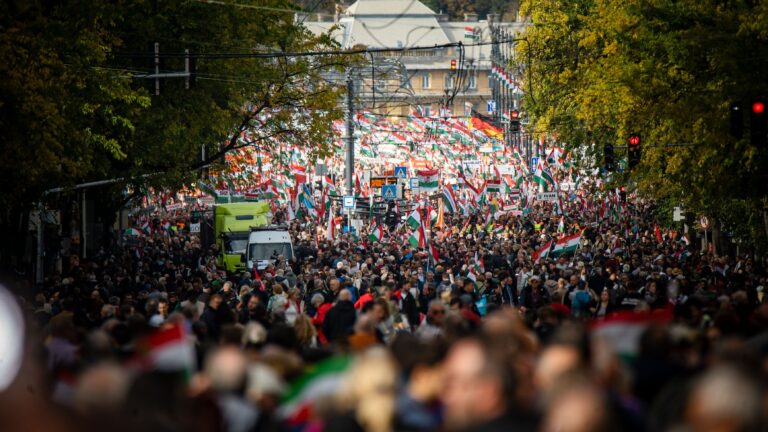
The decision triggered a wave of farmers’ protests in Strasbourg and other French cities. Farmers criticized the agreement for allowing Latin American poultry products to flood the European market. Critics argue that South American countries operate under lower quality and food-safety standards than EU member states, giving Latin American producers a comparative advantage and enabling them to undercut European farmers.
‘Critics argue that South American countries operate under lower quality and food-safety standards than EU member states’
France was deeply outraged by the EU’s decision to sign the Mercosur agreement—so much so that a former French member of the European People’s Party (EPP), the European Parliament’s largest group and the party of the Commission President, defected on Tuesday evening. Laurent Castillo left the EPP to join the Patriots for Europe. The MEP from the Union of the Right for the Republic thus became the 86th member of the Patriots group in the European Parliament.
As the European Commission rushed to finalize the deal, the European Parliament began to dispute the legal basis of the Mercosur agreement. On Wednesday, by a narrow margin of just ten votes, the Parliament decided to refer the agreement to the European Court of Justice for a review of its legality. MEPs adopted the resolution on Mercosur with 334 votes in favour, 324 against and 11 abstentions. The resulting legal battle between the Parliament and the Commission could delay ratification of the Mercosur agreement by up to six months.
Hungary’s Access to SAFE
In December Hungary has submitted a request for 17.4 billion EUR in funding to the European Union for the purpose of developing its defence capabilities. According to the European Commission’s initial schedule, Hungary could have accessed 15 per cent of these funds by spring 2026. However, citing ‘rule of law concerns’, a faction in the European Parliament called for freezing Hungary’s access.
Because of the debate scheduled for 20 January, Hungary’s SAFE plan was not approved by the Commission on 15 January, when the first eight Member States’ requests were green-lighted. The debate took place on Tuesday evening, with MEPs contesting Hungary’s access to the SAFE funds and labelling Budapest ‘Putin’s puppet’ and ‘corrupt’.
‘The European Union continues to finance Ukraine despite a series of corruption scandals over the past months’
Some, however, highlighted that the European Union continues to finance Ukraine despite a series of corruption scandals over the past months. Powerful presidential adviser Andrii Yermak was forced to resign after a group of Ukrainian oligarchs were exposed as war profiteers. Among them was President Zelensky’s former business partner, Timur Mindich, co-owner of Kvartal 95 Studio, the production company Zelensky co-founded.
Despite these scandals, the EU continues to support Ukraine—Brussels is currently finalizing the details of a €90-billion loan to Kyiv, following €200 billion in aid over the past four years. While these proven corruption scandals did not prevent EU financing of Ukraine, Budapest’s alleged ‘corruption’ is now being used by the European Parliament as a reason to urge the European Council to block Hungary’s access to the SAFE fund.
Related articles: