The European Commission has not ruled out the possibility of taking Hungary, Poland, and Slovakia to court for continuing their bans on Ukrainian agricultural imports. Commission Deputy Spokesperson Olof Gill told POLITICO Brussels on Thursday that Brussels sees ‘no justification’ for such national measures to remain in place following the renewed EU–Ukraine trade deal, which came into effect earlier in October.
Gill said the EU executive would ‘intensify its contact’ with the defiant capitals. Pressed on whether the Commission had ruled out launching infringement proceedings, he replied: ‘All options are on the table.’ According to POLITICO, Brussels’ main concern about a legal step is that it might strain relations between the Commission and Donald Tusk’s government in Warsaw, while taking only Budapest and Bratislava to court would ‘look like double standards’.
Despite the new agreement between Brussels and Kyiv—intended to ease the negative effects of Ukrainian goods flooding European markets—Poland, Hungary, and Slovakia still view the framework as insufficient to shield their domestic markets from renewed import shocks. Warsaw argues that its national measures ‘do not automatically lift’ and will remain in force, while Budapest says Brussels is ‘prioritizing Ukrainian interests,’ pledging to protect farmers amid persistent price pressures and storage bottlenecks since 2022. Bratislava described the new deal’s safeguards as ‘not strong enough’ to defend national interests and farmers.
‘Poland, Hungary, and Slovakia still view the framework as insufficient to shield their domestic markets from renewed import shocks’
Ukraine, one of the world’s largest grain exporters, accounted for roughly 10 per cent of global wheat exports and nearly 50 per cent of sunflower oil exports before the war. However, when the conflict erupted in 2022, maritime shipments were halted, posing a significant threat to global food security. As sea routes remain unsafe, Ukrainian grain has been redirected to European ports via Eastern and Central European states—yet, in practice, this has resulted in products grown under looser regulations flooding EU markets.
To protect their farmers, five member states—Hungary, Slovakia, Poland, Bulgaria, and Romania—appealed to the Commission in 2023. Under pressure, Brussels allowed these countries to impose limited restrictions on imports of Ukrainian cereals. The measure was lifted in September 2023 following a Commission decision.
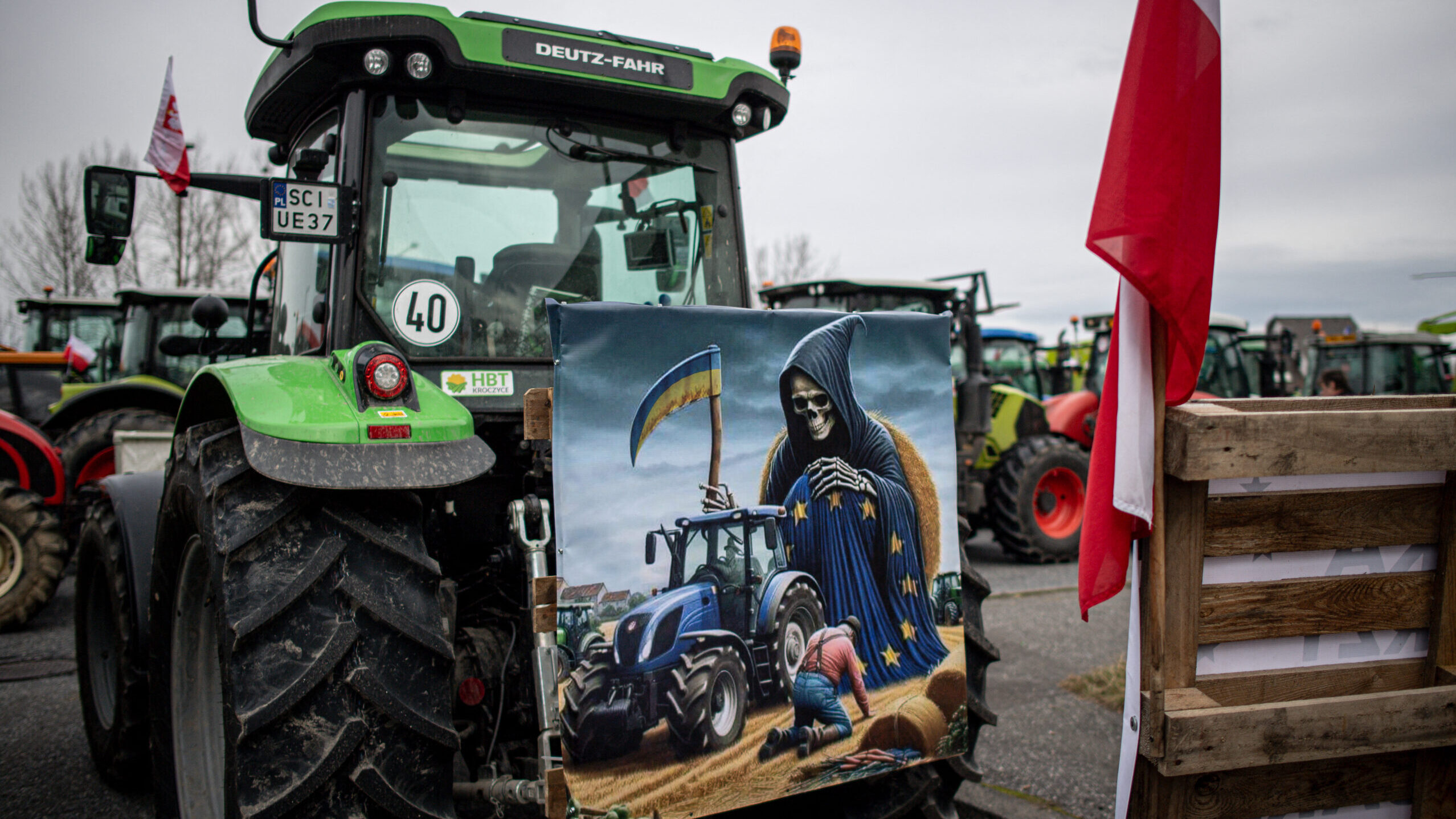
Ukrainian agricultural imports were among the key drivers of farmer protests across Europe in 2023 and early 2024. Farmers took to the streets in capitals from Warsaw to Brussels, Paris to Madrid, with Polish farmers blocking border crossings to prevent Ukrainian goods from entering the EU. Similar protests took place on the Hungarian–Ukrainian border at Záhony.
Too Slow, Too Weak, Too Narrow
Unlike the unilateral Autonomous Trade Measures that expired in June 2025, the new EU–Ukraine agreement introduces reciprocal and predictable customs arrangements, reducing or eliminating duties on a broad range of agri-food products such as dairy, fruit, vegetables, and meat. It also links Ukraine’s market access to gradual alignment with EU standards on animal welfare, pesticides, and veterinary medicines—tying liberalization to regulatory convergence. A key feature is a ‘robust safeguard mechanism’, allowing either side to restrict imports if local markets are disrupted, while sensitive products like sugar, poultry, wheat, maize, eggs, and honey remain protected through phased liberalization.
Critics of the new deal argue that the EU safeguards are too slow, too narrow, and too weak to protect border-state farmers. In practice, it is a reactive, Commission-driven tool with a high evidentiary burden—authorities must prove ‘market disruption’, often using EU-wide data that obscure local shocks in Poland, Hungary, and Slovakia. Triggers are not automatic, investigations take weeks or months, and remedies are temporary and limited—unlike the swift national bans these governments prefer. Furthermore, there is no built-in compensation for farmers or solutions for storage and logistical bottlenecks, and Ukraine’s regulatory alignment will take time.
Hungarian Minister of Agriculture István Nagy said on Monday that Brussels is supporting Ukraine at the expense of European and Hungarian farmers, whose funding faces significant cuts in the EU’s next seven-year budget proposed by Commission President Ursula von der Leyen earlier this year. ‘Instead, the discussion should focus on what impact, for example, the 35,000 tonnes of honey imported from Ukraine under the agreement will have on the EU’s beekeeping sector; what the 120,000 tonnes of poultry will mean for the EU poultry industry; how EU grain producers will cope with 1.3 million tonnes of wheat; and what the zero tariff on maize will cause for EU farmers,’ Nagy emphasized.
V4 Resurrection?
The resistance of the Eastern European countries comes as Hungarian Prime Minister Viktor Orbán seeks to form a Ukraine-skeptic coalition within the EU to counter pro-war policies. The alliance would include Slovakia, which also criticizes unconditional support for Kyiv and relies heavily on Russian oil imports, and Czechia, where Andrej Babiš’s ANO entered government after winning elections in early October. ‘It worked very well during the migration crisis. That’s how we could resist,’ Balázs Orbán, political director to the prime minister, told POLITICO Brussels regarding the potential alliance.
‘Defending European markets from Ukrainian dumping has long been viewed as a potential catalyst for renewed cooperation’
With Babiš’s return, there is also increasing talk of a potential revival of the highly successful Visegrád Four format. Although it is currently frozen due to strained relations between Donald Tusk’s government in Warsaw and the Hungarian leadership, defending European markets from Ukrainian dumping has long been viewed as a potential catalyst for renewed cooperation. Should Brussels decide to take these states to court, the Commission risks driving the V4 countries closer together—prompting coordinated action and strengthening their collective ability to assert their interests.
Related articles: